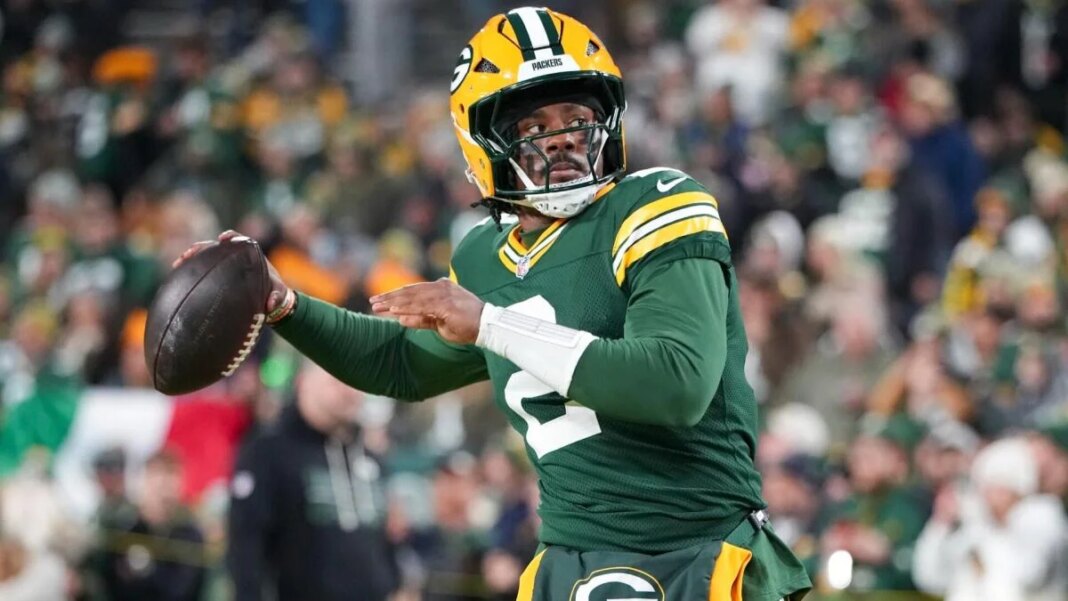
For all the excitement of a potentially busy quarterback carousel this offseason, only one clear starter has signed so far: Malik Willis, who got a three-year, $67.5 million deal from the Dolphins that includes $45 million guaranteed.
A second starter — Geno Smith — switched teams via trade, heading from the Raiders to the Jets, but otherwise, the carousel is in a sort of nebulous state. What will happen with Kyler Murray? What will happen with Aaron Rodgers? Will Kirk Cousins get another chance to start? Who will win the impending quarterback battle between Tua Tagovailoa and Michael Penix Jr. in Atlanta?
Willis was the most intriguing name on the market. He’s young (26) and even younger in terms of NFL experience. Through four seasons, he has only appeared in 22 games and started six. A third-round pick of the Titans in 2022, Willis hardly played in his first two seasons. The first, he spent behind Ryan Tannehill and struggled when called upon; the second, he spent behind Tannehill and Will Levis.
The Packers took a flyer on Willis, sending a seventh-round pick Tennessee’s way shortly before the 2024 season began. Willis, at that point, was behind Levis and Mason Rudolph on Tennessee’s depth chart.
Never expecting to rely on him much, Green Bay quickly found itself with other plans: Jordan Love sprained his MCL in Week 1 of the 2024 season. Willis stepped in and won in Week 2 and Week 3. He led a game-winning drive after Love suffered a groin injury in Week 8.
It didn’t end there. In 2025, Willis made a few spot appearances and a Week 17 start against the Ravens. Every time he played, he impressed. Among 62 quarterbacks with at least 100 dropbacks over the past two seasons, Willis ranked …
- First in passer rating (134.6)
- First in yards per attempt (10.9)
- First in completion percentage (79%)
- First in expected points added per dropback (0.41)
(NOTE: We’ll use this 62-player sample for all following ranks.)

Of course, it is a tiny sample size. Willis had the benefit of being a surprise starter/fill-in multiple times; teams didn’t prepare for him. He also had the benefit of being under Matt LaFleur, whose flexibility and skill as a play caller were on display. He won’t have either benefit in Miami. Will it matter? What should we expect of him as a full-time starter? Let’s dive in.
Strengths
Mobility
Any Willis discussion has to start with his mobility. Across his final two college seasons at Liberty, he ran for 1,822 yards and 27 touchdowns. In three career starts with the Packers, he had 174 rushing yards and three rushing touchdowns. He can boogie.
Willis averaged 8.9 yards per scramble — and he scrambled a lot: on over 14% of his dropbacks, the highest rate in the NFL. However, for as creative a scrambler as he can be, he devastates defenses on designed runs, like the one above. His 6.9 yards per designed run is the best of any quarterback over the past two seasons, and lots of the most successful ones came out of the shotgun, with a play fake or RPO.
It will be absolutely crucial for Dolphins offensive coordinator Bobby Slowik to put Willis in these situations, especially with running back De’Von Achane in the fold in Miami. Willis is at his best using misdirection. He can take advantage of one wrong step by a defender, but more importantly, he can take advantage of even a moment of hesitation.
LaFleur used this to his advantage: Over the past two seasons, Willis used play action (which includes RPOs) on 36% of his dropbacks, the highest rate in the NFL. The second-highest rate belonged to Marcus Mariota, a similarly mobile player who, like Willis, wants to push the ball downfield. Regardless of how they get there — whether under center or from the shotgun — Willis and Slowik should lean on play fakes that can get Willis on the move in a hurry.
Arm strength
Willis also has a howitzer of an arm, and not just on your typical deep-ball shots. Want to see some arm strength that isn’t just for show? Check out the three clips below:
These are absolute rips downfield, the type of throws former Dolphins quarterback Tua Tagovailoa couldn’t make. There’s no floating on any of these balls. And Willis was more than willing to make these types of throws. Over the past two years, only Anthony Richardson had a higher rate of deep ball attempts. Of course, this is a feature of the Green Bay offense — Love had the fourth-highest deep throw rate — but the willingness and ability to be aggressive were impressive.
Willis’ arm strength has never been a doubt. What was really impressive in Green Bay was his ability to combine strength with accuracy, especially on throws to the perimeter. On throws outside the numbers over the past two seasons, Willis averaged an NFL-best 12.9 yards per attempt, with the league’s highest completion rate (80%) and lowest off-target rate (5.9%). Again, he and LaFleur made sure to set up these opportunities with play action (39% of dropbacks, first in NFL). And while play action can be a crutch for some quarterbacks, there’s no denying Willis has produced some jaw-dropping perimeter throws. There are explosive plays all over the place.
Well-coached
Finally, Willis has been well-coached thanks to his time under LaFleur and the Green Bay staff. He can handle under-center and shotgun plays, he has improved noticeably, and he can operate both on time and when forced to improvise.
When Willis was wallowing deep on Tennessee’s depth chart two offseasons ago, no one could have envisioned he’d one day be a high-level backup, much less a guy who now has the opportunity to start. It’s a stunning development, and Willis deserves all the credit in the world.
“I don’t think I put a timeline on it,” Willis said Monday regarding biding his time to become a starter. “I think it happened when I was prepared. I think when I came into the league, I wasn’t prepared, and that’s not a knock toward my coaches or myself; that’s just what it was coming from the system I came from, and I’ve had a chance to learn the last four years since I’ve been in the league. I went through four different offenses and seen a bunch of different defenses, and I just think I’ve grown a lot and I’m grateful for the opportunity once again.”
Malik Willis to sign with the Dolphins: Fantasy Football fallout, Dynasty ranking, what it means for Achane
Heath Cummings

Weaknesses
If you only watched Willis’ highlights, you’d wonder why he only got $22.5 million per year, which puts him among the cheapest non-rookie contract starting quarterbacks. He looks outstanding. The skills jump off the tape.
When you zoom out, you see some weaknesses.
Holding onto the ball
For example, one of the reasons Willis scrambles a lot is because he has to scramble a lot. Willis likes to hold onto the ball. His 3.15-second average time to throw was sixth-longest in the NFL over the past two years. There are some usual suspects — Lamar Jackson, Jalen Hurts, Caleb Williams — ahead of him. That’s the good group. Shedeur Sanders and Tyrod Taylor are also ahead of him. That’s the bad group.
Willis’ 11% sack rate over the past two seasons is the fifth-highest in the NFL. The only players above him? Deshaun Watson, Kenny Pickett, Levis and Brady Cook. Players just behind him include Carson Wentz, Justin Fields, J.J. McCarthy and Sanders. Again, that’s a bad group.
Willis’ play style inherently invites pressure — even the best offensive lines can only hold up so long — and for all his athleticism, Willis doesn’t do a particularly good job avoiding pressure. He’s been sacked on 24% of pressured dropbacks over the past two seasons, the ninth-highest rate in the league over that span. Many of the names in the “bad” groups we’ve already listed surround him. Several of the league’s best quarterbacks, like Love, Matthew Stafford, Josh Allen, Patrick Mahomes and Jackson, are below 17%. Love is arguably the league’s best at this skill; he’s only sacked 10% of the time he’s pressured.
Sacks are drive killers. Willis likely won’t be afforded the same offensive line or protection plans in Miami that he had in Green Bay. In fact, Slowik’s protection plans were infamously poor in Houston, and Miami’s offensive line is lacking. This is a crucial area for Willis, Slowik and the team as a whole to improve.
Ball security
Willis also has to be better handling the ball. He had two aborted snaps last year, one of which resulted in a turnover. He also lost a fumble in 2024 when he was blindsided by a blitz.
The great unknown
Then, of course, there’s the great unknown that comes with any quarterback who has hardly played. Willis was the NFL’s least accurate quarterback (by completion percentage) when he was in Tennessee. Then he was the most accurate in Green Bay. As The Athletic explored, a handful of quarterbacks have shone in small sample sizes. There’s no proven way to know who continues that strong play and who is fool’s gold.
What will Willis do in lesser surroundings? What will he do when teams have several weeks’ worth of film on him? Or when he has to be more of a true dropback passer — unable to rely upon a heavy dose of play action — when the Dolphins are trailing?
The great unknown(s) can be scary and intriguing at the same time. The Dolphins have made the sort of investment in Willis in which they’re not anchored to him if he doesn’t perform. Even if he does play decently — or even well — they’re likely not close to contending. That can wear on a quarterback.
Willis’ success level will come from how he fixes his weaknesses, how Slowik can help mitigate those weaknesses and accentuate the strengths, and how willing Miami is to be patient as it tries to build its roster up for the long haul. Those are a lot of factors that can go in a lot of directions.