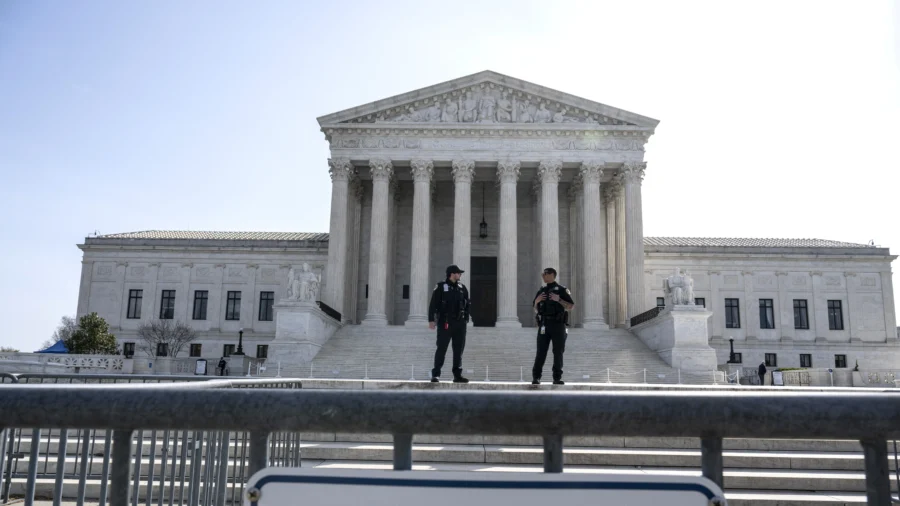
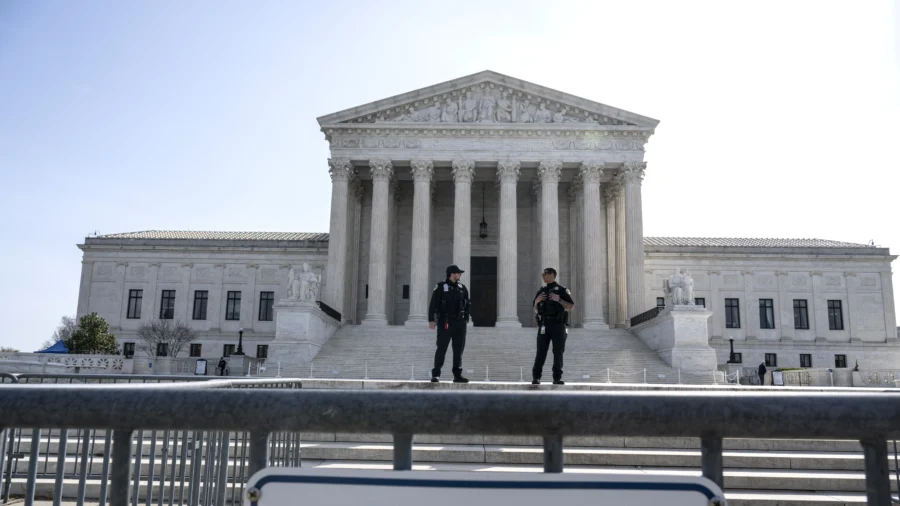
The U.S. Supreme Court on April 1 appeared skeptical of President Donald Trump’s executive order excluding the children of illegal immigrants and legal temporary visitors from automatic birthright citizenship.
During the more than two hour hearing, part of which Trump attended in person, the justices seemed concerned about the lawfulness of the order, which has been blocked by multiple lower courts. Some justices suggested that it would be difficult to enforce and could strip current citizens of U.S. citizenship.
The justices discussed the significance of the wording of Trump’s executive order 14160, which focuses on the 14th Amendment’s citizenship clause. The clause states: “All persons born or naturalized in the United States, and subject to the jurisdiction thereof, are citizens of the United States and of the state wherein they reside.”
The executive order states that the amendment has never been interpreted to bestow citizenship universally on everyone born in the United States. According to the order, an individual born in the United States is not “subject to the jurisdiction thereof” if that person’s mother was unlawfully present in the country and the individual’s father was not a U.S. citizen or lawful permanent resident at the time of the person’s birth.
American Civil Liberties Union attorney Cecillia Wang said upholding the order would call into question the status of many current citizens. U.S. Solicitor General D. John Sauer said the order is prospective in effect, meaning that it doesn’t affect those born before it was signed.
Justice Elena Kagan told Sauer that the federal government was taking a “revisionist” approach to birthright citizenship.
Since United States v. Wong Kim Ark (1898), the federal government has recognized that almost all persons born in the United States are U.S. citizens at birth.
Everyone has thought for a “long, long time” that birthright citizenship was the rule, Kagan said.
Legal Concept of ‘Domicile’
Sauer said the citizenship clause was adopted after the Civil War “to grant citizenship to the newly freed slaves and their children whose allegiance to the United States had been established by generations of domicile.”
The legal concept of domicile refers to the place where a person intends to permanently reside.
The clause did not grant citizenship to “the children of temporary visitors or illegal aliens who have no such allegiance” to the United States, Sauer said.
Sauer said the court recognized in Elk v. Wilkins (1884) that “subject to the jurisdiction” means “owing direct and immediate allegiance,” which in turn means the clause “did not extend citizenship to the children of temporary visa holders or illegal aliens.”
Chief Justice John Roberts said the examples that Sauer gave to support his interpretation of “subject to the jurisdiction thereof” were “very quirky.”
Roberts said Sauer gave as examples children of ambassadors, children of enemies during an invasion of the country, children on warships, and then expanded it to “a whole class of illegal aliens [who] are here in the country.”
“I’m not quite sure how you can get to that big group from such tiny and sort of idiosyncratic examples,” the chief justice said.
Justice Sonia Sotomayor said the Wong Kim Ark decision quotes early American statesman Daniel Webster, who said it was “well-known that by the public law, a non-citizen, while he is here in the United States, owes obedience to this country’s laws,” regardless of domicile, the taking of an oath of allegiance, or renouncing a former allegiance.
Wang said the 14th Amendment prevents Congress from adding conditions to the birthright citizenship rule.
In response to Wang’s assertion, Justice Brett Kavanaugh said: “I guess the answer you just gave means they don’t have any authority to look at this, even if they passed it 435 to zero in the House and 100 to zero in the Senate. … Your point is no, they’re closed. They’re frozen forever.”
“Correct,” Wang replied.
The 14th Amendment was supported by people who wanted “to grow this country” and “make sure [the United States] had a citizenry to populate the military, to settle the country,” the attorney said.
“They also had an intuition that was consistent with the founding aversion to inherited rights and disabilities,” Wang said.
Roberts and Kagan questioned why Wang considered domicile irrelevant when, as Roberts said, the word appears in Wong Kim Ark “20 different times.”
“Why did they sprinkle that in the opinion?” Kagan asked.
Wang said that under English legal tradition, which was embedded in the 14th Amendment, “domicile was not relevant, and the children born to temporary visitors in the territory of the sovereign were always considered birthright citizens.”
Justice Neil Gorsuch said domicile was not mentioned in debates over the amendment, adding that the legal community’s grasp of Wong Kim Ark is “a mess.”
Wang replied, saying, “What we have on our side post-Wong Kim Ark is numerous federal court decisions … that said that domicile is not relevant.”
‘Birth Tourism’
Roberts asked Sauer how significant the problem of “birth tourism” was.
Sauer said there have been reports of “birth tourism” companies sending Russian elites to Miami and that as of 2015 there were 500 birth tourism companies operating in China “whose business is to bring people here to give birth and return to that nation.”
Roberts asked whether the incidents of birth tourism had any relevance to the legal analysis in this case.
Sauer said the interpretation of the 14th Amendment over time “has made a mess of this provision.”
Roberts said it “certainly wasn’t a problem in the 19th century.”
Sauer said, “We’re in a new world now … where 8 billion people are one plane ride away from having a child who’s a U.S. citizen.”
“Well, it’s a new world,” Roberts replied. “It’s the same Constitution.”
After Sauer said the court should confine its ruling to “prospective relief only,” Sotomayor asked whether the logic behind his legal theory would allow the government to “move to unnaturalize people who were born here of illegal residents.”
Sauer replied that it would not and said, “We are not asking for any retroactive relief.”
Some justices looked at the practical implications of the executive order.
Justice Samuel Alito asked about the “humanitarian problem” of illegal immigrants who plan to stay and probably can because of immigration laws that have been “ineffectively” and “unenthusiastically enforced” by federal officials.
Sauer said, “The United States’ rule of nearly unrestricted birthright citizenship is an outlier among modern nations.”
Every country in Europe follows a different rule, the solicitor general said.
“[The idea that European countries] have a huge humanitarian crisis as a result of not having unrestricted birthright citizenship, I don’t think, is a strong argument,” he said.
Justice Ketanji Brown Jackson suggested to Sauer that if the order is upheld, some parents may have difficulty proving their babies’ citizenship.
When a baby is born, do documents have to be presented in the delivery room, Jackson asked.
“Are we bringing pregnant women in for depositions?” she said.
The Supreme Court is expected to issue a ruling by the end of June or early July.