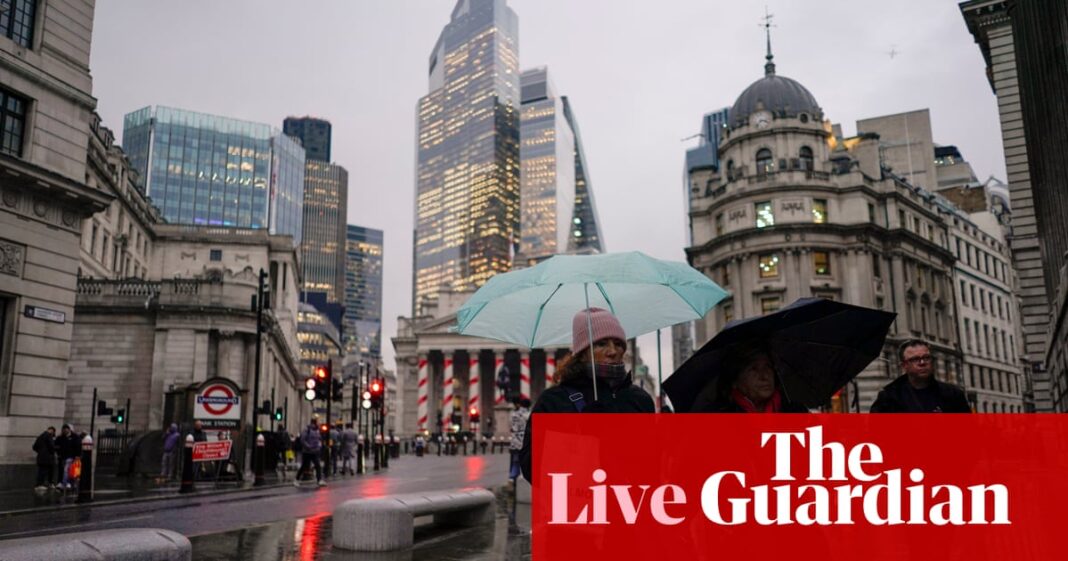
Bank of England governor faces questions from MPs
Over in Westminster, top officials from the Bank of England are appearing before the Treasury Committee.
Governor Andrew Bailey is in the hot seat, flanked by the new boy on the Monetary Policy Committee, Alan Taylor, plus deputy governor Clare Lombardelli, and Catherine Mann.
Mann is the most hawkish member of the monetary policy committee – the only one to oppose this month’s cut in UK interest rates, to 4.75%.
The committee point out that this is their first session with the Bank since the July general election (s well as last month’s budget).
They say:
MPs are likely to ask witnesses about the current economic picture and how it affects the Bank’s interest rate decisions, particularly in relation to the measures announced in the Chancellor’s 2024 Autumn Budget.
MPs may also choose to probe the Bank’s plans for unwinding its QE portfolio and the most recent pay and jobs figures, including the continued issues with the reliability of official data.
Key events
Bailey: Retailers right to warn NICs increase will lead to job cuts
Q: Your latest forecasts show a 40% chance that inflation rises to 3% – would that be a failure?
Andrew Bailey points out that the Bank’s forecasts also show inflation at target at the end of its forecast horizon.
That’s why the Bank is taking a ‘gradual approach’ to lowering rates, the governor explains, saying:
The evidence we’ve seen recently is that the outturns have been lower than we thought they would be, but we don’t know if that’s going to continue. We’ll see.
Q: Does your model show how many jobs will be lost due to the rise in employers’ national insurance rates?
Bailey says the Bank has not made a calculation.
He says the Office for Budget Responsibility’s forecast of 50,000 job cuts is based on ‘pretty similar assumptions’ to the Bank as to how the NICs changes will be passed through the various channels. (prices, wages, profit warnings or job cuts).
And he says UK retailers are right to warn that the NICs changes will lead to jobs cuts, as they did in a letter organised by the British Retail Consortium this morning (see opening post).
Bailey says:
I saw the BRC’s letter. I think they’re right to say…
I think there is a risk here that the reduction in employment could be more. I think that’s a risk.
Bailey: Budget measures could be deflationary, if they hit jobs market
Governor Andrew Bailey also explains that Budget measures such as the increase in employers’ national insurance contributions could actually be deflationary – allowing faster cuts to interest rates.
It all depends how firms handle the increase – do they raise prices, or cut wages?
As Bailey tells the Treasury committee:
You could get higher inflation, but you could get quite a weakening of the labour market, and downside pressure on pay.
MPC member Alan Taylor says UK households are being cautious about spending their savings, following the Covid-19 pandemic, which is weighing on the economy.
Taylor explains that we saw a similar phenomenen after the Great Depression of the 1930s (he remember his parents explaining how their approach to money changed at that time.).
Taylor, who is based in New York, adds that he’s planning to visit the UK regularly to assess the situation – he’s already visited Scotland, and has trips to Leeds and Bristol lined up in early 2025.
Bailey: UK budget and US election has pushed up swap curve
Labour MP Lola McEvoy takes the Bank of England onto mortgages….
Q: We’ve seen mortgage rates go up, since you cut interest rates earlier this month. That’s a blow to hard-working households trying to get by – did you expect it, and why did it happen?
BoE governor Andrew Bailey points out that mortgages rates have fallen since August, when the Bank made its first cut to interest rates in this cycle.
He points out that most UK mortgages are fixed-rate, and priced off the ‘swap curve’ (which measures where the markets expect interest rates to be in future).
Bailey concedes that the curve has risen, due to ‘event risk’ – namely the reaction to the UK budget at the end of October, and the US presidential election this month.
He says it’s not unusual for the UK swap curve to be influenced by the US curve, and points out that they’re both down today*.
* – due to worries of escalating tensions in Russia-Ukraine, as covered earlier.
Andrew Bailey then offers a supportive arm to the hawkish Catherine Mann, saying he agrees with many of the points she just made (even though the pair disagreed on this month’s interest rate decision).
He says the Bank has not decided how the increase in employment costs will feed through – it could mean higher prices, lower pay rises, lower headcounts, or improved productivity (although the latter takes a while to feed through…)
Q: What market conditions would be needed to go faster than traders expect?
Clare Lombardelli says the key is conditions in the economy.
That includes levels of demand and potential supply in the economy, what that means for firms’ ability to raise prices, and how cost pressures play out.
Plus, the supply side of the labour market – and how close the jobs market is to full capacity.
Expectations for next year for price rises, especially in the services sector, are also important.
MPC’s Taylor: We could cut rates faster than markets expect
Q: What does the Bank mean when it talks about taking a ‘gradual’ approach to rates – how quickly might they fall?
Monetary policy committee member Alan Taylor says this is the question on everyone’s mind, and the word ‘gradual’ means different things to different people.
Taylor suggests that some in the markets believe ‘gradual’ means a cut at every other Bank of England meeting, while ‘aggressive’ would mean a cut at every meeting.
But, he points out, the Bank has eight meetings per year, and makes a decision each time.
His view is that the key is the labour market, warning:
We don’t necessarily have the best statistics there.
[the Office for National Statistics has been struggling for months to get accurate data on the jobs market]
Right now, the ‘gradual’ pledge is aligned closely with market expectations of about one percentage point of cuts this year, Taylor explains.
But that doesn’t mean that’s what will unfold.
Taylor says:
If conditions are weaker, and my own view is skewed to the downside risks now versus the upside risk of a year ago, then we could go faster.
Mann: Budget encouraged me to oppose rate cut this month
BoE policymaker Catherine Mann adds that the measures in Rachel Reeves’s budget encouraged her to vote– alone – to hold interest rates at 5% this month.
Mann says she concluded that the budget was “front-loaded”, meaning it lifted demand in the near term, and also “geographically dispersed” across the country.
That could allow firms to push through the price rises they are planning, she says.
[Reminder: the MPC voted 8-1 to cut rates on 7 November]
Q: What impact did the increase in the national minimum wage, and employers’ national insurance contributions, in the budget have on your vote?
Mann says the firms were already struggling to incorporate previous increases in minimum wage rates, which have squeezed the differential in wages across their businesses.
A higher-than-inflation increase in the living wage next April will add to those pressures, she argues.
Mann adds that companies can pass the NIC increase on through higher prices, or lower wages, or by cutting their workforce, or invest in raising productivity.
These are upside risks to inflation, she argues, so the Bank should have waited to see what happens….
Bailey: Disinflation led to interest rate cut
Labour MP Dame Meg Hillier, who chairs the Treasury committee, begins today’s session by asking the Bank of England about this month’s decision to cut interest rates, from 5% to 4.75%.
Q: What tipped the balance on your decision?
Governor Andrew Bailey says he voted to cut borrowing costs due to the “pace and progress on disinflation”, which has been faster than expected – with inflation dropping below target to 1.7% in September.
Bailey says the Bank also flagged that it emphasises the word ‘gradual’ when looking forwards, due to the various risks to inflation.
Deputy governor Clare Lombardelli says the dominating factor for her vote to cut rates was the drop in inflation, and the fall in services inflation, and in wage settlements.
Taken together, that suggests the drivers of inflation were less strong than in the past.
But, Lombardelli warns, there are “risks on both sides” on the inflation outlook.
Professor Alan Taylor says he’s “broadly in agreement” with Bailey and Lombardelli.
Taylor says that historical patterns show that energy shocks feed into some sectors quickly – such as goods and foods – but arrive later in other sectors. What’s happening in the UK isn’t abnormal, Taylor says, but there is still the possibility that inflation beomes embedded.
But as inflation has been lower than forecast, that gave “reassurance” that it was OK to make a second cut to interest rates.
Catherine Mann, who opposed the rate cut, says she looks at the data in a slightly different way. She points out that recent earnings growth was higher than the Bank had forecast back in August, and that wage settlements are running higher than is compatible with hitting the Bank’s 2% inflation target.
Forward-looking measures of future prices and wages have been over target for the last four months, and haven’t fallen, Mann adds – that’s a sign that inflationary expectations may be higher than the Bank would like.
Bank of England governor faces questions from MPs
Over in Westminster, top officials from the Bank of England are appearing before the Treasury Committee.
Governor Andrew Bailey is in the hot seat, flanked by the new boy on the Monetary Policy Committee, Alan Taylor, plus deputy governor Clare Lombardelli, and Catherine Mann.
Mann is the most hawkish member of the monetary policy committee – the only one to oppose this month’s cut in UK interest rates, to 4.75%.
The committee point out that this is their first session with the Bank since the July general election (s well as last month’s budget).
They say:
MPs are likely to ask witnesses about the current economic picture and how it affects the Bank’s interest rate decisions, particularly in relation to the measures announced in the Chancellor’s 2024 Autumn Budget.
MPs may also choose to probe the Bank’s plans for unwinding its QE portfolio and the most recent pay and jobs figures, including the continued issues with the reliability of official data.
Dollar up, shares down, as Russia issues new nuclear doctrine
A shiver of fear just rippled through the financial markets, after Vladimir Putin approved an updated Russian nuclear doctrine today.
Kremlin spokesperson Dmitry Peskov has said the use of western non-nuclear missiles by the Ukrainian armed forces against the Russian Federation under the new doctrine could lead to a nuclear response.
The warning came after US president Joe Biden gave approval for Ukraine to strike targets within Russia with US-supplied long-range missiles.
And there are reports that Ukrainian armed forces have carried out their first strike in a border region within Russian territory with a ATACMS missile, according to news agency RBC Ukraine.
This has triggered a flight to safety, with investors piling into the US dollar, the Swiss franc and the Japanese yen. The British pound is down half a cent against the dollar, at $1.262.
US and European bond prices are also jumping, pushing down government borrowing costs. But Ukraine’s bonds are falling, having rallied earlier this month on hopes that Donald Trump might end the war with Russia.
Equities are dropping, with the FTSE 100 share index down 40 points or 0.5% at 8067 points, with bank stocks among the fallers.
And the Euro stoxx volatility index – a measure of fear in the markets – is up 1.3 points to 19.1 points.