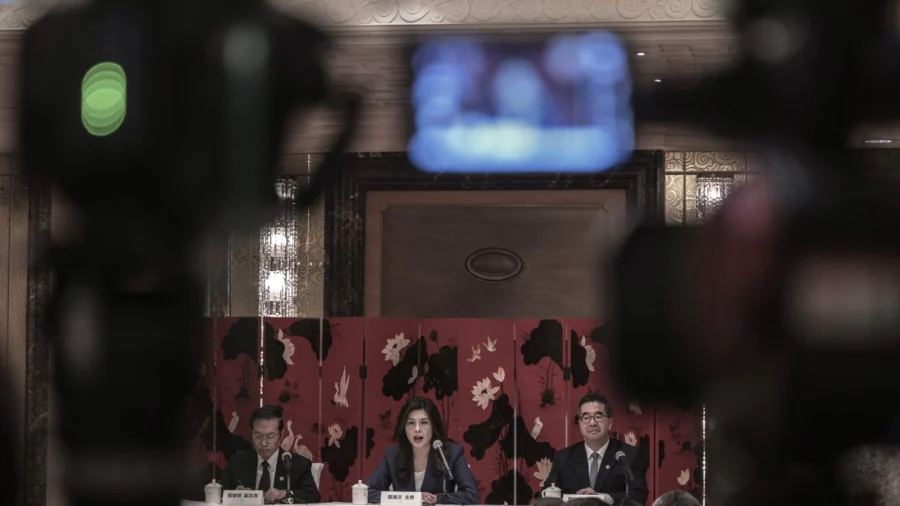
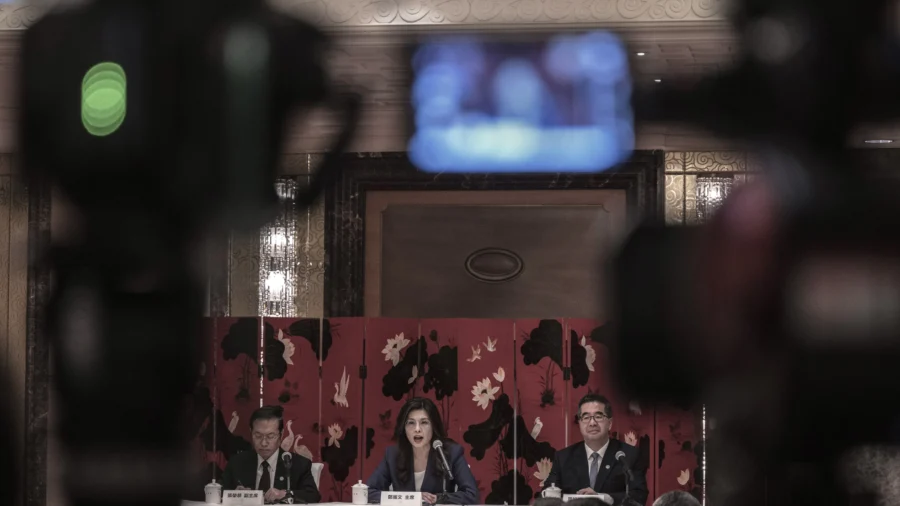
Cheng’s visit was the first by a Kuomintang (KMT) party leader in 10 years.
Communist Party Rhetoric
Chinese state media outlet Xinhua News Agency portrayed the meeting as cordial, while state TV aired a prolonged handshake and Xi’s message that people on both sides of the Taiwan Strait are “one family” who should pursue peace, development, and cooperation.
Cheng, chair of Taiwan’s opposition KMT, expressed similar themes. She called for expanding exchanges and cooperation to build a “peace framework” and suggested that cross-strait relations could evolve toward a shared future.
She also adopted several phrases commonly used in official Chinese Communist Party (CCP) rhetoric, including references to “national rejuvenation” and a “shared destiny,” while praising Beijing’s development achievements.
That language raised eyebrows among some analysts.
“This kind of terminology, especially invoking slogans closely associated with Xi’s era, is striking given her political position,” China current affairs commentator Li Linyi told The Epoch Times.
Both leaders emphasized “peace,” but critics say the term is being used in ways that obscure underlying tensions and the views of Taiwan’s ruling party, the Democratic Progressive Party, under Taiwanese President Lai Ching-te.
Shen Ming-shih, a research fellow at Taiwan’s Institute for National Defense and Security Research, told The Epoch Times that Beijing’s softer tone masks ongoing military pressure.
“Xi Jinping may present a smiling face and speak of peace,” Shen said, “but the CCP continues to project military strength and apply coercion behind the scenes.”
Others argued that genuine peace between China’s socialist democracy with Chinese characteristics and Taiwan’s liberal democracy requires more than dialogue.
Chen Wen-Chia, vice president of Kainan University in Taiwan and a defense strategy expert, told The Epoch Times that meaningful stability must be built on the cessation of military intimidation and the establishment of institutional dialogue—conditions he said were absent from the meeting.
Taiwan Government Responds
The meeting has triggered a polarized response across Taiwan’s political landscape, including at the presidential level.
Beijing’s Political Posturing
Analysts have said the meeting may serve broader geopolitical purposes for Beijing, particularly in its relationship with the United States.
Mark Cao, a U.S.-based military tech analyst, a former materials engineer, and the host of the Chinese-language military news YouTube channel Mark Space, told The Epoch Times that Beijing may be trying to signal that cross-strait issues can be handled without U.S. involvement.
Others warned that the optics of the meeting could influence perceptions abroad.
Shen said the event risks creating the impression that Taiwan’s opposition parties are aligned with Beijing, potentially affecting future elections and international confidence.
Despite the political symbolism, Chen said he believes the meeting is unlikely to produce concrete changes in cross-strait relations.
“Real decision-making power lies with Beijing’s leadership and Taiwan’s sitting government, not opposition figures,” he said.
Without official authority or negotiating leverage, he added, such visits are unlikely to yield substantive breakthroughs.
Taiwan’s Future
Chen said the episode illustrates a deeper challenge in Taiwan: the lack of a unified strategy toward Beijing.
Political parties remain sharply split over how to manage relations with China. Taiwan’s ruling Democratic Progressive Party supports maintaining the island’s sovereignty and rejects Beijing’s “One China” framework under CCP governance, while the opposition KMT favors closer relations and cooperation with the communist regime in Beijing.
Chen said Taiwan’s path forward may depend on balancing three priorities—security, international partnerships, and controlled engagement with China—without compromising its political autonomy.
Ning Haizhong, Luo Ya, and Fei Zhen contributed to this report.