There are two global problems you probably don’t like to think about. First, burning gas and coal is still heating up the planet. Second, the thousands of AI data centers popping up all over the country consume enormous amounts of power, which produces even more carbon pollution – and drives up our electric bills. And as Garth Sheldon-Coulson says, this is not going to stop. “We’re still at the beginning of this demand,” he said.
Sheldon-Coulson, the CEO and co-founder of Panthalassa, in Vancouver, Wash., hopes to address both problems at once with wave energy. “The ocean is really unlimited in terms of how much energy is available,” he said. “It will really be the cheapest energy on the planet.”
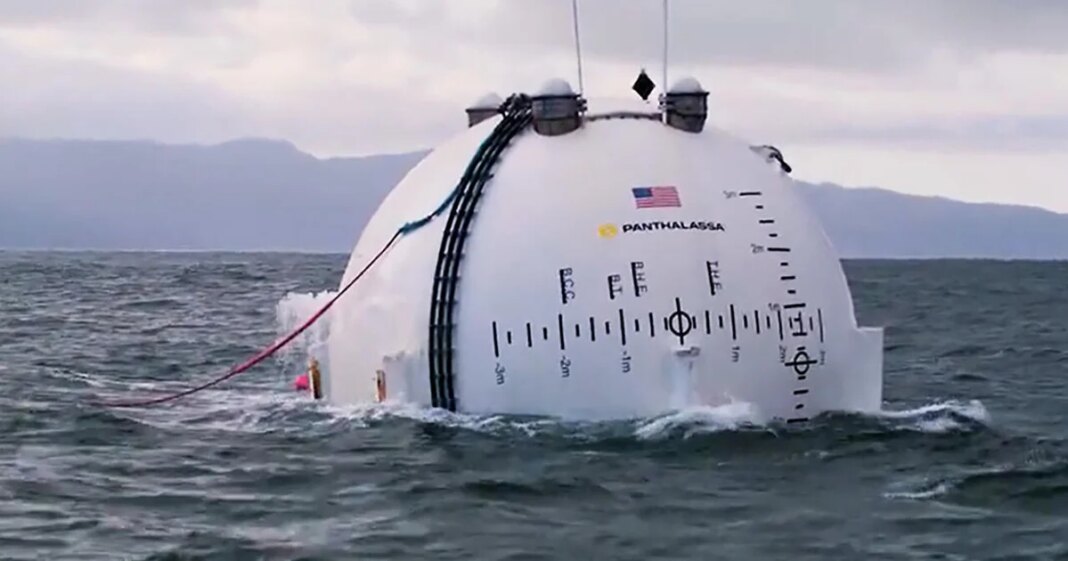
He likened Panthalassa’s test model, the Ocean-2, to a floating hydroelectric dam. “As it goes up and down with the waves, it causes water that’s in that tube to be forced up into the top. Once it’s in the ball, the water is forced through a turbine. The turbine spins, and that’s what makes the electricity.”
Panthalassa 
Using a model of Panthalassa’s latest design, the Ocean-3, Sheldon-Coulson explained the most surprising part: there’s no anchor – and no cables. It’s a self-propelled system that is not tethered to the ocean floor. “It’s like a little Roomba, except it’s enormous,” he said.
CBS News 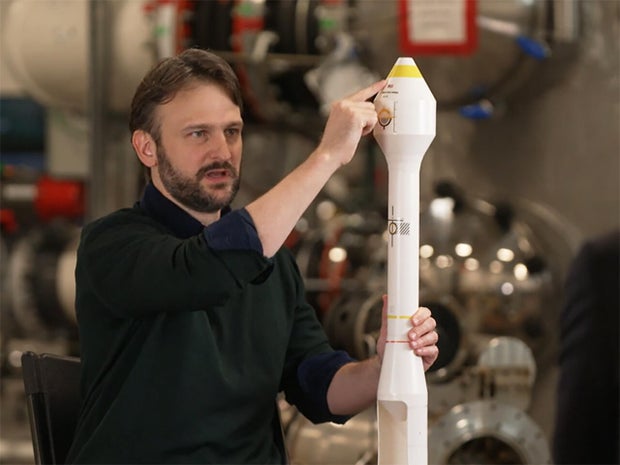
There’s no cable to bring power back to shore, either. In essence, these are floating data centers. They generate power from the waves; process AI computing tasks on the spot; and send us the answers by satellite.
“When you deploy many of our systems, they work together basically as a data center,” Sheldon-Coulson said. “So, we think of it as a really good alternative to data centers on land.”
Panthalassa has all of the private funding it needs, because it offers AI companies a quicker, cleaner way to get power than building data centers on land. Construction of the Ocean-3s is well under way.
Sheldon-Coulson expects them to be operating off-shore by around August of this year. Their advantages? “Clean, no fuel, no land use, no getting in the way of other activities on land, and very fast to scale,” he said.
Eventually, the company hopes to deploy thousands of them, far out at sea.
“It is really exciting that we’re working on something that is coming along right at the right time, in a way that’s much cleaner, much more sustainable, and quite scalable, so that we can really meet that demand as it comes,” Sheldon-Coulson said.
For more info:
Story produced by Annie Iezzi. Editor: Emanuele Secci.
See also: