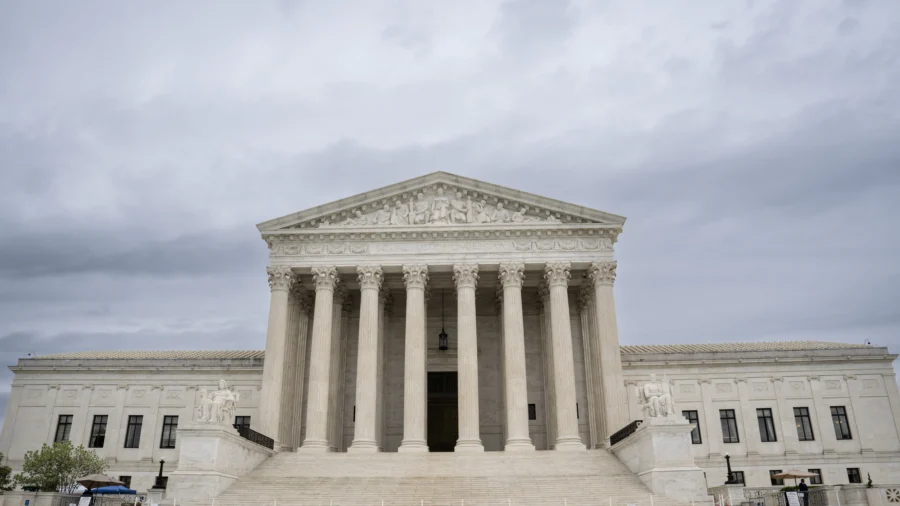
The Supreme Court appeared divided on April 29 over the Trump administration’s terminations of Temporary Protected Status (TPS) shielding Haitians and Syrians from deportation.
During oral arguments, the justices focused on whether lower court judges had exceeded their authority in blocking those TPS terminations.
Then-President Barack Obama’s administration granted TPS status for Haitians and Syrians in the United States in 2010 and 2012, respectively, because conditions in their countries made it difficult for them to return home.
The first Trump administration terminated the TPS designation for Haitians, but it was redesignated under the Biden administration. Homeland Security Secretary Kristi Noem announced that the TPS designation for Haitians would again be terminated in September 2025.
Noem terminated TPS for Syrians after the Assad regime’s fall in 2024. She said, among other things, that progress had been made with a transitional government and that the United States was unable to reliably vet Syrians.
One of the Justice Department’s primary arguments was about a section of that law that states that “there is no judicial review of any determination … with respect to the designation, or termination or extension of a designation” of Temporary Protected Status.
Some of the justices seemed skeptical that the law prevented judges from reviewing certain aspects of the administration’s decision-making process.
At one point, Justice Sonia Sotomayor told U.S. Solicitor General D. John Sauer that he was suggesting that the statute had no purpose.
The Justice Department had also argued that the Supreme Court afforded the president significant leeway in crafting immigration policy.
It pointed to the 2018 decision in Trump v. Hawaii, which upheld President Donald Trump’s travel ban on several countries that he said posed a national security threat.
However, Chief Justice John Roberts suggested that the case was different because TPS involves foreign nationals who are already in the United States.
“Your argument is a significant expansion of Trump v. Hawaii, isn’t it?” he asked Sauer.
Justice Samuel Alito was more sympathetic to the administration’s argument, suggesting to Ahilan Arulanantham, an attorney for Syrian plaintiffs, that his view of the law was conflicting with its ordinary meaning.
Alito questioned Arulanantham’s interpretation of the word “determination,” regarding the Homeland Security secretary determining when to terminate temporary protected status.
“In order for you to win this case, is it necessary for us to find that the word determination … is a term of art?” Alito asked. “Would it be necessary for us to say that we give that term in that provision something other than its ordinary meaning in regular speech?”
Arulanantham disagreed, saying that “context is everything.”
Attorney Geoffrey M. Pipoly, who represented the Haitians, told the court that the administration’s decision on that country wouldn’t have happened without Trump’s purported racial animus toward the nation.
“The true reason for the termination … is the president’s racial animus towards non-white immigrants and bare dislike of Haitians, in particular,” Pipoly said.
Justice Elena Kagan seemed skeptical that Trump targeted Haitians due to their race. She noted how Trump targeted TPS designations for many countries, not just Haiti.
“The injection of this racial component into it—I guess I don’t quite see how that operates when all of these programs went,” she said.