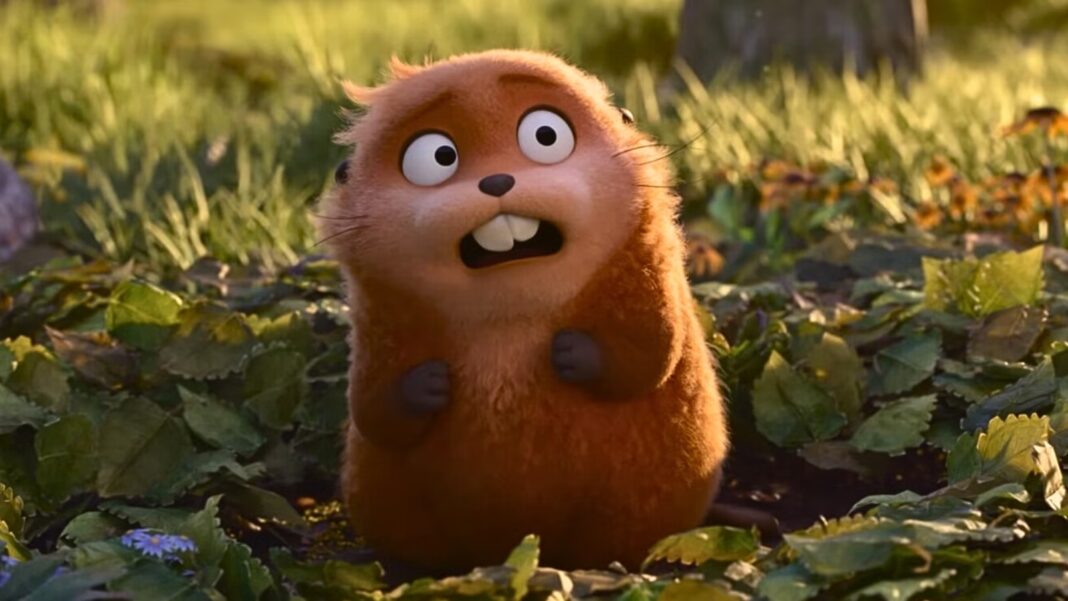
Warning: Spoilers ahead for Pixar’s Hoppers!Pixar fans have theorized for years that every movie made by the studio exists within the same shared universe. Although this may seem a little far-fetched given Pixar’s disparate filmography, Hoppers has just quietly proven the theory to be correct. The evidence is somewhat overwhelming, but it could also be described as a self-aware and incredibly meta Easter egg. On the other hand, the scene in question feels far too substantial to be anything other than a direct confirmation of what fans have already considered canon for a very long time.
Pixar makes an effort to set most of its movies during distinct periods in human history. If the shared universe theory is to be assumed correct, then 2015’s The Good Dinosaur is where the sprawling timeline begins. Then, movies like Brave (2012) and The Incredibles (2004) can be treated as period pieces in the lead-up to present-day efforts like Finding Nemo (2003), Up (2009), and most recently, 2026’s Hoppers. However, there has long been a lot of canonical connective tissue missing from the shared universe theory, which is why Hoppers is now so pivotal to the possibility of a deceptively complex Pixar movie franchise.
Dr. Sam’s ‘Hoppers’ Idea Board Reveals Her as the Inventor Behind Several Key Franchise Developments
It’s certainly fun to think about how all the Pixar movies are connected, but there’s been very little so far to actually solidly support the theory. As a result, it has always just felt like a thought experiment more than anything else. However, Hoppers either couldn’t resist toying with fans even more than Pixar already has, or the studio has decided that now is the time to tell everybody the truth. Toward the end of the movie, Kathy Najimy’s Dr. Sam reveals what’s next for her in the wake of the Hoppers program being shut down by Beaverton University. The blackboard she unveils is only shown briefly, but eagle-eyed viewers are rewarded with a treasure trove of game-changing revelations.
The plans that are the easiest to spot are right in the middle. Dr. Sam has blueprints that perfectly describe the talking dog collar that’s so present in Up. From this, we can assume that Hoppers takes place before Up. Looking at other parts of the board gets way more interesting, though. Dr. Sam’s frantic musings also include the designs for the title character of 2008’s WALL-E, the plan for a sort of spin-off Hoppers Program to put human consciousness into automobiles (which would explain the Cars franchise), and even the early blueprints for a device intended to “harness energy through vocalization,” just like in 2001’s Monsters, Inc. There are others, too.
Perhaps including one or two of these could have passed for a fun little nod to the shared universe theory, but with every one of Dr. Sam’s ideas having already come to life on the big screen, the brief shot of her chaotic blackboard feels way more important than that. Through Dr. Sam’s implied importance to the larger Pixar universe, we can surmise that her Hoppers technology was also used to transfer human consciousness into playthings for 1995’s Toy Story, insects for A Bug’s Life (1998), and more. If this connection is being canonized in the 2026 effort, then it becomes more likely that all the other Pixar movies are also part of the same timeline in equally cool ways.
One of Dr. Sam’s Ideas Actually Hurts the Pixar Shared Universe Theory
It’s really exciting to consider that Dr. Sam is the great mind behind key Pixar inventions like WALL-E and the talking dog collar, but her ideas board throws an incredibly meta spanner in the works. There is a direct reference to a piece of tech from the worst movie in the Toy Story franchise: 2022’s Lightyear. There’s a chalk etching of Sox, the robotic cat voiced by Peter Sohn from the failed Buzz spin-off. Just like Up‘s talking dog collar, which allows humans to converse with their canine companions, it makes perfect sense that Dr. Sam could adapt the Hoppers tech to create Sox. After all, building a mechanical cat that is, in Dr. Sam’s words, “deliberately more robot-like,” feels like a breeze when compared to the hyper-realistic creatures that are constructed in Hoppers.
Where things become complicated is that Lightyear is canonically a movie within the Toy Story universe. It’s the movie Andy saw that made him want the Buzz Lightyear action figure we see him receive in the 1995 effort. In other words, Lightyear is a fictitious project within a fictitious project. It would be easy to understand if Sox existed within the main Toy Story movies, but the suggestion that Dr. Sam invented the mechanical cat in the Lightyear canon, as well as being so busy in core Pixar efforts like Hoppers and Up, is a bit too much of a stretch. If anything, Sox’s presence on the blackboard is one of the biggest signs that all of Dr. Sam’s ideas should only be viewed as Easter eggs. Either that, or it’s an oversight.
So, Does ‘Hoppers’ 100% Confirm that Every Pixar Movie Is Part of the Same Timeline?

No, not 100%. I would say there is a strong chance the theory is true after Hoppers, though. Ignoring the weird choice to include Sox in Dr. Sam’s designs, the blackboard is just too full of references to developments in other Pixar movies. Furthermore, Dr. Sam’s intelligence seems to be key to plugging some of the biggest holes in the theory’s logic. Humans suddenly becoming cars once felt like too much of a leap, but Hoppers‘ Avatar-inspired tech sets up that possibility.
Although there are still many issues with the famous Pixar theory, Hoppers leaves the door open for Dr. Sam to also be the answer behind those missing pieces. Her ideas in the movie are numerous, and not all of them are shown. Her most recent plan is labeled “Plan #206,” and references teaching dogs to fly planes, as in Up. There are nowhere near 206 designs on the board, though. As such, it’s safe to assume that Dr. Sam has more ideas written down somewhere, and they could easily come into play down the line to explain holes in the shared universe theory in Pixar movies made before or after Hoppers.

- Release Date
-
March 6, 2026
- Runtime
-
105 minutes
- Director
-
Daniel Chong
-

Piper Curda
Mabel Tanaka / Mabel Beaver (voice)
-