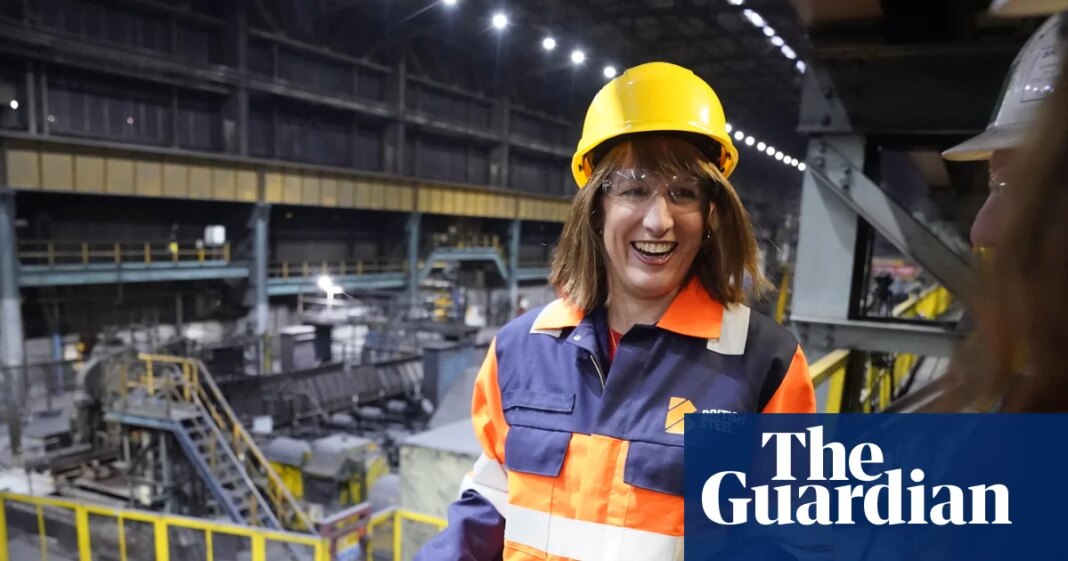
Rachel Reeves has instructed cabinet colleagues to award government contracts in four critical industries directly to British companies, making clear her irritation that ministers have been sending too much government business abroad.
In a letter seen by the Guardian, the chancellor tells every cabinet minister in charge of a spending department to “buy British” wherever possible, adding that she is disappointed they are not already doing so.
Officials in the Treasury and Cabinet Office say they will now monitor billions of pounds’ worth of contracts in shipbuilding, steel-making, energy and artificial intelligence – and if necessary, override decisions taken by departmental ministers.
Reeves’s letter was sent last week as she attempted to stamp her authority over her restive party, many members of which are expecting a change of prime minister within months.
It comes amid a wider battle over who should be chancellor if Keir Starmer is replaced during this parliament, with allies of both Reeves and the energy secretary, Ed Miliband, insisting their chosen candidate should be given the keys to No 11.
In the letter, which was co-signed by the Cabinet Office minister Chris Ward, the chancellor wrote: “We should all want to see more businesses grow and prosper and create good, skilled jobs and apprenticeships here in Britain. Every secretary of state can and must lead this agenda within their departments if we are to deliver the change the public expect.”
She added: “Therefore, it is disappointing that we are still seeing too many government contract awards where this is not happening. We have instructed officials to take further steps to ensure your departments act in the wider national interest rather than solely focusing on narrow operational priorities.”
There are also fears over how badly the UK economy will be hit by the Iran war, given how reliant the country is on importing its energy supply. Earlier this year the International Monetary Fund warned that the UK would suffer the biggest hit to growth of any developed economy as a result of the war.
Reeves is understood to be extremely unhappy that a series of high-profile contracts have either been awarded to foreign bidders or have gone out to open tender rather than being given directly to a British contractor.
They include a £200m a contract for navy support vessels, which was awarded to the Dutch shipbuilder Damen, and a £9m deal to refit the research ship David Attenborough, which was signed with the Danish shipyard Orskov.
The chancellor is also said to be disappointed that a £1.9bn contract to upgrade the Faslane shipyard, which services Britain’s nuclear submarines, could go abroad as part of a competitive tender.
And she is said to be uneasy about the possibility that turbines at a major offshore windfarm in the North Sea could be made by the Chinese company Mingyang.
Some of those decisions have been greeted with protests from some of Britain’s biggest unions.
Speaking about the Faslane contract, Louise Gilmour, the secretary of GMB Scotland, said: “It is hard to imagine another country in the world being so willing to send such work abroad … It is beyond time the MoD started defending our workers and their communities.”
Others in government however say that allowing companies to bid competitively for contracts allows the UK to secure the best products for the cheapest price. They add that awarding contracts directly to certain preferred companies is likely to push the costs up for British taxpayers.
Aides to Healey say he is as committed as the chancellor to buying from the UK, pointing out that he announced new funding last week to help British defence companies grow.
They point out that the Faslane deal has not yet been struck, and that the £200m contract for naval support vessels was actually made by Serco, the prime contractor.
Meanwhile, UK Research and Innovation has defended the Orskov deal, saying it was made after an extensive competitive-bidding process.
Allies of the chancellor say her irritation is not directed at individual cabinet ministers, but at what she sees as the “inertia” of civil servants following rules which prioritise cost over contractors’ nationalities.
They say the tendency to grant contracts to foreign companies risks undermining British national security, for example in the energy sector – where experts have expressed concern that China could gain a level of control over critical infrastructure.
In March, Ward said he would issue guidance clarifying that the government sees the four identified sectors as critical for national security.
Ministers argue that doing so will allow departments to award contracts in those industries directly to companies rather than running a competitive bidding process.
Under the terms of the 2023 Procurement Act, ministers are able to ban companies for bidding for certain contracts if they are deemed to be a national security risk.
But government insiders acknowledge that the promise of new guidance has not been enough to change how Whitehall spends government money, and hope that Reeves’ warning will put “rocket boosters” under the policy.
In her letter, she promised to issue further guidelines to government accounting officers telling them to take contractors’ nationality into account as well as costs.
And she warned: “We look forward to confirmation that your departments are complying with the new guidance when it is issued later this summer. Each department will be held to account on the progress being made.”
Government insiders said this would involve the Cabinet Office reviewing individual contracting decisions, and if necessary “calling in” those over which officials had concerns and potentially overriding them.
The letter was sent last week amid a flurry of activity from the chancellor, whose allies are openly campaigning for her to remain in office should Starmer be replaced by Andy Burnham, who is standing to be the MP for Makerfield.
Over the last few days Reeves has also announced a package of measures to make summer activities cheaper for families, become embroiled in a public spat with supermarkets over their prices and launched her own TikTok account.
The Treasury and Cabinet Office have been contacted for comment.