Rep. Brian Fitzpatrick, R-Pa., talks with a reporter in the U.S. Capitol’s Statuary Hall on Friday, March 27, 2026.
Tom Williams | CQ-Roll Call, Inc. | Getty Images
Republicans have said for months that inflation is former President Joe Biden’s problem. Now, they’re staring down the barrel of an inflation crisis of their own making just in time for the midterm election, and the blame game is just getting started.
Inflation ticked up to 3.8% year-over-year in April, the highest mark since 2023. Much of that spike is coming on the back of soaring energy prices, which have persisted since President Donald Trump launched a war in Iran.
Trump and congressional Republicans swept into power in 2024 by promising to defeat the inflation that dogged Biden’s presidency. But they now risk getting trounced in the 2026 midterm election due to their own inflation crisis, and they are struggling to find a clear message to battle high prices as the president pushes for a $400 million White House ballroom and a $1.8 billion taxpayer-funded legal relief fund for victims of government “weaponization.”
Members of the congressional GOP are now left wondering whether their priorities are in the right place.
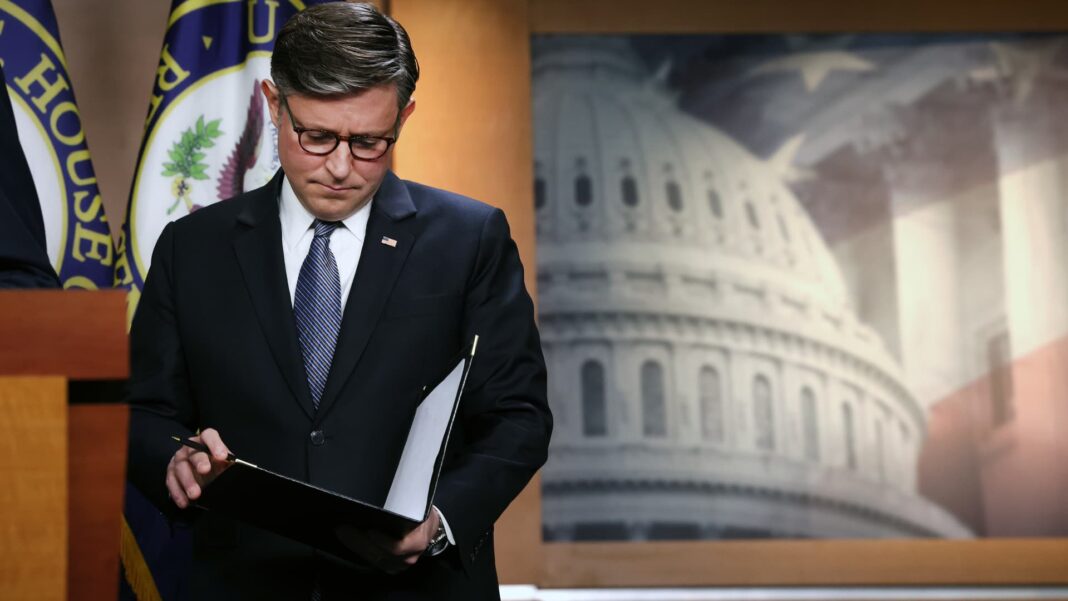
“When half of America is living paycheck-to-paycheck, the word ‘ballroom’ should not be in anyone’s vocabulary,” Rep. Brian Fitzpatrick, R-Pa., a moderate who represents a swing district, told reporters at the Capitol. “We should always be focused on affordability, always. Both parties have gotten it wrong. That’s why we’re in the crisis we’re in now.”
Fitzpatrick’s comments were a rare rebuke of Trump’s priorities from within his own party, which has largely remained in lockstep with the president through months of economic tumult brought on by an on-again, off-again tariff regime and now the war with Iran.
And asked about what Republicans could tell voters in their districts, Fitzpatrick didn’t exactly make the case for the GOP.
“How about both parties are broken, which is why we need to do away with the two-party system?” he said.
He’s not alone among Republicans who are warning that the pinch of inflation is going to hurt the party in November, especially after years of elevated costs have ground on Americans.
“It’s not as bad as the worst it was under Biden,” said Rep. Don Bacon, R-Neb., a frequent critic of the president who will retire at the end of his term. “But I think most Americans have not recovered from all that, and that’s why it’s still an issue.”
Bacon trained his fire on Trump’s tariffs for inflation.
“I think tariffs are bad policy. Milton Friedman, Adam Smith, they’re the bibles of conservatism, and we have violated those,” he said, referring to free-market economists. “We should not have rolled over on that here in Congress.”
Asked what Republicans can say to show Americans that life is better under GOP rule, Bacon said that “the president can surely show that we secured the border.”
It’s been four years since the U.S. consumer price index peaked at 9% in June 2022, igniting Americans’ anger at post-pandemic price hikes. Now the war with Iran is fanning affordability fears again.
Food at home rose 0.7% between March and April alone, according to the most recent Consumer Price Index release from the Bureau of Labor Statistics. That contrasts with the .25% average monthly gain in food prices in 2025.
And the national average for a gallon of gas was $4.49 on Tuesday, 51% higher than just before the war began, according to AAA.
Voters have been registering their discontent with the cost of goods and the economy broadly for years. Trump’s approval on the economy, meanwhile, has nose-dived, with only 33% of voters giving him positive marks in a recent New York Times/Siena College poll. His approval on the cost of living was even worse, with only 28% of voters saying they approved.
Democrats are leading in generic congressional polling. A RealClearPolitics polling average puts Democrats up 7.1% points over Republicans. Republicans hold a five-seat majority in the House.
Rep. Suzan DelBene, D-Wash., chair of the New Democrat Coalition, speaks with members of the press outside the West Wing of the White House after meeting with President Joe Biden to discuss his domestic agenda, Wednesday, March 30, 2022, in Washington. Standing with DelBene are Rep. Scott Peters, D-Calif., left, and Rep. Ami Bera, D-Calif.
Patrick Semansky | AP
Rep. Suzan DelBene, D-Wash., who is the chair of the House Democratic campaign arm, told CNBC that voters are reacting to “broken promises.”
“They’ve been saying over and over again, `wait and things are going to be better,'” DelBene said. “None of that has been true, and people are tired of the broken promises. Trump said he was going to lower costs on day one.”
Not all Republicans are giving up hope that they can turn the tide on inflation.
Rep. Zach Nunn, R-Iowa, said he expects voters will respond to the tax cuts Republicans passed as part of the 2025 budget reconciliation measure known as the “one, big, beautiful bill.”
“If you’re looking for solutions on this, which group just gave the largest tax cut in American history?” Nunn said. “We’ve gotten more trade deals than any time in recent memory …, we’ve gotten things like biofuels passed, that’s $23 billion in economic growth for my home state of Iowa, and we’ve also been able to say we’ve made real onshoring a priority, so local economic growth is kicking off.”
And top Republican leadership continues to present a rosy outlook on the economy and the upcoming election.
House Speaker Mike Johnson, R-La., said on Sunday that he expects Republicans to win in November.
“I’m absolutely convinced that we’re going to grow the majority,” Johnson told Fox News during an interview at the Indy 500. “The kitchen table issues are going to decide the midterms.”
How Republicans bring down kitchen-table prices in time for the election, however, remains an open question. Some Republicans have pitched a third tax and spending package this year, focused on lowering costs. Doing so would be a monumental task, especially after Trump angered some allies in the Senate last week with his ballroom push, endorsements of challengers to popular incumbents and Justice Department “weaponization” fund.
But most Republican policymakers agree that the most critical of those prices, gasoline, is unlikely to come down until the war with Iran ends or the Strait of Hormuz — the critical channel that carries a fifth of the world’s oil — is opened.
Natural resources research firm Wood Mackenzie, in a recent analysis, found that under a quick resolution to the conflict, Brent crude would drop to $80 per barrel by the end of the year. If the strait remains closed through the end of the year, it would make matters significantly worse, with crude rising toward $200 per barrel by the end of the year.
“It all comes down to getting energy costs back where they need to be, which is going to involve getting some resolution in Iran,” said House Natural Resources Chair Bruce Westerman, R-Ark. “There are still some things we could do through reconciliation, but this is just a fundamental supply and demand issue right here.”