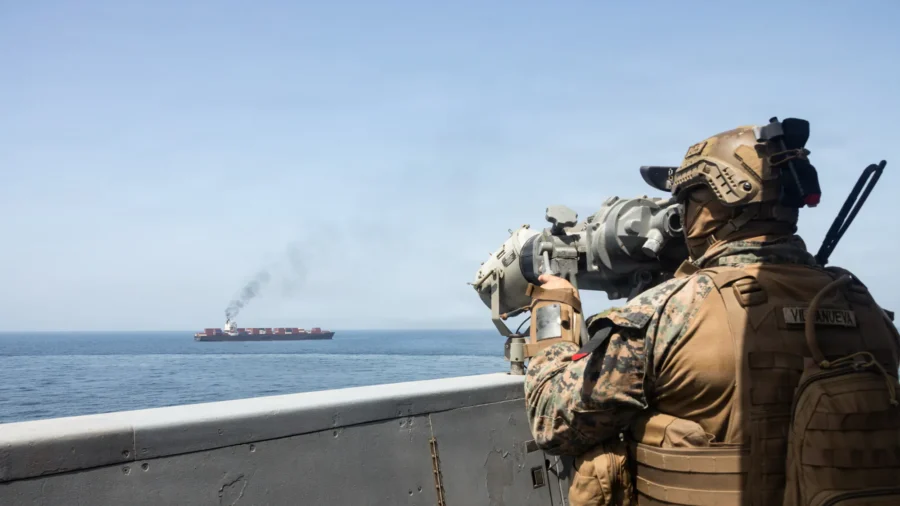
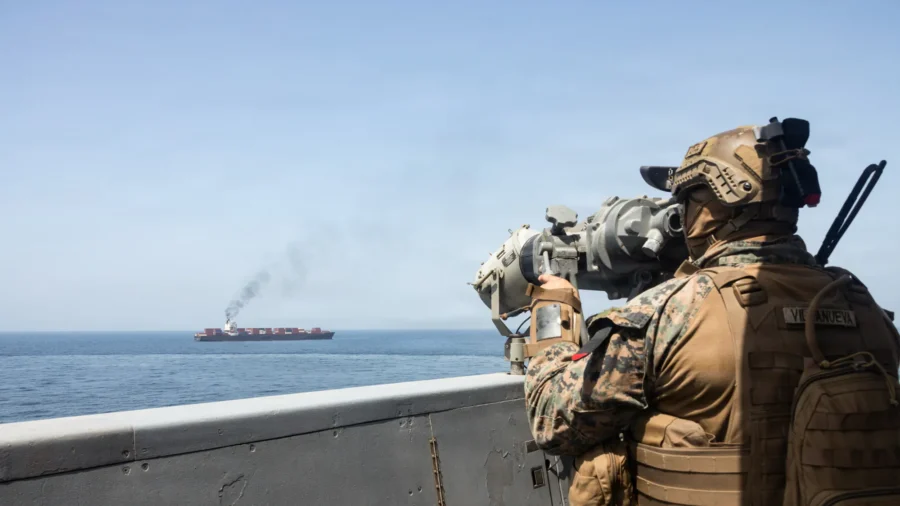
The U.S. Navy has warned commercial shipping that “dangerous military activities” will take place in and around the Strait of Hormuz, cautioning that vessels suspected of supporting mine-laying operations could be targeted and that the U.S. blockade of Iranian ports remains in force.
The warning was issued May 29 by U.S. Naval Forces Central Command through the Joint Maritime Information Center and shared with shipping operators via the United Kingdom Maritime Trade Operations office. It comes as Washington and Tehran continue negotiations over a possible agreement to extend a fragile ceasefire and prevent a resumption of war.
“The maritime security threat level in the [Strait of Hormuz] remains critical due to ongoing military conflict,” said the advisory, which was issued on the same day that President Donald Trump called for the narrow shipping lane connecting the Persian Gulf to global markets to be “immediately open” and that any mines set in the strait by Iranian forces must be “terminated.”
Posting on social media, Trump on Friday outlined the key terms of a possible deal with Iran. He said Tehran must permanently renounce nuclear weapons, immediately reopen the Strait of Hormuz to unrestricted shipping without tolls, and remove or destroy any remaining naval mines.
Iranian officials said later Friday that no final understanding had been reached between Iran and the United States. Foreign Ministry spokesman Esmaeil Baghaei said in remarks cited by Iranian state-run media IRNA that “exchanges of messages” were continuing but that nothing had been finalized, while rejecting Trump’s demands regarding the Strait of Hormuz and broader negotiations.
US Navy Warns of Possible Use of Force
The advisory from U.S. Naval Forces Central Command warned mariners to expect an increased naval presence, potential radio challenges from military vessels, and congestion near anchorage areas as the U.S. military conducts operations north of Oman’s Musandam Peninsula, a strategic area overlooking the Strait of Hormuz, the critical shipping lane that Iranian forces have been choking off amid the ongoing conflict.
“Iran continues to attempt illegal control of the Strait of Hormuz, to include dangerous and illegal mining that places ships and mariners at risk,” the advisory stated. “The United States is committed to freedom of navigation.”
The advisory instructed vessels to avoid the Strait’s traffic separation scheme where possible, coordinate movements with the U.S. Navy, and immediately comply with instructions from American forces.
U.S. Naval Forces Central Command further warned that any mine-laying activity would be targeted and, more broadly, any vessels failing to heed directions from U.S. forces could be considered an imminent threat and fired upon.
“Any vessel observed to be engaged in, or supporting, mine-laying activities will be targeted by U.S. forces in self-defense,” the advisory said, adding that the U.S. military operating in the Strait of Hormuz is on “high alert for Iranian attack.”
While the temporary ceasefire between Iran on the one side and the United States and Israel on the other has largely held, there have been sporadic skirmishes and alleged truce violations.
Blockade Remains in Effect
In a separate advisory issued on May 29, the Joint Maritime Information Center said a military blockade of Iranian ports remains active across the Arabian Gulf, Gulf of Oman, North Arabian Sea, and Strait of Hormuz.
The notice described a restricted area associated with blockade operations and warned that vessels entering or departing Iranian ports, or participating in ship-to-ship transfers linked to Iran, could face enforcement action.
“Enforcement actions include disabling and destructive fires upon vessels who do not demonstrate immediate compliance with blockading forces,” the advisory said.
The warning added that vessels contacted by U.S. forces must comply immediately or risk being fired upon.
“Failure to immediately comply may result in rapid escalation to disabling or destructive fire,” it said, adding that vessels are free to navigate international waters but that the U.S. Navy cannot guarantee the safety of neutral or commercial shipping due to the fact that “dangerous military operations” are taking place in the region.
The maritime warnings came as Trump indicated in his Friday message that the blockade could be lifted as part of a broader agreement with Tehran.
“The Hormuz Strait must be immediately open, no tolls, for unrestricted shipping traffic, in both directions,” Trump wrote, adding that the U.S. naval blockade would be lifted if Iran were to agree to the terms.
Mohsen Rezaei, a former commander of Iran’s Islamic Revolutionary Guard Corps and a senior adviser to Supreme Leader Ayatollah Ali Khamenei, accused Trump of undermining diplomacy by maintaining the restrictions.
“As predicted, the President of the United States is betraying diplomacy for the third time,” Rezaei wrote on X on May 29. “By continuing the naval blockade and making excessive demands in negotiations, he has once again proven that he is not inclined toward negotiation and is pursuing other objectives.”
Despite the sharp rhetoric, both sides have indicated that negotiations remain active.
Iran’s Foreign Ministry spokesman said Friday that talks continue but that “a final understanding has not been reached,” adding that the focus of the discussions is on ending the war, while declining to comment on Iran’s nuclear program or its stockpile of highly enriched uranium.