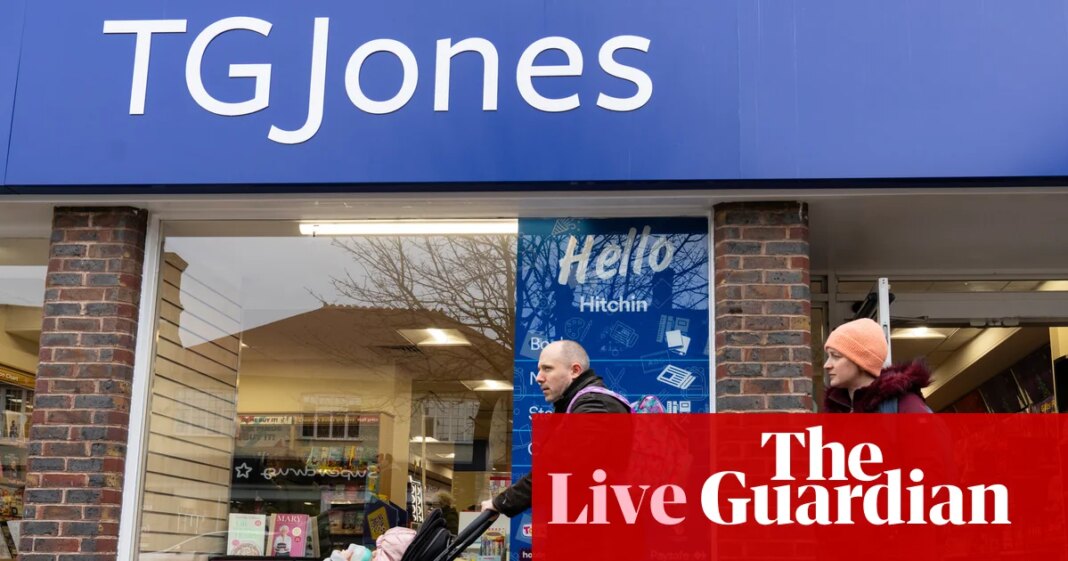
Key TG Jones landlords back restructuring plan, though some creditors oppose it

Sarah Butler
The owner of WH Smith’s former high street business – TG Jones – will next week seek court approval for a stringent restructuring plan involving the closure of up to 150 stores after major landlords, the Post Office and some suppliers backed the plan.
More than 80% of landlords controlling TG Jones’ top stores voted to support the deal this week, according to documents seen by The Guardian with the majority other classes of landlords, who will face swingeing rental cuts under the plan, voting against it.
Several different classes of creditor voted over two days this week on the restructure but the plan requires approval – judged as backing from 75% or more – from just one class of creditor and from a high court judge to go ahead.
Only 72% of business rates creditors – mostly local councils – backed the plan and less than a third of general creditors, who include card makers, pen brands, gave it the thumbs up. No landlords owning unwanted stores where rent will be cut to zero or closed backed the plan.
Small suppliers are to lose at least half the money owed to them by the former WH Smith high street chain if a High Court judge approves the restructure next week. There will be two hearings related to the two companies which make up TG Jones which are being restructured – one on Monday and one on Tuesday.
The books to paperclips retailer, which has 450 stores, was bought by the private equity firm Modella Capital last year and rebranded TG Jones.
The company has said it is likely that it will have to call in administrators if its restructuring plan is not approved.
Dozens of “exit contract” suppliers, which TG Jones does not wish to work with in future, including toy makers and greetings card companies, are expected to have debts owed to them by the retailer wiped out if the proposal is approved.
They would retain the right to a share of any profits over a certain level from the retailer – which is now loss-making – in three years’ time.
Key events
Back in the Middle East, a total of about 115 vessels and 2,500 seafarers have been evacuated from the Strait of Hormuz since Tuesday, the head of the UN maritime body has said.
International Maritime Organization secretary-general Arsenio Dominguez gave the update after the IMO on Thursday suspended its efforts to evacuate some 600 ships and 11,000 sailors, following an attack on a vessel in the Gulf of Oman.
Dominguez told an online press conference that “115 (vessels) have evacuated in the last three and a half days, representing around 2,500 seafarers that have now safely left the Strait of Hormuz”, the AFP newswire reports.
Key TG Jones landlords back restructuring plan, though some creditors oppose it
Sarah Butler
The owner of WH Smith’s former high street business – TG Jones – will next week seek court approval for a stringent restructuring plan involving the closure of up to 150 stores after major landlords, the Post Office and some suppliers backed the plan.
More than 80% of landlords controlling TG Jones’ top stores voted to support the deal this week, according to documents seen by The Guardian with the majority other classes of landlords, who will face swingeing rental cuts under the plan, voting against it.
Several different classes of creditor voted over two days this week on the restructure but the plan requires approval – judged as backing from 75% or more – from just one class of creditor and from a high court judge to go ahead.
Only 72% of business rates creditors – mostly local councils – backed the plan and less than a third of general creditors, who include card makers, pen brands, gave it the thumbs up. No landlords owning unwanted stores where rent will be cut to zero or closed backed the plan.
Small suppliers are to lose at least half the money owed to them by the former WH Smith high street chain if a High Court judge approves the restructure next week. There will be two hearings related to the two companies which make up TG Jones which are being restructured – one on Monday and one on Tuesday.
The books to paperclips retailer, which has 450 stores, was bought by the private equity firm Modella Capital last year and rebranded TG Jones.
The company has said it is likely that it will have to call in administrators if its restructuring plan is not approved.
Dozens of “exit contract” suppliers, which TG Jones does not wish to work with in future, including toy makers and greetings card companies, are expected to have debts owed to them by the retailer wiped out if the proposal is approved.
They would retain the right to a share of any profits over a certain level from the retailer – which is now loss-making – in three years’ time.
The UK public are less anxious about inflation, following the easing of tensions in the Middle East.
Expectations for inflation in a year’s time have dropped to 3.8% from 4.7%, nearer to the Bank of England’s 2% target (although still rather higher!).
Inflation expectations in five or more years’ time have fallen to 3.9% this month from 4.0% in May, new data from US bank Citi and pollsters YouGov shows.
The chip firm sell-off has resumed on Wall Street, as trading begins for the final day this week.
Wall Street’s main indexes have all dropped at the start of trading; the Dow Jones Industrial Average fell 116.9 points, or 0.23%, to 51803.77, while the broader S&P 500 lost 0.6% and the tech-focused Nasdaq is down 1%.
ON Semiconductor Corp (-20%) is leading the slide, with Sandisk down 8.6%, and Nvidia losing 1.8%.
US trade in goods deficit hits one-year high
Oof! America’s trade deficit with the rest of the world has ballooned, in a sign that Donald Trump’s trade war is not bearing fruit.
The US trade in goods deficit jumped by $22.7bn in May to $105.8bn, new data from the Census Bureau shows, up from $83.0bn.
That’s the highest monthly goods trade deficit since March 2025, when there was a scramble to import stuff before Donald Trump’s Liberation Day tariffs were announced.
The data shows that US goods exports fell by $11.8bn in May, to $207.7bn, including a fall in exports of ‘foods, feeds, & beverages’ and automobiles.
Imports jumped by $10.9bn to $313.4bn in the month, led by higher shipments of capital goods – which could include equipment to build America’s AI data-centre rollout.
Britain’s smaller share index, the FTSE 250, is also dropping today.
The FTSE 250, which contains medium-sized companies, is down just over 1%. AEP Plantations (-6.5%), which produces palm oil and rubber, are the top faller, followed by advertising group WPP (-5.4%).
Bars and pubs busy in the heatwave
UK pubs and bars are enjoying a roaring trade in the heatwave, according to data from global payments platform Square.
Square reports that there was a jump in transactions on Monday, Tuesday and Wednesday, compared with a year ago. However, restaurants in London experienced a drop in trade, as some workers decided to stay at home rather than brave the commute.
Tuesday, when the England men’s football team struggled against Ghana’s low block, was particularly busy in the pubs.
Square reports:
-
Bars and pubs saw transactions up 11.7%, the strongest signal across any hospitality category
-
Restaurants were roughly flat (+1.0%)
-
London showed a different pattern, as bars and pubs were up just 2.0%, while restaurants were down -4.7%
-
Tuesday 23 June was the peak day nationally for bars, pubs and restaurants
John O’Beirne, CEO of Square International, says:
“Across the country, Brits gravitated towards bars and pubs to cool down as temperatures spiked this week. This is in contrast to what we saw in London, where there was a spend shift away from the centre, suggesting people have been seeking out suburban venues and more outdoor spaces to escape the heat of the capital.”
XTB: The hand to mouth tech rally has halted
Today’s losses show that the tech stock rally is losing momentum, points out Kathleen Brooks, research director at XTB:
A rotation is going on in US stocks right now, the weakest performing companies on the S&P 500 include those most closely linked to AI, including Palantir and Oracle, which are down 18% and 16% respectively this week. There are also chunky losses for some of the Magnificent 7, including Microsoft, Alphabet, Apple and Nvidia. The move away from tech heavy AI names is allowing value stocks to shine. The top performing sectors in the US this week include industrials, real estate, consumer discretionary, energy and healthcare, which is the top performing sector and is higher by more than 4%.
The hand to mouth tech rally has come to an abrupt halt at the end of the week. After Thursday’s recovery rally on the back of Micron results, which caused the stock price to soar by 15%, a dearth of good news is weighing on the sector and the entire AI narrative. Micron’s stock price is down 4% in the pre-market, other memory chip stocks are also sinking, and SanDisk is down 5%. Nvidia is also lower by 1%, which could drag US stock indices lower if Nvidia’s losses persist as we move through Friday.
Markets fall as tech worries rise
European stock markets are dropping today, as a sell-off in technology shares on Wall Street yesterday rattles investors’ nerves.
In London, the FTSE 100 is down 80 points, or 0.77%, falling away from its highest closing level in two months.
Germany’s DAX has lost 1.2% today, with France’s CAC down just 0.6%.
That follows the sell-off in Asia-Pacific markets overnight, where South Korea’s KOSPI lost 6% (see earlier post) as Apple’s plan to hike some hardware prices hit market confidence, as did an announcement that Microsoft is lifting the prices of its Xbox gaming console.
Chris Beauchamp, chief market analyst at IG, says “a battalion of worries” are pushing shares down, including reports that OpenAI might delay its stock market float until 2027.
Apple and Microsoft’s price rises have struck at the market’s fear of inflation, raising worries that, far from being deflationary, the AI boom might be inflationary, particularly for the hard-pressed consumer, hurting rather than aiding economic growth.
Meanwhile, OpenAI seems to have little stomach for market volatility either, reportedly put off by SpaceX’s travails. Having piled in to AI and tech since the end of March, there is a desire to protect profits, and investors continue to be in a mood to sell first and ask questions later.”
Goldman Sachs: Very strong El Niño would push up food prices
The food industry also faces the threat of climate change, with forecasts of a “very strong” El Niño this year.
Goldman Sachs have predicted that global food commodity prices would be pushed higher, with a delay, if predictions that the El Niño detected in the tropical Pacific is unusually intense.
They say:
We find a 1.0°C El Niño shock drives a 9.55% peak increase in global wholesale food prices after two years. Scaled to the expected 2026 “very strong” event (implying a 1.65°C temperature increase), our model projects a cumulative 15.8% surge in food commodity prices, fully realised by 2028H2.
However, this would probably only result in a 1.3% rise in food, alcohol, and tobacco prices in the eurozone, Goldman estimates, and only a small rise in headline inflation.
El Niño is the term for a rise in ocean surface temperatures off the coast of South America, which has a dramatic impact on the global climate and can lead to heatwaves, crop failure and famine.
Asia-Pacific markets fell heavily today, as news of price rises from Apple hit the tech sector.
South Korea’s KOSPI index fell 6% and Japan’s Nikkei lost 4.15%, as technology shares continued to drop.
Apple’s decision to raise iPad and MacBook prices, and pass on higher costs of memory and storage chip costs, hit some semiconductor stocks.
Investors were also jolted by reports that artificial intelligence pioneeer OpenAI is considering holding off on its public debut until next year.
That knocked shares in SoftBank, an OpenAi investor, down by 12.5%.
Volkswagen CEO ‘aims to cut up to 100,000 jobs in next years’
German carmaker Volkswagen is reportedly planning to cut up to 100,000 jobs over the next few years, as it intensifies its shake-up.
German monthly business publications Manager Magazin says Volkswagen CEO Oliver Blume is planning to drastically intensify job cuts, and close four German plants.
Blume is also planning to spin off the VW brand into a new company, they add.
Back in March, Volkswagen was expected to shed 50,000 jobs by the end of the decade, after being hit by falling sales in China and North America, and US tariffs.
The oil price is easing back this morning, after jumping following an attack in the strait of Hormuz.
Brent crude is down 2.3% today at $73.53 – still above yesterday’s four-month low of $72.06, lower than before the Middle East conflict began.
Taiwan’s Evergreen Marine has said one of its ship was hit close to Oman by an “unknown object” while on a route recommended by the British navy agency UKMTO.
This has prompted the UN’s International Maritime Organization to pause its operation to escort ships through the strait.
Britain’s electricity grid operator issues system warning due to heatwave
Energy news (2): Britain’s electricity grid operator has warned that the power supply could be squeezed tonight, as the country continues to swelter.
The National Energy System Operator (Neso) has issued an Electricity Margin Notice (EMN) for this evening – a sign that it fears a power supply crunch, and wants producers to provide more energy.
NESO’s forecasts are showing tight margins on the electricity system for Friday night, a spokesperson says, adding:
This is due to the impact of extremely high temperatures affecting Great Britain and the continent.
“An Electricity Margin Notice (EMN) has been issued to the market. This is a routine tool, and means we are asking market participants to make any additional generation capacity they may have available.”
On Wednesday, NESO issued an EMN, and then cancelled it after agreeing to pay around £10m to fire up gas power plants.
Demand is high in the evenings as people turn on electric fans and air conditioning units to try to keep cool.
UK’s Ofgem advances 16 long-duration energy storage projects
Energy news (1): Regulator Ofgem has announced it is giving a “provisional green light” to 16 long-duration energy storage projects that could strengthen domestic power supplies.
The selected projects cover four technologies – pumped storage hydro (PSH), compressed air energy storage (CAES), lithium-ion batteries and vanadium redox flow batteries (VRFB).
Energy minister Michael Shanks, says:
“Forty years after the country’s last pumped storage facility, this government is getting Britain building again.
“The lesson from the conflict in Iran is clear: Britain cannot afford to remain at the mercy of volatile fossil fuel markets and leave families exposed to the next price shock.
“That is why we are further and faster in delivering the clean power mission by rolling out a new generation of pumped hydro storage and state-of-the-art batteries – making more of the clean, homegrown power we already produce, cutting waste, lowering bills and strengthening our energy security.”
Heathrow forecasts drop in passengers this year
Heathrow Airport has warned that passenger numbers could fall this year, due to the Middle East crisis.
In its latest investor report, released this morning, Heathrow says its base case is that it will handle 83.6m passengers this year, a 1.1% fall compared with 2025.
It says the outlook remains uncertain, despite ‘resilient’ demand so far this year, explaining:
In the 5 months to May 2026, passenger numbers reached 32.8 million, a 0.7% increase year on year, driven by larger aircraft and a boost in connecting passengers, although the ongoing conflict in the Middle East is putting notable downward pressure on traffic.
Heathrow says this forecast reflects the risk that continued volatility in the Middle East could dampen global travel demand over the rest of the year.
It has also lowered its earning forecast, predicting that profits on an adjusted EBITDA basis will fall by £147m compared to 2025, and be £60m lower than predicted in December.
The FDF also reports that the UK’s food and drink export surplus with the US has fallen by over 69% – from £359m to £110m in Q1 2026.
This was driven by the 27.9% drop in UK exports to the US, and also by a 11.5% rise in US food and drink exports into Britain.
The FDF fears this trend will continue, warning:
The US are also set to benefit from proposed tariff suspensions announced by the UK government this year, which would make it cheaper for US businesses to export products like chocolate, biscuits, jams and spreads to the UK, while UK manufacturers face higher costs sending products to the US, meaning this trend is likely to persist.
UK food and drink exports hit by US tariffs and Brexit trade friction
Good morning, and welcome to our rolling coverage of business, the financial markets and the world economy.
UK food and drink manufacturers are losing ground to global competitors, the industry fears, after exports fell to the lowest in a decade.
The Food and Drink Federation’s (FDF) latest Trade Snapshot report shows that UK food and drink exports fell by 4.8% year-on-year, to £5.7bn, in the first quarter of this year.
In volume terms, exports in January-March were down 8.9% to the lowest level for the period in the last decade (if you exclude 2021 when the Covid pandemic hit shipments), the FDF warns.
Ten years on from the Brexit referendum, it’s notable that EU export volumes fell by 6.9%, which the FDF blames on “the added cost and complexity of trading with our closest trade partner since Brexit”.
The federation hopes that the new sanitary and phytosanitary (SPS) agreement being hammered out by London and Brussels will cut some trade friction, by removing paperwork and reducing border checks.
But the biggest damage has been inflicted on exports to the US, which tumbled by 28% after Donald Trump’s trade wars disrupted transalantic trade.
Karen Betts, chief executive at The Food and Drink Federation (FDF):
“Food and drink businesses are part of the fabric of every community in the UK, and it’s concerning to see them struggling to compete overseas. The UK produces world-class food and drink, drawing on our heritage and our reputation for innovation, but we have to be able to remain competitive overseas against local products. The costs of producing food and drink in the UK are higher than in many competitor economies, from energy to employment, and constantly changing regulation only adds to these.
“There is plenty government can do to improve the competitiveness of our food and drink exporters, many of which are SMEs, from helping companies to access the benefits of trade deals to lowering the cost of doing business in the UK.
The agenda
-
9am BST: Eurozone consumer inflation expectations report
-
10am BST: Italian business confidence data
-
3pm BST: University of Michigan’s US consumer confidence index