Iceland Prime Minister Kristrun Frostadottir participates at a listening session on a referendum in Reykjavik, Iceland, on August 24, 2026.
Jonathan Nackstrand | Afp | Getty Images
Icelanders on Saturday will vote in a knife-edge referendum on whether to resume negotiations to join the European Union, reopening a debate that has taken on deeper significance in the wake of U.S. President Donald Trump’s Arctic saber-rattling.
The question put to the Nordic nation of nearly 400,000 is simply: “Should Iceland resume accession negotiations with the European Union?”
Opinion polls indicate the advisory vote is likely to go down to the wire, with the country effectively split in half on the issue. If a majority of voters answer yes, accession negotiations will take place, which if successful, would lead to a negotiated agreement being put to a second referendum for the Icelandic people to accept or reject.
It comes as the Arctic emerges as a major hotbed for critical minerals and climate change rapidly melts sea ice, opening seasonal shipping routes, and amid Trump’s renewed push to acquire Greenland, Iceland’s closest neighbor.
The U.S. president has long advocated for control over Greenland on national security grounds. Notably, Trump appeared to repeatedly mix up Greenland and Iceland during a special address at the World Economic Forum in Davos, Switzerland earlier in the year.
“All of the arguments put forth by the U.S. president for why it would be necessary for the U.S. to acquire Greenland actually equally applied to Iceland. The only difference is that Iceland is formally an independent country,” said Eiríkur Bergmann, professor of politics at Iceland’s Bifröst University.

Iceland applied to join the EU in 2009 in the aftermath of the global financial crisis, before suspending membership talks in 2013 when a euroskeptic coalition government came to power.
At the start of the year, Iceland Foreign Minister Thorgerdur Gunnarsdottir said that deeper dialogue and collaboration with the EU would be a key factor in shoring up the country’s interests.
“It is clear that the international system we have lived in since the end of World War II is in turmoil,” Gunnarsdottir said in an article for Icelandic newspaper Visir, according to a Google translation.
Economy, sovereignty and fisheries
Alongside Trump’s Greenland ambitions, Bergmann said diminishing trust in the U.S. as a security partner is another key concern ahead of the vote.
Iceland, a founding member of NATO, is the only ally that does not have its own military forces. The country also sits astride the so-called GIUK Gap, a naval choke point between Greenland, Iceland and the U.K. that links the Arctic to the Atlantic Ocean.
“Iceland’s security and defense is guarded by our membership in NATO, but also, for many, more importantly, by a bilateral defense agreement with the U.S. since 1951. Now many people are sort of reconsidering the validity of that defense agreement,” Bergmann said.
While these geopolitical developments have influenced the context in which Icelanders have discussed the prospect of EU membership, political experts have stressed the debate has primarily been driven by domestic issues — particularly the economy, sovereignty and fisheries.
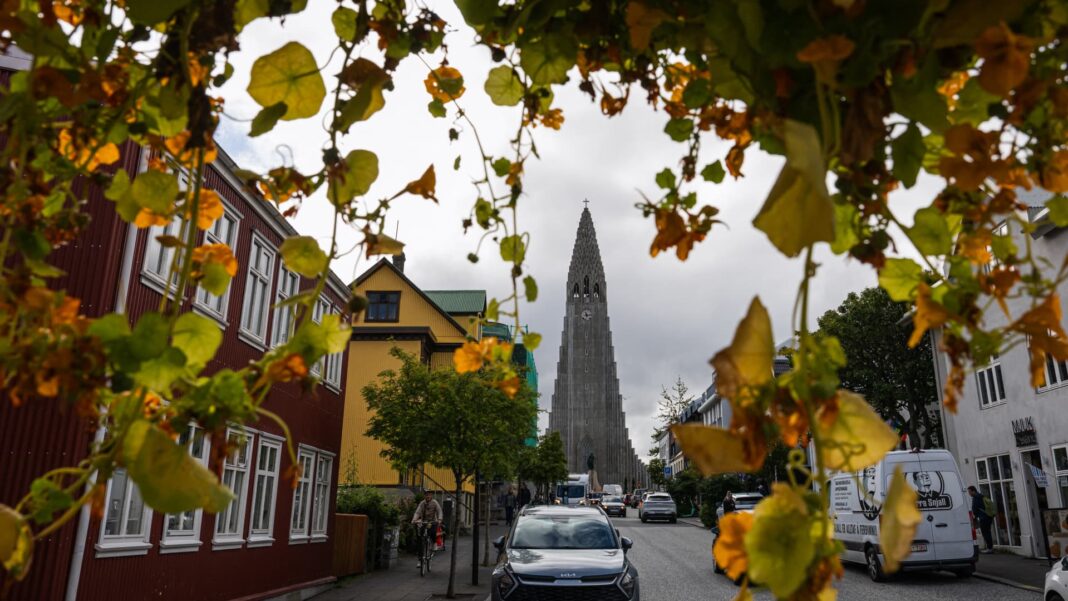
This image taken on August 25, 2026 shows an Icelandic flag displayed along a street in central Reykjavik, Iceland, ahead of the country’s upcoming referendum. Icelanders are to vote August 29, 2026 on whether to resume entry talks with the European Union 13 years after they were suspended, in a referendum seen going down to the wire.
Jonathan Nackstrand | Afp | Getty Images
Jon Danielsson, director of the Systemic Risk Centre and reader in finance at the London School of Economics, said Iceland has previously fought tough battles against EU member states over control of its fishing industry, describing the issue as “totemic” given the sector’s economic importance.
“For the Icelanders, the key issue in joining is the euro and to get away from the instability of its own currency and very high interest rates. So, the euro is really what they see as the target they want,” Danielsson told CNBC’s “Europe Early Edition” on Friday.
“Even if it voted to join, the vast majority of the population would be looking at the fishing and whether the EU would provide the necessary conditions — which, to my mind, seems doubtful,” he added.
Former Icelandic Prime Minister Katrín Jakobsdóttir, meanwhile, has said that she doesn’t see the argument for joining the EU, saying the country maintains close economic collaboration with the 27-nation bloc and its citizens already enjoy high living standards.
“If a majority of the people wants to apply, it is very important to listen to that majority, but I haven’t changed my position,” Jakobsdóttir told CNBC in mid-April.
To be sure, Iceland is already deeply integrated into the European framework, partly through its membership of the European Economic Area, which gives the volcanic island access to the EU’s single market without requiring full membership.
Iceland is also a member of the Schengen Area, which allows passport-free travel between it and other participating European countries.
“The current Social Democrat-led government, which actually initiated or applied for membership the first time round, is now reheating its bid to close this unfinished business, so to speak,” Steven Blockmans, deputy director at the International Centre for Defence and Security think tank, told CNBC by telephone.
A success case for the EU?
For the EU, political experts have said the bloc is in the market for something of a success case, particularly after Britain’s exit in 2020.
A victory for the yes campaign could pave the way for a negotiated agreement to be reached relatively quickly, Bergmann said, because Iceland’s coalition government is approaching its next general election, which must be held no later than Aug. 2028.
“Bigger is better in this day and age, it seems,” Blockmans said.
He added that the EU potentially welcoming a country ranked among the leading nations in GDP per capita and among the leading nations in global democratic performance would undoubtedly give “extra shine to the European integration project.”