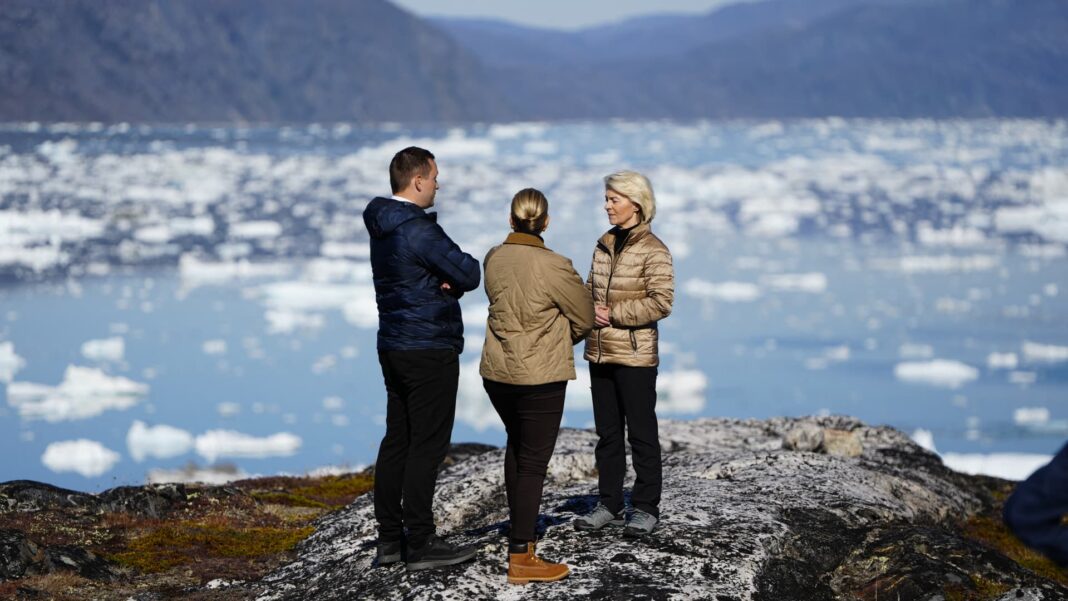
European Commission President Ursula von der Leyen (R), Greenland’s Prime Minister Jens-Frederik Nielsen (L) and Denmark’s Prime Minister Mette Frederiksen visit Qoornoq, an abandoned settlement on the island of Qaarusuup Nunaa, also called ‘Bear Island’, Greenland on September 6, 2026.
Mads Claus Rasmussen | Afp | Getty Images
European Commission President Ursula von der Leyen on Monday announced a fresh funding boost for Greenland, seeking to shore up Arctic ties with the self-governing Danish territory amid U.S. President Donald Trump’s annexation drive.
Speaking alongside Greenlandic Prime Minister Jens-Frederik Nielsen and Danish Prime Minister Mette Frederiksen, the EU chief said the 200-million-euro ($232.3 million) funding package reflects “a clear choice” by Greenland to strengthen ties with the 27-nation bloc.
“This partnership package focuses mainly on three domains, or strategic priorities. We call them the big Cs: connectivity, clean energy [and] critical raw materials,” Von der Leyen told reporters at a news conference.
The funds, which is to be invested this year and in 2027, is designed to bolster ties between the EU and the Arctic, with Von der Leyen describing Greenland as “a strategic ally and a trusted friend.”
It comes shortly after Icelanders voted to reject restarting EU membership negotiations and as Trump renews his push to acquire Greenland on national security grounds.
“The European Union continues to be, not only an important partner for Greenland, but also a loyal and trusted friend,” Greenland’s Nielsen said.
“Through these challenging times, your support to us is unfailing. You have stood by us and continue to stand by us. We feel it and are deeply grateful. Thank you,” he added.
Asked whether they had any concerns about how Trump may react to the funding package and what message he should take from the announcement, Denmark’s Frederiksen said: “We have been under pressure and it has been very clear, and we are very thankful for the great support that we have received from our European partners — but, by the way, also globally.”
Frederiksen insisted that Denmark would like to work closely together with the U.S. on issues such as security and defense, “but we, of course, would also like to work even closer together with our European allies and that is exactly what we are doing in the Arctic region now.”

The EU’s Von der Leyen said Greenland “stood firm and stands firm under enormous pressure,” in an apparent reference to Trump’s pursuit of U.S. control of the territory. “Europe is firmly united with you too. This is the basic message,” she added.
Trump has long advocated for control of Greenland, a vast, sparsely populated and largely frozen island, but the U.S. president’s fixation on the territory became a major trans-Atlantic issue at the start of the year.
Trump, who had refused to rule out the use of military force to annex Greenland, abruptly announced in late January, however, that he and NATO Secretary General Mark Rutte had formed a “framework of a future deal” with respect to the territory.
A working group of representatives from the U.S., Denmark and Greenland have since been meeting to discuss the way forward.