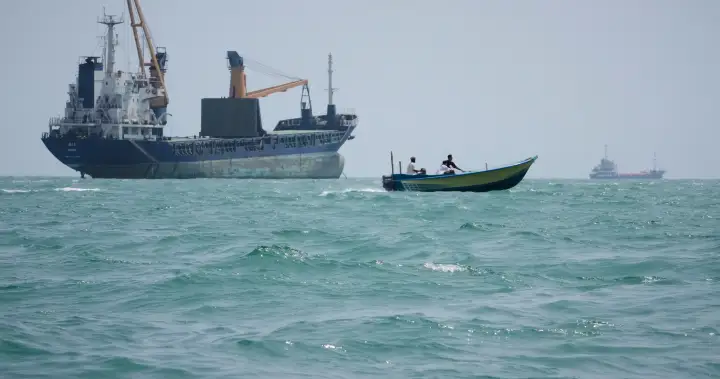
Iran said Sunday it struck an unmanned U.S. vessel trying to enter the Strait of Hormuz, a claim that the U.S. military dismissed as a “total lie.”

The purported attack came a day after the U.S. military said forces struck three Iranian oil tankers in response to Navy warships being targeted with ballistic missiles. Experts called it a dangerous escalation after Iran’s previous attacks at sea targeted commercial shipping.
The war began with U.S. and Israeli attacks on Iran on Feb. 28. But since a fragile ceasefire agreement was announced in June, on-and-off fighting has persisted, with both sides trying to inflict military and economic pain as negotiations have collapsed.
Strikes came about a week after fighting resumed
The United States and Iran resumed attacks last week, following a month of relative calm, with the Strait of Hormuz and areas along Iran’s southern coast again being targeted. At least five people were killed earlier in the week during a U.S. bombardment that returned attention to the area where a school was hit in the war’s opening strikes.
The Trump administration appears to have adopted a dual-prong approach to the conflict, responding militarily to attacks on the strait while going after foreign financial institutions that handle Iran’s money.

Get breaking National news
Get breaking Canada news delivered to your inbox as it happens so you won’t miss a trending story.
But Tehran’s hard-line new senior leaders have signaled a willingness to dig in after weathering decades of sanctions. Iran has found ways over the years to circumvent sanctions, and now a U.S. blockade of its ports, and get its oil to buyers to help ease growing economic pressures. That relies in part on a shadow fleet transporting its oil.

US says million barrels of oil a day pass through the strait
Tehran’s new leverage focuses on the Strait of Hormuz that is crucial to global oil and natural gas shipments. It was seen as an international waterway before the war began.
On Sunday, U.S. Energy Secretary Chris Wright said that on average, 9 million barrels of oil a day are getting through the strait, which should help to relieve pressure on energy prices. His estimate appeared to exceed average flows over the past 28 days through the strait, according to TankerTrackers.com and other sources.
Wright told CNN that with oil also flowing through pipelines in the region, “we’re probably two-thirds or more of pre-conflict flows.”
But those flows depend on the presence of the U.S. Navy to help escort tankers and provide some protection against possible Iranian attack. Wright said he expected that other countries would eventually support the Navy’s efforts.
Meanwhile, Iran’s nuclear program, the issue that contributed to the outbreak of the war, was meant to be addressed in negotiations that fell apart soon after the U.S. and Iran signed a memorandum of understanding in mid-June.
Diplomats say the U.S., Britain, France and Germany now seek to refer Iran to the U.N. Security Council for failure to comply with its nuclear nonproliferation obligations.
—Magdy reported from Cairo and Frankel reported from Jerusalem. Associated Press writer Konstantin Toropin in Washington and Josh Boak in Bridgewater, New Jersey, contributed to this report.
© 2026 The Canadian Press