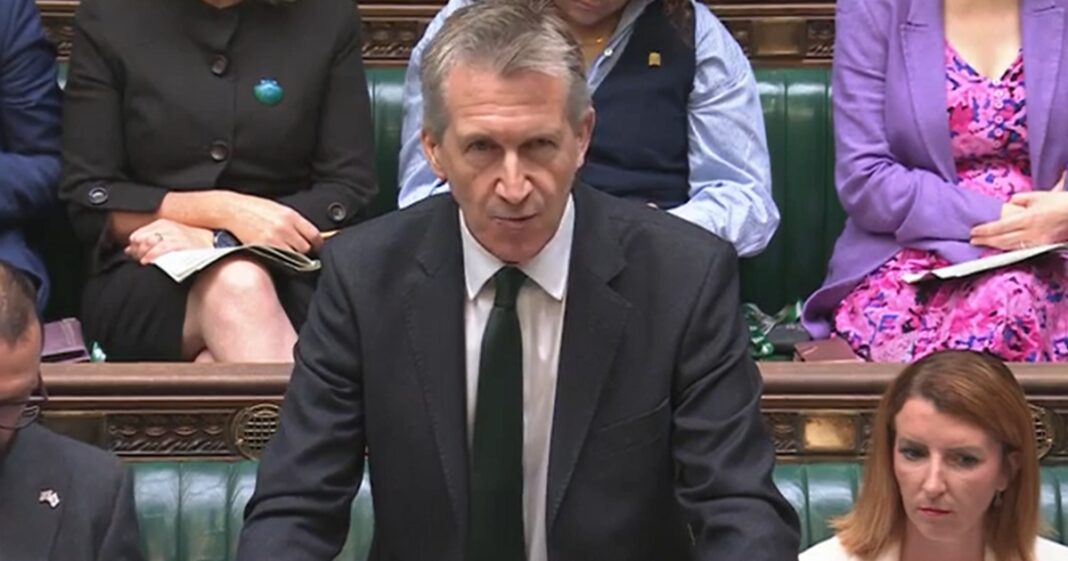

Dan Jarvis Minister of State (Security Minister) gave an update on a campaign to encourage stockpil (Image: Parliament TV)
Nine items UK households are urged to stockpile as Ministers issue fresh guidance calling on people to set aside nine essential supplies amid growing concern over potential emergencies striking Britain. The UK has weathered a succession of crises in recent years, encompassing wildfires, droughts and dangerously intense heatwaves, while anxiety mounts over foreign cyber or so-called ‘hybrid’ assaults on critical infrastructure.
Further strain is being placed on oil supplies after Saudi Arabia’s principal energy firm suspended certain deliveries to Europe following attacks on vital pipelines, with the ongoing Middle East conflict severely disrupting tanker movements through the Strait of Hormuz.
Earlier this month, Defence Secretary Wes Streeting issued an urgent warning encouraging households to stockpile nine essential items, cautioning that emergencies can arise without warning. The UK Government announced this summer that it would shortly publish a significant strategy addressing national resilience and the country’s capacity to withstand major crises.
In a recent parliamentary question, Conservative MP David Reed put it to the Minister for the Cabinet Office: “With reference to the Written Ministerial Statement of 14 July 2026 on National Resilience, on what date the national resilience public awareness campaign will launch?” Responding yesterday (21st September), Dan Jarvis, Minister of State (Security Minister), stated: “The household resilience public information campaign announced through the Annual Statement on National Resilience(opens in a new tab) is being developed by the Cabinet Office and will launch later this year.”
Liberal Democrat Adam Dance questioned the Secretary of State for Environment, Food and Rural Affairs: “What steps she is taking to improve engagement with local resilience forums on food resilience in the (a) South West and (b) UK?” Minister Stephen Morgan answered: “Defra engages with Local Resilience Forums across England, including those in the South West, through established resilience and planning arrangements. This engagement supports information sharing, preparedness and response planning for a range of risks that could affect food supply and access.”
“This Government continues to work with resilience partners at national and local level to maintain the UK’s food resilience.”
Earlier this year, Darren Jones, Chief Secretary to the Prime Minister, Chancellor of Duchy of Lancaster and Minister for Intergovernmental Relations, unveiled the key Resilience Action Plan, declaring it essential because: “Conflict in the Middle East and Russia’s war in Ukraine have exposed the vulnerabilities in global energy supply chains and driven up energy prices, and the increasing sophistication and proliferation of artificial intelligence not only brings huge opportunities, but threats too if it is weaponised by criminals against us. This could include novel ways of developing or carrying out hostile cyber-attacks against businesses and our critical infrastructure.
“As we saw with temperatures across the UK breaking records in May, only to be exceeded again in June, the risks we face from climate change cannot be underestimated, from our infrastructure, food and water systems or people’s immediate health. Climate change is also exacerbating the spread of high-consequence infectious diseases, alongside the changing boundaries of the human-animal interface.”
Later this year, he committed to releasing an Energy Resilience Strategy to bolster the robustness of Britain’s energy infrastructure, alongside a Transport Resilience Strategy, outlining how collaboration across these industries will deliver secure and dependable systems for the British public. The government is also poised to roll out a national resilience public awareness initiative later this year, designed to educate citizens about the modest yet crucial measures they can adopt to prepare for emergencies and disruption – ‘be that severe weather or a cyber attack which can impact access to power, water, phone signal or local shops to get food’.
Defence Secretary Wes Streeting said last week: “I think we do need to have a national conversation about our resilience as a country and our preparedness. And before we turn to that scenario you described of an event where this country is under attack, I would actually say let’s think about resilience today. We’ve just had a summer of wildfires across the country.
“Lots of communities across the UK will be looking to winter with trepidation about extremely cold weather or flood. And I’d ask people watching actually on a really practical level, in the event you have a power cut, would you know where you keep a torch? Have you even got matches or candles?” Emergency preparedness guidance suggests carefully considering what might be necessary during a crisis spanning multiple days, such as electricity failures or water supply disruptions, or circumstances where authorities advise remaining indoors or evacuating your property.
Specialists recommend gathering vital items together in one easily reachable place should the power fail. Keeping everything consolidated makes it considerably easier to find what you require during an emergency.
Here’s everything else you might require:
- A battery or wind-up torch – torches are safer than candles. A portable power bank for charging your mobile phone.
- A battery or wind-up radio to receive updates during a power outage – a car radio can be utilised, however, in severe weather it might be safer to stay indoors.
- Spare batteries for torches and radios and a backup battery for any medical equipment you depend on.
- A first aid kit (or some first aid supplies) including items such as waterproof plasters, bandages, a thermometer, antiseptic, eyewash solution, sterile dressings and gloves, medical tape for dressings, and tweezers.
- Hand sanitiser and wet wipes for hygiene purposes when the water supply is disrupted.
- Bottled water – there is no standard quantity for this as emergencies can vary in duration and people consume different amounts. The World Health Organisation recommends a minimum of 2.5-3 litres of drinking water per person per day for survival. 10 litres per person per day will make you more comfortable by also providing for basic cooking and hygiene needs. Additional water might be required for preparing baby formula, for medical devices, and for pets.
- Non-perishable food that doesn’t require cooking, like ready-to-eat tinned meat, fruit or vegetables (and a tin opener). As with water, the quantity you need will depend on your personal circumstances.
- Don’t overlook food for pets.
- Baby essentials such as nappies and baby formula – ready made or ready-to-feed formula is ideal as you may not have the ability to boil water or sterilise bottles.