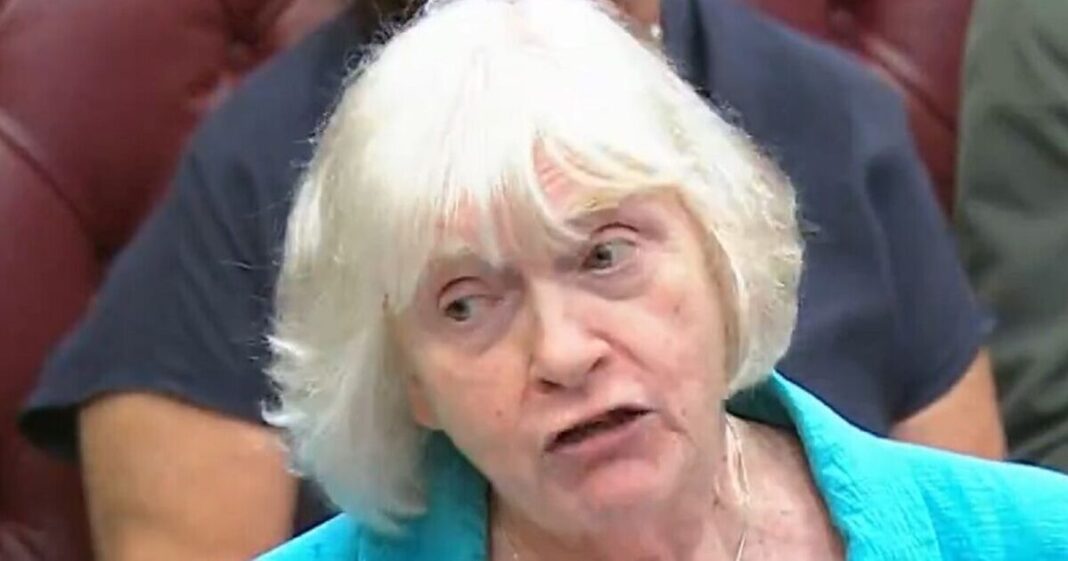

DWP minister Baroness Sherlock speaking in the House of Lords recently – file image (Image: Parliament TV)
The Department for Work and Pensions has issued a new update on the state pension age as the Government faces scrutiny over the timing of future increases. And a subtle shift in what they have said this time might get people thinking.
In July, the Office for Budgetary Responsibility surprised many when it stated in a report that “the state pension age reaches 68 between 2037 and 2039, which the Government has confirmed is its current policy position rather than the rise to 68 happening between 2044 and 2046 as is currently legislated for.”
This would mean people born between 1971 and 1977 would need to remain in employment until reaching 68.
However, pensions minister Torsten Bell subsequently dismissed the OBR’s claim in a series of messages posted on X.
“Legislation sets out that the State Pension age is due to rise to 68 in the 2040s. The previous Tory government said it wanted to bring this forward to the late 2030s – that is what this story is referring to NOT anything this govt has said.
“We have not announced any change of policy – and certainly not this specific one. There is currently a review of the State Pension age underway – that is simply because legislation (the 2014 Act) requires the Secretary of State to conduct such reviews on a fairly regular basis. If you want to see what we’ve actually said – not least about the 2011 disaster of raising the State Pension age in a rush that gave some people only 5yrs notice – you can read a the (long) evidence I gave to the Select Committee recently.”
The Treasury also said at the time: “This is untrue. The law remains to increase the state pension to 68 in 2044. In July 2025 we announced the launch of the third review of the state pension age, which is required by legislation.”

Torsten Bell, right, had previously rejected strongly the OBR claim on the state pension age rise (Image: Getty)
Under the Pensions Act 2014, the Government is obliged to examine the state pension age every six years. The most recent review commenced last year and is expected to conclude in 2028.
Additionally, the state pension age is increasing to 67 between 2026 and 2028. Looking further into the future, the state pension age is projected to reach 69 between 2073 and 2075.
On Tuesday this week, the DWP released a new statement on the matter after two additional questions being tabled in Parliament.
Lord Davies of Brixton, a Labour Life peer, asked “whether the statement in the Office of Budget Responsibility’s report Fiscal risks and sustainability, published in July, that their policy position is that the “state pension age reaches 68 between 2037 and 2039 […] rather than […] between 2044 and 2046 as is currently legislated for” is correct.”
In response, Baroness Sherlock – Minister of State (Department for Work and Pensions) – delivered a brief reply that was far less emphatic than the Treasury statement. It stopped short of branding the OBR assertion ‘untrue’ or confirming that legislation remained in place for the state pension to increase to 68 in 2044.
She stated simply: “The previous government committed to bring forward the rise in the State Pension age to 68 between 2037 and 2039. The first chance this government will have to consider this issue will be via the State Pension age Review.”
Her reply was a mere 39 words – far fewer than the much stronger 143 word response from Mr Bell.
Lord Davies also posed a further, more detailed question that asked the DWP “if their policy position is as reported by the Office of Budget Responsibility, that the state pension age will reach 68 between 2037 and 2039, when and how this confirmation was given to the OBR; when they anticipate that the necessary legislation will be introduced; what formal notice period they will give of their intention to legislate accordingly; and what publicity they intend to issue so that those affected can adjust their retirement planning accordingly.”
The Baroness did not address these extra questions and simply repeated the answer she had given to the other question. Government guidance issued this summer states that in 2025 to 2026 the government is forecast to spend £322.6 billion on the social security system in Great Britain. Total GB welfare spending is forecast to be 10.6% of GDP and 23.6% of the total amount the government spends in 2025 to 2026.
The gov.uk document noted: “Around 55% of social security expenditure goes to pensioners; in 2025-26 we will spend £177.7 billion on benefits for pensioners in GB. This includes spending on the State Pension which is forecast to be £146.1 billion in 2025 to 2026.”
In 2023, the OBR said “the state pension is the largest single item of welfare spending, forecast to make up 42 per cent of the total in 2023-24.”
The IFS highlighted in a 2023 report that the state pension is an important source of income across the income distribution, although more important for poorer households. For example, among households with someone aged 66–70 where no one is in paid work, the state pension makes up 71% of income for the poorest fifth and 23% for the richest fifth.
It noted: “Indeed, if one wanted to buy an index-linked annuity to provide a pension that was equal to the current value of the new state pension (and then price indexed) from the age of 66, then that would require an outlay of over £200,000. This is a significant sum even at the top of the income distribution.”
Claiming the state pension – new, basic and additional
You are eligible to claim the new State Pension upon reaching State Pension age if you are a man born on or after 6 April 1951 or a woman born on or after 6 April 1953.
If you were born earlier than these dates, different rules apply. Instead, you’ll receive the basic State Pension, and may also qualify for Additional State Pension.
Your State Pension amount is determined by your National Insurance record. The full rate of new State Pension stands at £241.30 per week, while the full basic State Pension is £184.90 weekly.
The Additional State Pension is paid alongside your basic State Pension.
The Additional State Pension represents an extra sum you could receive on top of your basic State Pension if you’re a man born before 6 April 1951 or a woman born before 6 April 1953. There is no fixed sum for the Additional State Pension.
For more on the state pension, including eligibility rules, visit the dedicated government web page.