Fears surrounding AI continue to grow in the modern era. The Guardianreported that workers at companies like OpenAI and Anthropic believe the technology could wipe out humanity. Samuel Marks, Anthropic’s scalable oversight lead, noted in a personal statement on X that “AI developers believe their technology could cause human extinction,” adding, “This could happen in the next few years. In general, the more senior the employee, the more concerned they are.” Within days, Anthropic CEO Dario Amodei also called for a similar slowdown, saying AIs “could be capable of taking over the entire internet” in six to 12 months. While that is terrifying enough, Sam Altman of OpenAI and Elon Musk expressed a similar need for caution (via TIME).
With AI fears at the height of global news, it’s safe to say the idea of superintelligent computers grips the cultural zeitgeist. In times like these, I like to look back at classic sci-fi films that posed similar concerns decades ago. What once felt like speculative sci-fi now presents like a potentially bleak reality. That is not to say we’re about to face Judgment Day as envisioned by James Cameron in the Terminator films, but it could mean a modern-day Skynet is slowly building strength. When it comes to classic movies about AI, people tend to think of prominent examples like HAL 9000 from 2001: A Space Odyssey (1968) turning on the crew or the machines in The Matrix (1999) enslaving humanity with a false reality. However, what if I told you one of the most terrifying futures and quotes about AI was hidden in a violent sports film that predicted modern concerns 51 years ago?
When Rollerball debuted in 1975, the movie boldly envisioned the future of 2018. The film depicts a dystopian society where massive global corporations replaced world governments after the Corporate Wars. The era of politicians has ended, with executives running the world. Corporations control food, housing, transportation, and entertainment. Even luxuries are controlled by privilege cards reserved for executives and notable athletes. There are upsides, as war, major diseases, and poverty have been wiped out. Yet these come at the expense of human freedom and controlled information.
Rollerball is a violent sport meant to entertain and appease the masses. It is a brutal mix of roller derby, football, and motorcycle racing where players routinely die during matches. A corporation controls each team, and the sport is loved worldwide, with players idolized. It is an algorithm-curated, futuristic form of gladiatorial spectacle meant to misdirect attention from society’s negative aspects. Mr. Bartholomew (John Houseman), head of the Energy Corporation, states, “The game was created to demonstrate the futility of individual effort.”
Rollerball challenges that statement by following Jonathan E. (James Caan), the sport’s top star. After 10 years as the dominant player, Bartholomew asks Jonathan to retire, which seems odd since he is having one of his best seasons. Jonathan reveals past problems, as he lost his wife when she was taken by an executive who claimed her for himself. The retirement request pushes him too far, and Jonathan seeks information about who is pulling the strings. His journey exposes harrowing truths about Rollerball, and what he uncovers about AI offers chilling commentary, often overshadowed by surface-level readings of the film’s violent sport.
‘Rollerball’s Future Is Built on Sanitized Information From a Central AI Computer

Like anyone doing in-depth research, Jonathan heads to the library but hits a roadblock. The books he requested are restricted. Audiences learn that all books have been digitized and destroyed, leaving no original record. The central, corporate-controlled artificial intelligence, Zero, sanitizes and summarizes that information. Jonathan can get the summaries of his requests, but there are no sources to verify any facts. This presents a terrifying future where information cannot be trusted, but Rollerball takes it further with a lack of accountability.
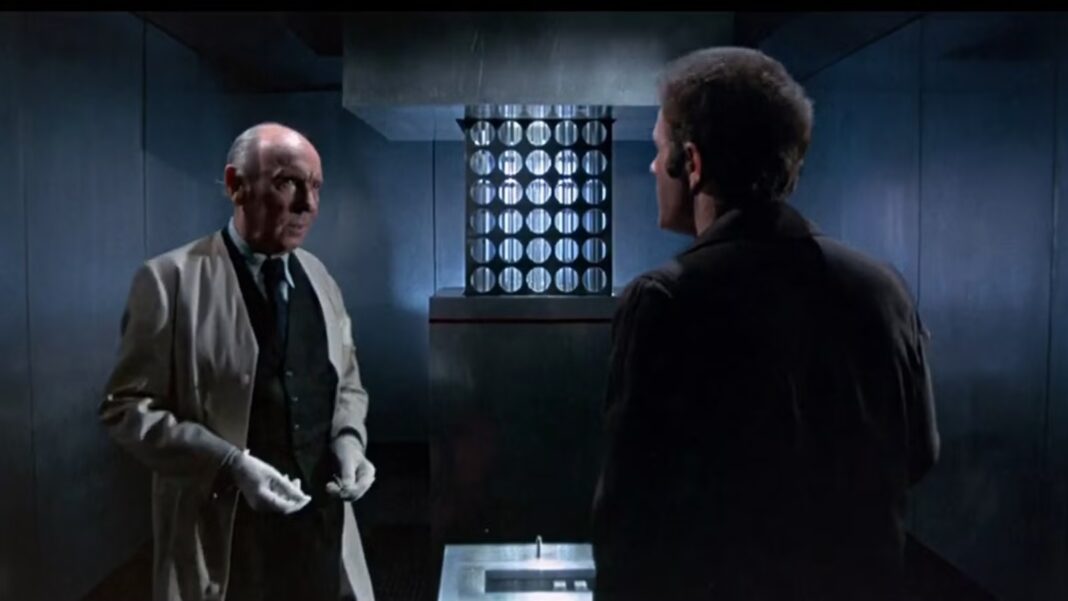
Jonathan eventually makes a trip to Geneva to speak with Zero in person. What should be an impressive hub of the world’s information feels more like a technologically advanced place spiraling toward failure due to budget cuts and neglect. Jonathan meets the librarian (Ralph Richardson), who seems to be having a bad day, saying, “It’s embarrassing to misplace things.” We’ve all misplaced things, so it’s a simple setup viewers understand, making the librarian’s overly lackadaisical response to a staggering data loss even more jarring. When Jonathan asks what has been misplaced, the librarian responds with a quote that becomes more haunting with each reading, saying:
“The whole of the 13th century. Misplaced the computers, several conventional computers. We can’t find them. We’re always moving things around, getting organized, my assistants and I. This – this is Zero’s fault – Zero, he’s the world’s file cabinet. Pity, poor old 13th century.”
‘Rollerball’s Chilling Quote Highlights the Need for AI Accountability

Malfunctioning AI and possible human error have wiped out a century’s worth of information. With all books scanned and destroyed, there is no way to recover the entire 13th century. It is lost, never to be known by future generations. The quote’s implications are already horrifying, but there’s also no accountability, as the librarian immediately blames the computer, not those who built or control it. The librarian then tries to qualify it as a minor loss, saying, “Not much in the century, just Dante and a few corrupt Popes, but it’s so distracting and annoying!”
Recent AI breaches have brought accountability to the forefront. AP News compares the situation to individual hackers being held liable while corporations escape blame. Rollerball offers a harrowing parallel as things get so bad the librarian kicks Zero like a jukebox that won’t start playing a song. This shows complete disregard for the machine’s immense power, mirroring a lack of respect in modern companies that fail to implement safeguards. One shocking aspect of Rollerball is that it predicted books being digitally scanned and destroyed 51 years ago, while data centers and AI companies are reportedly doing the same now (via CBS).
Rollerball is often dismissed as a violent sports movie, but at its core, the sci-fi story offers compelling commentary that hits harder today. The world may face the threat of digitized, sanitized information controlled by corporate interests. However, Rollerball also offers a valuable lesson in resistance. Jonathan becomes the symbol the corporations feared. He showed he had the will of the people, symbolically overthrowing corporate dominance with the resilience of the human spirit. Rollerball shows that people rallying for a single cause can change the world. Jonathan gives people a hero and hope for a better future.

- Release Date
-
June 25, 1975
- Runtime
-
125 minutes
- Director
-
Norman Jewison
- Writers
-
William Harrison
-

-

John Houseman
Bartholomew
-
-