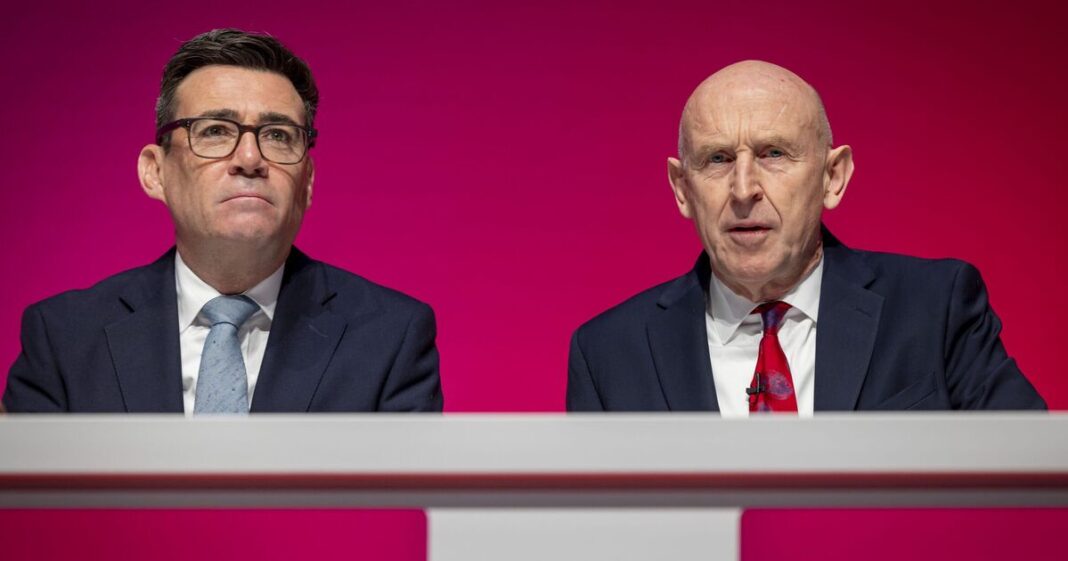
Andy Burnham has been told to freeze the State Pension and phase out defined-benefit pensions. The Chancellor, John Healey, will present his Budget on October 28, and speculation is rife as to what could be announced. The Institute of Economic Affairs (IEA), a free-market think tank, has published its “Alternative Budget”, outlining its recommendations. It said the Government should “bring rising national debt and the deficit under control by combining more sensible taxation with spending restraint”. The document added: “Welfare spending would be frozen in cash terms, with its ceiling then reduced by 0.85% annually for three years.
“The pension triple lock would be suspended and the basic State Pension would be frozen over that period.” It comes after the Prime Minister announced in his conference speech that he would adjust the triple lock in April 2030.
Under the proposed, changed model, pensions would rise by the highest of either inflation, 2.5% “or what is required to maintain its record high level against average earning”, the Work and Pensions Secretary, Pat McFadden, said earlier this month. The IEA also suggested that the Government should consider “phasing out defined benefit pensions”, which pays a guaranteed retirement income based on your salary and service.
“This would make future employer commitments more predictable, whilst transferring more investment and retirement-income risk to savers,” the think tank wrote. “Diverting contributions from unfunded schemes into individual pension pots would leave existing pensions needing replacement financing.
“Any reduction in future commitments ought to be weighed against transitional cash costs, as explained in HM Treasury’s Hutton report (Independent Public Service Pensions Commission 2011).” Mr McFadden said that reforming the triple lock is the “right answer to a difficult question”, and warned changes to the current policy were “inevitable”.
Mr McFadden told the House of Commons that, despite proposed changes to the triple lock, “pensioner poverty is set to fall” under the Government’s overall plan. He also said the Pensions Commission, a Government-backed body set up to look at retirement outcomes, had been tasked with exploring ways of “further supporting lower-income pensioners”.
The state pension is currently guaranteed to rise by either average wage growth, consumer price index inflation (CPI) or 2.5%, whichever is highest. “This year, the full new state pension is rising by £575,” Mr McFadden said.
“It is set to be over £2,000 a year more by the end of this Parliament compared to when we took office in 2024. That will take the new state pension to over 30% of average earnings by the end of the Parliament (in 2029) – this is forecast to be a record high.”