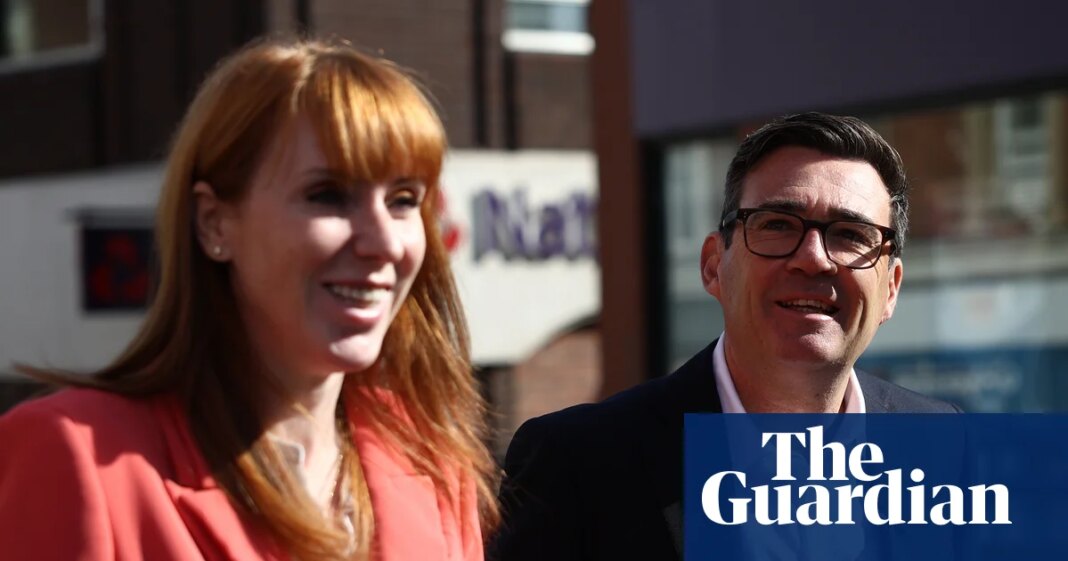
Andy Burnham’s call for the UK to consider a return to free movement with Europe has been backed by senior cabinet ministers but risked a rift with “red wall” Labour MPs, who say it could jeopardise Brexit-voting seats.
The prime minister made his plea for an “honest discussion” about freedom of movement in an interview with the Sunday Times, making clear that staying out of it would no longer be a red line in talks with the EU.
Burnham also revealed his belief that rejoining the single market and accepting free movement could be done without the need for another referendum, if Labour put it in their manifesto. In contrast, he said fully rejoining would need another in-out poll.
The prime minister said: “Freedom of movement had very significant challenges associated with it and I spoke about them in my previous time in parliament. But, at the same time, it was a type of immigration that perhaps wasn’t as difficult [as now].
“Revolving-door migration where people would come and then go back is different. The balance of migration has changed, hasn’t it, since then? I think we’ve just got to have an honest discussion about those things.”
His remarks were supported by Angela Rayner, the housing secretary, as well as Stella Creasy, the chair of the Labour Movement for Europe. However, Shabana Mahmood, the home secretary, is among those Labour MPs who have previously been more cautious about closer ties with Europe, while a number of backbenchers with heavily pro-Brexit seats in the north and Midlands are wary about reopening the arguments for free movement or rejoining the EU.
Rayner told the BBC’s Sunday with Laura Kuenssberg she would “like to have an honest conversation about what the trade-offs could be, and then put that to the people at a general election”, and Creasy, the Labour MP for Walthamstow, said Burnham was right that the UK was “long overdue for a grownup conversation about what EU freedom of movement actually means”.
A number of senior cabinet ministers are keen for the UK to form a much closer relationship with the EU to help boost growth, potentially involving a return to the single market and accepting free movement as a result. Those in favour of reopening the discussion include Ed Miliband, the foreign secretary.
At a New Statesman event during the Labour party conference in September, however, Mahmood said rejoining the EU would not be a “simple, straightforward thing” and there were “quite hard trade-offs”, such as eliminating trade friction without “some of the burdens that also brings”.
One senior minister under Keir Starmer said the reopening of the debate on free movement was “brave” given how divisive it had been in the Brexit years. “It’s a question of timing. Public opinion is of a place where you can start to have this debate,” he said. “Theresa May, Rishi Sunak, Keir Starmer: what they were all trying to do was get as close as possible without freedom of movement. There is now the a possibility of being brave and making the case on single market and free movement without going for rejoin.”
Labour MPs with pro-Brexit seats have expressed scepticism about rejoining the bloc, including Jonathan Hinder, the MP for Pendle, who recently pressed the prime minister in parliament to rule out a return to free movement.
One red wall MP said they thought debating free movement was the right thing to do but many colleagues in the north-east, especially in coastal areas, had begun to raise serious concerns. “These MPs are definitely raising the alarm,” they said. “Andy may have to work out if he can win without them, which is brutal but true.” Another Labour MP from a Brexit-voting area said it would “undoubtedly put seats at risk to Reform” but that Burnham was making an argument from a position of strength, having taken the party to higher poll ratings in recent weeks.
Worries were brought up publicly on Sunday by Richard Walker, the Labour peer and executive chair of Iceland, who told Times Radio that restarting the debate would be a “dangerous precedent” and that opening the borders would not help the “1 million young people that are out of work”.
In his party conference speech last month, Burnham fired the starting gun on the argument about rejoining the EU as one potential route, but his latest comments suggest he appears to be favouring the option that would avoid a referendum.
Although Labour’s manifesto pledges no return to free movement and the single market, Burnham signalled it could still be up for discussion at next month’s EU summit.
Burnham’s comments at the weekend drew an immediate response from the right of politics, with the Conservatives and Reform UK criticising the idea of reopening the debate. Kemi Badenoch, the Conservative leader, said the idea of reopening free movement was “another example of Burnham’s foot-in-mouth syndrome”.
Nigel Farage, the Reform UK leader, called it a “total betrayal of Brexit Britain and his Makerfield pitch”.
“He is also deluded to say immigration was different when we were members of the EU. We will fight this dishonesty,” he added.
Polling suggests voters in the UK are increasingly open to rejoining the EU or a single market arrangement involving free movement. The concept of free movement was that British and EU citizens could move more freely for jobs within the bloc, which also shared a single market for goods and services.
Luke Tryl, a polling and focus groups expert at the More in Common thinktank, said on Sunday that people tended to be less concerned about free movement given years of high non-EU migration but would be more exercised about EU budget contributions or joining the euro.
During the Brexit referendum, the topic was hotly debated, with the leave campaign arguing that the UK would be able to take control of its borders if it voted to exit the EU. However, in the years that followed, net migration rose to a peak of 944,000 in the year ending March 2023 under a new points-based system, up from 330,000 before the Brexit vote.
Burnham’s decision to open the debate on free movement was welcomed by some businesses, which have grown frustrated at the lack of progress on the issue, and on reducing the extra paperwork required to do business with EU customers since Brexit – both seen as obstacles to faster economic growth.
The British Chambers of Commerce lobby group called for the Treasury to analyse the various economic options for different forms of EU-UK relationships. Most economic studies have concluded that a closer EU relationship would benefit the UK economy.
William Bain, head of trade policy at the BCC, said the common understanding strategy agreed by Keir Starmer in May 2025 was “approaching the ceiling of what can be achieved”.
This week’s budget is expected to underscore the damage to the economy from Brexit, including from a drop in net migration. The Resolution Foundation, a thinktank, said that if migration falls by 300,000 over the next five years it would translate to a hit to government tax revenues of £4.7bn in 2029-30, reducing chancellor John Healey’s room for manoeuvre.
The Institute for Fiscal Studies, another thinktank, estimated that lower net migration estimates would reduce the chancellor’s “headroom” by between £1bn and £5bn by 2031-32, depending on how the government’s Office for Budget Responsibility (OBR) chooses to model the expected reductions in population.
The OBR has previously estimated that Brexit barriers to trade and free movement have caused a long-term hit of about 4% of UK output.