The EU is a constantly evolving institution. The rules keep changing and, since Britain is destined by geography to want a close economic relationship with the bloc, there will always be something to negotiate in Brussels.
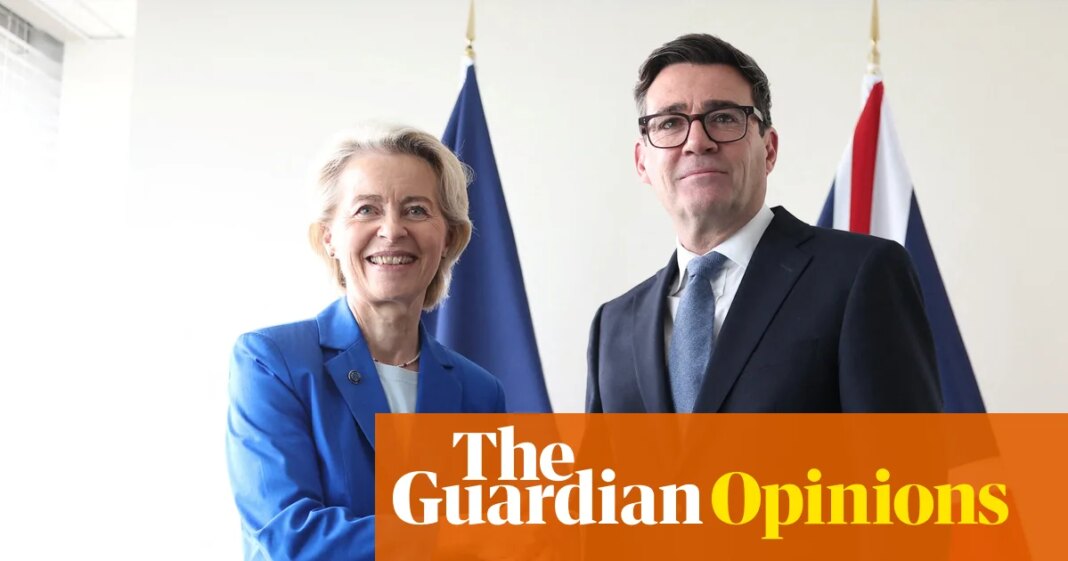
Most of those discussions over the past two years have been uncontroversial, except in the eyes of dogmatic Eurosceptics. That doesn’t mean the talks have been easy. They never are with a club of 27 nations. But later this month, at a summit with the EU commission president, Ursula von der Leyen, Andy Burnham is expected to complete a treaty covering closer cooperation in a wide range of areas, including elimination of customs barriers to agricultural goods, a youth-mobility programme and integration with the EU’s carbon emissions trading scheme.
The agenda was set by Sir Keir Starmer as part of his intended “reset” of EU relations. Mr Burnham has since pledged to move further and faster towards closer ties, although he remains bound by his predecessor’s manifesto prohibition on membership of the single market and customs union this side of a general election.
What the prime minister can achieve in that space will be determined partly by his judgment of what domestic public opinion will allow, but more immediately by the terms of the European Commission’s proposed Industrial Accelerator Act. This legislative package, more commonly called “Made in Europe”, mobilises public procurement rules to insulate continental industries from what many EU political leaders see as unfair overseas competition – chiefly from China. Industrial policy and protectionism on such a scale is a symptom of the way a once-globalised trading system has in recent years fractured into rivalry between continental blocs. China’s colossal trade surplus, causing panic among European car manufacturers, for example, is one side of that story. Donald Trump’s capricious tariff wars are another.
Britain looks perilously isolated in such a world, which is why Mr Burnham is keen to find some accommodation within the Made in Europe regime. That isn’t straightforward, given that the essential purpose of the new rules will be to benefit enterprises in the single market to the deliberate disadvantage of those on the outside, which includes Brexit Britain. Some compromise is available, with the UK recognised as a “trusted partner”, but that status won’t be accorded simply as a reward for pro-European vibes from Labour. Mr Burnham’s declarations of strategic intent are helpful, but there will be a lot of hard bargaining ahead on the terms of a deal. Without one, Britain’s carmaker and other industries would face crippling new trade barriers.
For that reason, the “Made in Europe” question has shot up the government’s agenda. The Eurosceptic opposition parties, meanwhile, are silent on the subject. To acknowledge the existence of a problem would mean recognising Britain’s disadvantaged status outside the single market, which is a refutation of the founding case for Brexit. Mr Burnham will not find it easy to negotiate the next stage of Britain’s reintegration with the EU, but those who resist his direction of travel will find it ever harder to pretend there is any alternative.
-
Do you have an opinion on the issues raised in this article? If you would like to submit a response of up to 300 words by email to be considered for publication in our letters section, please click here.