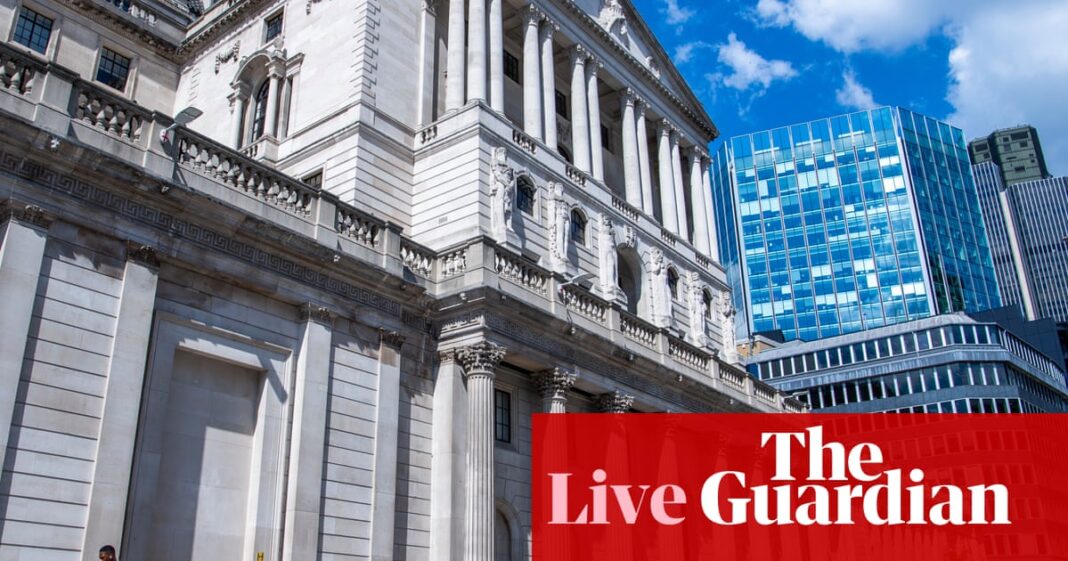
Bank of England policymaker plays down inflation concerns
Closer to home, a member of the Bank of England’s monetary policy committee (MPC) has played down inflation risk and renewed his call for lower interest rates in Britain.
Speaking to the Financial Times, Alan Taylor said the current rise in inflation is being driven by one-off factors and stressed the potential negative impact that Trump’s trade war could have on economic growth.
Taylor last voted for a half-point reduction in interest rates this month. When asked whether he would back a rate cut at the next meeting in June, he told the FT:
I’m not going to pre-emptively announce my vote, but I think I indicated in my dissent that I thought we needed to be on a lower [monetary] policy path.
I’m seeing more risk piling up on the downside scenario because of global developments…[the impact of Trump’s tariffs on imports would] be building up over the rest of this year in terms of trade diversion and drag on growth.
Earlier this month the MPC lowered rates by 25 basis points to 4.25%, taking it to the lowest level since 2023.
Taylor told the FT that while inflation had been “very strong” in April, the 3.5% reading was heavily affected by anticipated rises such as the energy price cap and regulated water bills. He said:
[The BoE] forecast path is saying there is going to be an inflation hump and then it’s going to go away….[Higher inflation] is not coming from demand and supply pressures; for the most part, it’s coming out of one-time tax and administered price changes.
Key events
Elsewhere this morning, official figures from Sweden showed its economy unexpectedly contracted in the first quarter of the year.
Gross domestic product shrank 0.2% in the three months ended in March compared from the previous quarter. Analysts had expected a 0.1% gain.
The Swedish statistics office said the fall was mainly due to investments in buildings and constructions. Household consumption also fell.
The Riksbank, Sweden’s central bank, left its benchmark rate unchanged at 2.25% earlier this month, although it suggested that lower growth this year could open the door to a rate cut, assuming that inflation continued to ease.
UK business confidence rebounds to nine-month high
Businesses are feeling more confident again, according to a poll by Lloyds Bank.
Its survey found that business confidence bounced back in May, rising by 11 points to 50%. That offset a 10-point decline in April and marked the highest score in nine months.
The increase was driven by a boost in economic optimism, which rose 16 points. Lloyds attributed the rise to a recovery in global financial markets after Trump paused his “reciprocal tariffs” until July.
Hann-Ju Ho, a senior economist at Lloyds Commercial Banking, said:
Equally as encouragingly is the fact that trading prospects, wage expectations and hiring intentions also saw improvements this month. The positive trends in these metrics are important signals for potential growth and resilience in the business community and the wider economy. While we know that fluctuations do occur month on month and the global economic outlook remains uncertain, this month’s increase in confidence is an encouraging sign.
Of the 1,200 British companies polled by Lloyds, 34% said they were planning to increase staff pay by at least 3%. It found that 65% of respondents said they were expecting to raise their prices in the next 12 months.
The asset manager and life insurer M&G is the best performer in the FTSE 100 today, with its shares rising by as much as 6% after it announced a new partnership with the Japanese insurer Dai-ichi Life Holdings.
As part of the partnership, the Japanese company plans to buy a 15% stake in the business, in a move that will make it M&G’s biggest single shareholder.
Richard Hunter, of the broker Interactive Investor, says it is another “show of strength” for the FTSE 100, which has been relatively strong this year despite the global turmoil. He said:
The index is now ahead by 7.1% in the year to date, bolstered by an additional 3.4% in average dividend yield, with the recent record high now just 1.4% away. Such proximity to the record level could well leave investors interested in chasing the index, which would represent a positive self-fulfilling outcome.
Three firms fined £8m by Ofgem over gas leak callout failings
The energy regulator has fined three companies £8m for failing to respond to some gas leak emergencies quickly enough, potentially putting the public at “serious risk”.
Ofgem said the three firms – Cadent Gas, Scotland Gas Networks (SGN Scotland) and Southern Gas Networks (SGN Southern) – had agreed to pay the fine after missing callout targets that require them to attend suspected gas leaks within one to two hours in 97% of cases.
An investigation by the regulator found all three had fallen short of that target between 2022 and 2023. The cash from the fines will go towards Ofgem’s voluntary redress fund, which provides money for projects that support vulnerable energy consumers.
Ofgem’s director of market oversight and enforcement, Cathryn Scott, said:
The potential risk to households and businesses if gas leaks aren’t investigated quickly is significant, so it’s right that the companies involved have acknowledged the seriousness of missing these targets.
We’re confident the companies have improved their systems and processes to make sure this doesn’t happen again and have demonstrated their commitment to this by meeting their targets in the two years since the breach.
The regulator said it opened an investigation into the companies after they self-reported missing their targets.
SGN Southern has received the biggest penalty, at £5.8m. Cadent will pay out £1.5m, while SGN Scotland will pay £700,000.
European stocks tick up after court pauses block on tariffs
European markets have opened slightly higher on Friday as investors digest news that an appeals court has agreed to temporarily pause the block on Trump’s trade tariffs.
The European Stoxx 600 nudged up 0.1% in early trading, with Britain’s FTSE 100 blue chip index up 0.3%. The German Dax index nudged up 0.3%, although France’s Cac 40 slipped slightly by 0.05%.
Investors will be watching Germany closely today as they await inflation data from Europe’s biggest economy this afternoon.
In the meantime, new figures this morning show that German retail sales fell by 1.1% in April compared with the previous month. That compares with an expected 0.2% increase, according to a poll of analysts by Reuters.
The German 10-year government bond yield, the benchmark for the euro area, is down one basis point at 2.504%, its lowest point in three weeks.
Bank of England policymaker plays down inflation concerns
Closer to home, a member of the Bank of England’s monetary policy committee (MPC) has played down inflation risk and renewed his call for lower interest rates in Britain.
Speaking to the Financial Times, Alan Taylor said the current rise in inflation is being driven by one-off factors and stressed the potential negative impact that Trump’s trade war could have on economic growth.
Taylor last voted for a half-point reduction in interest rates this month. When asked whether he would back a rate cut at the next meeting in June, he told the FT:
I’m not going to pre-emptively announce my vote, but I think I indicated in my dissent that I thought we needed to be on a lower [monetary] policy path.
I’m seeing more risk piling up on the downside scenario because of global developments…[the impact of Trump’s tariffs on imports would] be building up over the rest of this year in terms of trade diversion and drag on growth.
Earlier this month the MPC lowered rates by 25 basis points to 4.25%, taking it to the lowest level since 2023.
Taylor told the FT that while inflation had been “very strong” in April, the 3.5% reading was heavily affected by anticipated rises such as the energy price cap and regulated water bills. He said:
[The BoE] forecast path is saying there is going to be an inflation hump and then it’s going to go away….[Higher inflation] is not coming from demand and supply pressures; for the most part, it’s coming out of one-time tax and administered price changes.
Peter Navarro says Trump will find a way to impose tariffs
Trump’s chief adviser told reporters last night that the administration will “respond forcefully” to the US trade court’s ruling on the tariffs and that it plans to “fight this all the way up the chain”.
Speaking outside the White House, he said:
You can assume even if we lose, we will do it another way.
Introduction: Asian stocks fall after tariffs reinstated
News that a federal court had blocked most of Donald Trump’s sweeping trade tariffs helped stock markets rise yesterday. But now that an appeals court has agreed to a temporary pause in the decision, stocks are starting to fall again.
In Tokyo, the Nikkei index dropped 1.1%, while Hong Kong’s Hang Seng fell 1.5%. The mainland Chinese index the SSE Composite fell 0.3%, while South Korea’s Kospi fell 0.9%.
The US dollar has been shaky too, and is now heading for its fifth consecutive monthly decline as investors brace for more uncertainty around trade.
Trump said on Thursday he hoped the Supreme Court would overturn the trade court’s decision, while White House officials have suggested he could pursue other presidential powers to make sure that tariffs take effect.
Despite the uncertainty around Trump’s tariff regime, the White House says that negotiations with its top trading partners continue. Treasury Secretary Scott Bessent said in an interview with Fox News that he is scheduled to have talks with a high-level Japanese delegation later on Friday in Washington.
Trump had already paused his “Liberation Day” tariff rates on most trade partners for 90 days to July 9 and set a baseline rate of 10% in the meantime while they negotiate new deals.
Earlier this month the US and the UK confirmed they had agreed a trade deal, but no legal text exists yet to bring the concessions into force. The UK has said it wants to accelerate negotiations to conclude the deal with the US. The business secretary, Jonathan Reynolds, is expected to meet US commerce secretary Howard Lutnick at a meeting of the OECD in Paris next Tuesday.
The agenda
-
1PM BST: German inflation data
-
1:30PM BST: US PCE (Inflation measure)
-
3PM BST: University of Michigan’s consumer sentiment survey