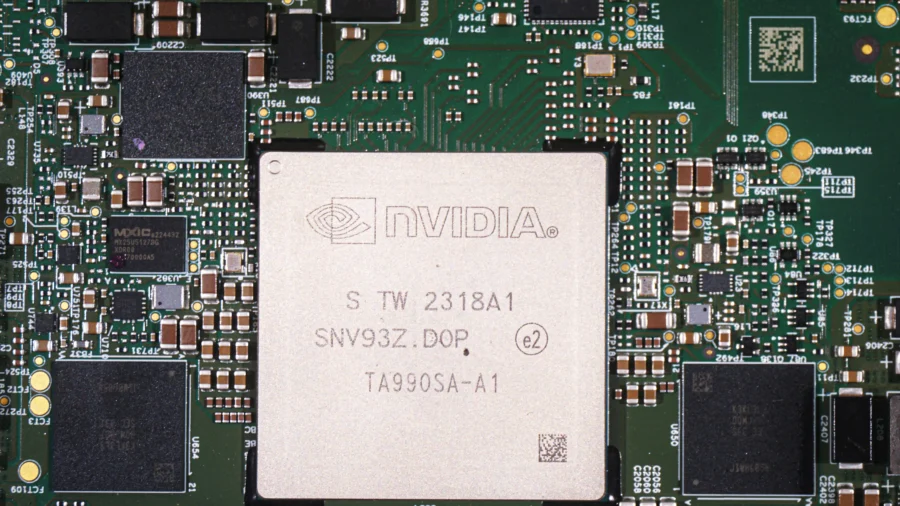
A Chinese university with close ties to the country’s military has recently purchased two of Nvidia’s H200 artificial intelligence chips, despite being on a U.S. export blacklist.
Northwestern Polytechnical University, one of China’s “Seven Sons of National Defense”—seven prominent universities with close ties to the country’s defense industry and military research—paid 874,700 yuan (about $123,000) for the two chips, according to a procurement notice dated Oct. 21 on the university’s website.
The listed supplier was Shaanxi Bosuan Network Technology Co., not Nvidia. The notice did not say whether the chips had been delivered.
The university, based in Xi’an, conducts research related to military aircraft, missiles, and satellites. Its close ties to China’s defense industry have made it a focus of U.S. export-control restrictions.
In January, the university’s School of Cybersecurity published two other procurement notices for servers equipped with eight H200 chips each. The school rented the servers from a Shenzhen-based supplier for seven months, paying 441,700 yuan (about $66,200) and 441,000 yuan (about $66,100), respectively. The services were intended for AI model fine-tuning and reinforcement learning.
Chinese Universities Continue to Seek Restricted Chips
Northwestern Polytechnical University is among dozens of Chinese entities that have reportedly bypassed U.S. sanctions to obtain restricted chips.
A Reuters review of 26 Chinese procurement and corporate records from this year found that multiple universities had purchased restricted chips through domestic suppliers or rented computing services using such chips. Some of the institutions have close ties to China’s defense industry.
Procurement records, according to Reuters, showed that Shenzhen University and Beihang University (a member of the Seven Sons of National Defense) purchased Nvidia H100 and A800 chips, respectively, while Wuhan University of Technology acquired H100-equipped servers and A100 chips. The University of Chinese Academy of Sciences also sought computing services using Nvidia H800 and A800 chips.
The records did not identify the chips’ original sources or the locations of the servers, nor did they establish whether the equipment was delivered or whether any transactions violated U.S. export laws.
Reuters has previously reported on an underground market in China for restricted Nvidia chips, supplied through overseas inventories and intermediaries in third countries.
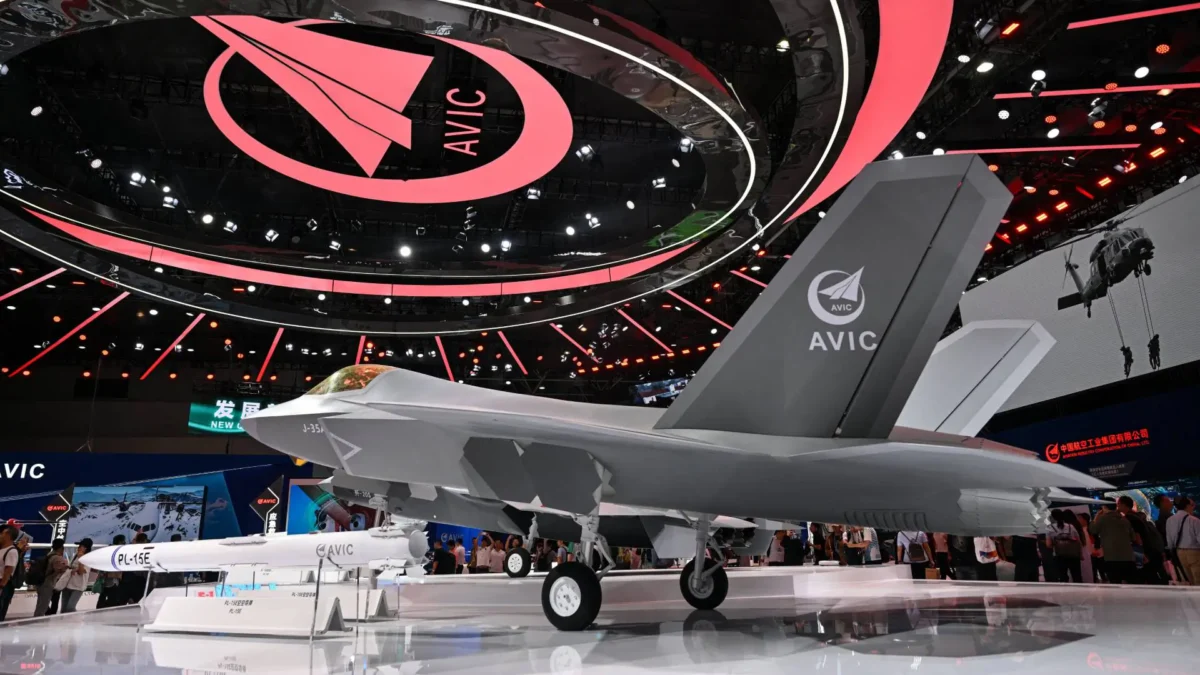
A model of a Chinese-made J-35A stealth fighter at an AVIC (China Aviation Industry Corporation) stand during the 15th China International Aviation and Aerospace Exhibition in Zhuhai, China, on Nov. 14, 2024. Hector Retamal/AFP via Getty Images
Cheung helped Bloomberg identify the links between Chinese universities, military, and China’s defense industry for its June 1 report, which said at least seven Chinese universities with military ties, including Beihang University and Northwestern Polytechnical University—both members of the “Seven Sons of National Defense”—were seeking access to Nvidia’s H200 chips. More than 25 other research institutions were also using or seeking access to other Nvidia chips, according to Bloomberg.
Cheung is also a fellow at several research organizations and specializes in Chinese politics, cross-strait relations, and emerging technologies, particularly AI, semiconductors, and other dual-use technologies.
While these insititutions seeking to purchase the chips does not necessarily means the institutions actually obtained them, Cheung believed that those records show that Chinese research institutions linked to the military still have a clear demand for advanced U.S. AI chips, and that the Chinese military’s need for U.S. AI technology may be more concrete than many realize.
Washington Should Focus on Broader Intelligence Risks: Researcher
Cheung urged Washington to investigate the flow of Nvidia chips into China and potential national-security risks involving Nvidia CEO Jensen Huang. However, Cheung believed that the current public discussion focused too narrowly on whether company secrets might have been leaked.
From an intelligence perspective, he said, investigators should also assess the information that Huang could access through his contacts with U.S. government officials, members of Congress, and executives of major global technology companies.
Such information could include the Trump administration’s thinking on export controls, Washington’s assessment of U.S.-China technology competition, and business leaders’ views on China and Taiwan. If Chinese intelligence were able to obtain these insights through people close to Huang, Cheung said, they could be valuable to Beijing.
“More importantly, investigators should examine whether sustained contact [with the alleged Chinese spy] could influence Huang’s own judgment,” Cheung said.
He cited questions such as how Huang views Taiwan’s security, the threat China poses to U.S. technology companies, and the impact of restrictions on chip exports to China.
That said, there was no evidence Huang had deliberately disclosed confidential information to China, according to Cheung in his Monday post, and a personal relationship alone did not establish wrongdoing.
Cheung also urged Washington to scrutinize end users, third-party procurement, and cloud-computing channels more closely, and to avoid relying too heavily on technology companies’ own assurances when setting export policies.
“When a company’s CEO can directly influence the White House’s technology policy toward China, and that company’s chips are resources that Chinese military AI researchers have been seeking to obtain, Congress has a responsibility to get to the bottom of these issues,” Cheung wrote.
He added that Nvidia, as one of the world’s most influential technology companies, has “a responsibility to do more to prevent its advanced chips from reaching China and strengthening the country’s AI capabilities and the PLA’s efforts to develop capabilities of ‘intelligentized warfare.'”
Reuters, Chen Ting, and Lin Yan contributed to this report.