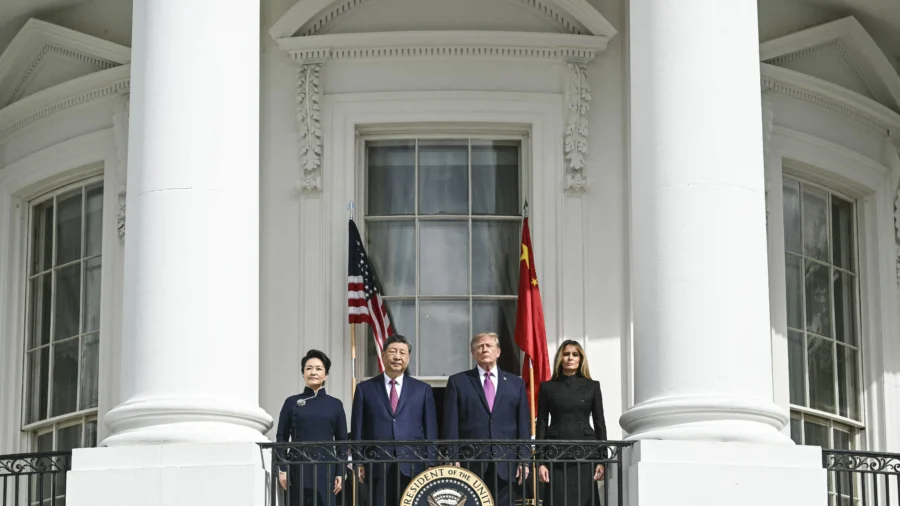
Chinese Communist Party (CCP) leader Xi Jinping has doubled the scale of a program inviting American young people to China over the next five years—a proposal that critics say raises questions about political influence, academic freedom, and the security of American students.
Xi made the announcement on Sept. 24 during a welcome ceremony at the White House, saying Beijing would invite 100,000 American young people to China for exchanges and study over the next five years.
Xi’s announcement was published on the same day on the official website of the China Education Association for International Exchange (CEAIE), the top watchdog that oversees the execution of these programs.
This new initiative builds on Xi’s 2023 pledge to invite 50,000 American youth to China over five years, which was implemented in part through the Young Envoys Scholarship (YES) program, administered by CEAIE. Programs include university exchanges, short-term visits, summer schools and camps, youth forums, and other educational and cultural activities.
Critics Warn of CCP Influence
Critics of the program have raised concerns that educational exchanges could also provide Beijing with an opportunity to shape American students’ favorable views of the Chinese regime.
“But if some people should go, let the DSA members and let them see the Uyghur concentration camps and poor rural villages. Let them speak to the political prisoners. And let them visit and meet Hong Kongers,” wrote Martino on X.
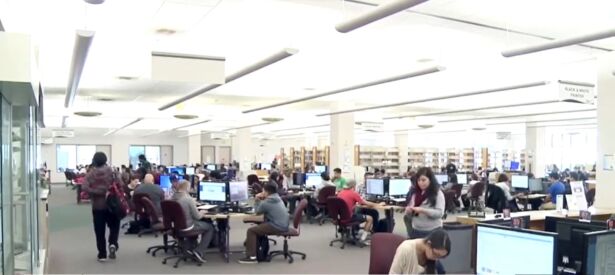
A CCP-controlled Confucius classroom operating inside an Oklahoma High School. Screenshot via NTD
Defending Education said the YES program is run by CEAIE, whose Chinese-language website states that the association is guided by Marxism-Leninism and Xi Jinping thought and integrates the CCP’s work into its operations.
NTD’s own search finds that CEAIE’s Chinese-language website has a category titled “Party building,” with publications linked to events and studies of communist theory organized by the party branches established within the organization. Its English-language website does not have these contents, an apparent effort to cover up the CCP’s influence and control of the organization.
Scholar Warns Students Could Become ‘Hostages’
Isaac Stone Fish, a visiting fellow at the Atlantic Council who previously lived and studied in China and majored in Chinese literature, said he would no longer recommend that American students follow the same path.
Fish also questioned whether American universities can maintain the same academic standards and freedom in programs operated in China.
“I’d feel better about Americans studying there if universities were more honest and transparent about the sacrifices they make to stay in China, and the benefits of those sacrifices,” he wrote.
“If tensions worsen between the United States and China, those students could effectively function as hostages,” he added.
Lawmaker Raises Detention Concerns
Rep. Ami Bera (D-Calif.), co-chair of the Congressional International Exchanges Caucus, said he welcomed educational exchanges but stressed that they depend on “trust” and participants being able to “study, speak, and engage without fear of harassment or arbitrary detention.”
Bera urged Xi to release Min Zin and said “Beijing continues to target scholars, human rights advocates, and diaspora communities whose work or speech it finds unwelcome.”
FBI Cites Risks of Foreign Intelligence Recruitment
Concerns over American students studying in China also intersect with U.S. counterintelligence warnings.
After graduating, Shriver returned to China, where Chinese intelligence officers cultivated a relationship with him and eventually paid him $70,000 to seek employment with the U.S. government, including the State Department and CIA, according to the FBI. His objective was to gain access to classified information and provide it to Chinese intelligence officers.
Shriver was arrested in 2010 and pleaded guilty to conspiring to provide national-defense information to Chinese intelligence officers. He was sentenced to four years in federal prison.
Zhang Ting contributed to this report.