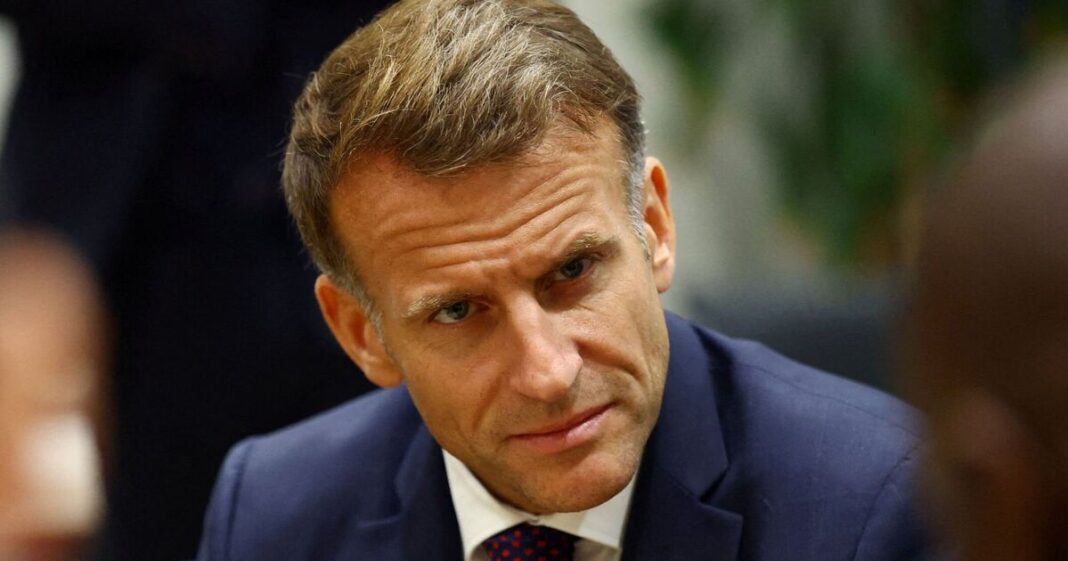

French President Emmanuel Macron (Image: Getty)
Christine Lagarde has been accused of quitting early to stop Marine Le Pen from influencing her successor, as an expert warns France has surrendered control of its finances. Bob Lyddon, writing for Britain Unbound, claimed the timing of Ms Lagarde’s departure would ensure Emmanuel Macron gets a say in choosing the next European Central Bank (ECB) president before France goes to the polls in 2027.
He warned that France was now in a position where its economic future was increasingly determined by unelected European institutions, leaving voters with little control over decisions affecting their country. Ms Lagarde announced on Thursday that she would leave her position on February 7, 2027, rather than completing her existing mandate, which was due to run until October that year.
Tax consultant Mr Lyddon suggested the move would ensure Mr Macron, rather than a potential President Le Pen, was France’s representative in discussions over the appointment.
He said: “Mme Lagarde’s early departure from leading the ECB is linked to the situation in France, on the face of it to ensure that it is President Macron who is the discussion partner for appointing Mme Lagarde’s successor, and not Marine Le Pen.”
He described the circumstances as a “shabby manoeuvre”, arguing that French voters were being denied the opportunity to have a future president influence the appointment.
Andy Burnham welcomes Emmanuel Macron to Downing Street

Christine Lagarde is stepping down from her job (Image: Getty)
He said: “This shabby manoeuvre says it all about the EU’s being a democracy, and demonstrates the degree to which matters of importance to French voters have been placed beyond their control by the Eurocracy.”
Mr Lyddon also raised the possibility that Ms Lagarde’s departure could be connected to disagreements over how the ECB should respond to France’s deteriorating financial position.

Marine Le Pen is poised to challenge Mr Macron again for the French presidency (Image: Getty)
He questioned whether she had wanted the bank to activate its Transmission Protection Instrument (TPI), which allows it to purchase government bonds to counter disorderly market conditions, potentially including French debt.
There is no evidence that such a disagreement prompted her departure.
He also suggested Ms Lagarde might be considering a run for the French presidency herself, or could be brought into the French government in a ministerial role to oversee a restructuring of the country’s debt.
Ms Lagarde has not indicated that either is her intention.
The financial pressure facing France is nevertheless becoming increasingly serious.
Pieter Cleppe, a European policy analyst, said France was now paying more to borrow than Italy, despite Italy having traditionally been regarded as the weaker borrower.
Our community members are treated to special offers, promotions, and adverts from us and our partners. You can check out at any time. Read our Privacy Policy
France’s ten-year government bond yield has exceeded 5%, increasing the cost of servicing its enormous national debt.
Mr Cleppe said: “An imminent default is not likely. France still manages to sell its debt.
“The greater risk is that France will continue to pay more and more interest rates, which stifles growth and progress, therefore causing unrest in society.”
He warned that the deteriorating economic situation was adding to existing social tensions in the country.
Mr Cleppe also criticised Ms Lagarde’s record at the ECB, arguing that she had continued policies which supported heavily indebted European governments through low interest rates and bond purchases.
He said she had also undermined the principle that central banks should remain politically independent by making public statements on climate policy and other issues.
Mr Lyddon argued that France’s membership of the eurozone had left it without control over key monetary powers, including interest rates, money supply and the value of its currency.
Those powers rest with the ECB, leaving the French government largely dependent on taxation and borrowing to manage its finances.
He said France had surrendered its monetary sovereignty, leaving it with little choice beyond raising or cutting taxes and increasing or reducing debt.
Meanwhile, attention is already turning to who will replace Ms Lagarde.
Among the leading potential candidates are former Dutch central bank governor Klaas Knot and former Bank of Spain governor Pablo Hernandez de Cos, who now heads the Bank for International Settlements.
Mr Cleppe described Mr Knot as the more hawkish of the two, although he questioned whether either candidate would fundamentally change the ECB’s approach to supporting heavily indebted European governments.
The timing of the appointment has consequently become a major political issue, with the French presidential election due in 2027 and Mr Macron unable to seek another consecutive term.
For Mr Lyddon, the circumstances surrounding Ms Lagarde’s departure expose the extent to which decisions affecting French voters have been transferred beyond their control.
He argued that the ECB and other European institutions now hold powers that should belong to the French people, leaving them increasingly powerless over their country’s economic future.