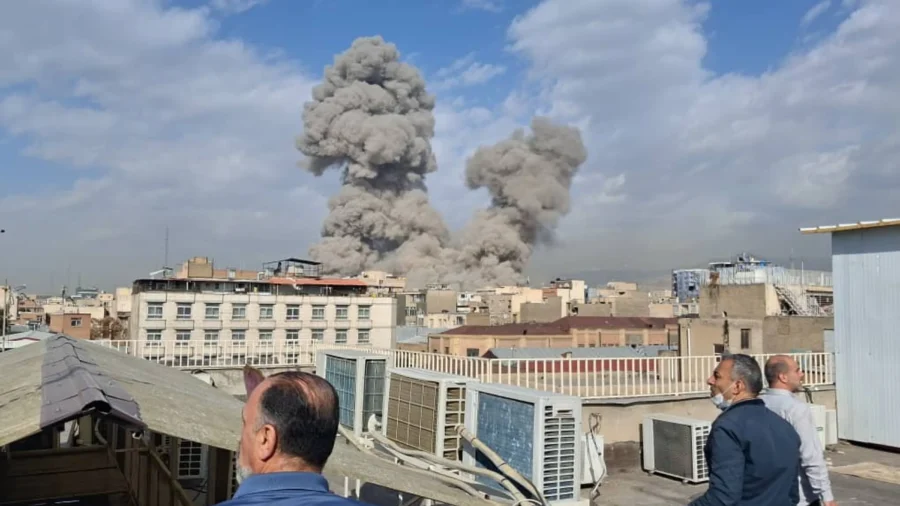
Iranian leader Ali Khamenei and other high ranking military figures were killed in U.S.–Israel airstrikes on Iran. U.S. and Israeli authorities said Feb. 28. Iranian state media later confirmed the death.
Operation Epic Fury strikes began at 1:15 a.m. ET, and President Donald Trump has said “pinpoint” bombings will continue through the coming week, or longer.
The deaths have left remaining Iranian armed forces leaders seeking immunity, Trump said on Truth Social Saturday evening.
A senior Trump administration official said during a press briefing on Saturday that the United States had “indicators” that Iran was planning to use its missiles “preemptively,” or simultaneously with U.S. action, to target U.S. forces in the region.
“We had analysis that basically told us, if we sat back and waited to get hit first, the amount of casualties and damage would be substantially higher,” the official said, adding that intelligence showed Iran was rebuilding what was destroyed by U.S. strikes on Iranian nuclear facilities last year.
The United States held several rounds of talks with Iran to come to a nuclear deal, and determined they were ineffective. The official said Iran refused to address ballistic missiles in the negotiations.
IDF Confirms 7 Iranian Leaders Dead
The Israel Defense Forces (IDF) said during a Saturday media briefing and on social media that strikes aimed at senior Iranian defense leadership killed seven targets.
Iranian Defense Minister Aziz Nasirzadeh was a veteran of the Iraq–Iran war and had served as Iran’s air force commander. He had said ahead of nuclear treaty talks with the United States last year that, in the event of a conflict, “the enemy’s losses will undoubtedly be greater than ours.”
“In that case, America will have to leave the region because all its bases are within our reach, we have access to them, and without hesitation, we will target all of them in the host countries,” he said.
Mohammad Pakpour was the commander of the Islamic Revolutionary Guards Corps (IRGC), an armed force separate from the Iranian military and directly under Khamenei’s control.
Intelligence official Saleh Asadi was the head of the Intelligence Directorate of the Khatam al-Anbiya emergency command, and a senior Intelligence Officer of the Supreme Command of the Iranian Forces.
Mohammad Shirazi had been the head of Khamenei’s Military Bureau for almost 40 years, functioning as a critical link between the leader and military forces, and a key figure in the regime.
Hossein Jabal Amelian was the chair of the SPND, the Organization of Defensive Innovation and Research; Reza Mozaffari-Nia was the former chair. According to the IDF, both advanced Iranian nuclear proliferation plans.
Khamenei’s Death Confirmed
Khamenei, 86, was the Supreme Leader Ayatollah of the Islamic theocracy that took power in Iran after a 1979 revolution. The role is elected from a council of eight senior figures called the Assembly of Experts, and commands the IRGC. Iran also elects a president and parliament on four-year terms, with powers that are defined by the supreme leader.
Khamenei’s high-security compound in Tehran was struck and destroyed, and Trump affirmed an IDF announcement that Khamenei had been killed.
Iranian state media later also confirmed Khamenei had been killed.
Trump Urges Peaceful Rebuilding
Trump said on Truth Social that members of the IRGC, military, security, and police now “no longer want to fight, and are looking for Immunity from us.”
He said he hoped they can “peacefully merge with the Iranian Patriots, and work together as a unit to bring back the Country to the Greatness it deserves.”
“That process should soon be starting in that, not only the death of Khamenei but the Country has been, in only one day, very much destroyed and, even, obliterated,” he added.
In a phone interview with NBC News, Trump said much of the regime’s leadership had been killed, and he declined to put forward who he thought should lead Iran.
Exiled Iranian crown prince Reza Pahlavi said similarly in a social media post that with Khamenei’s death, “the Islamic Republic has in effect reached its end and will very soon be consigned to the dustbin of history.”
Pahlavi said attempts to preserve the regime “will fail” and any appointed successor would “have neither legitimacy nor longevity.” He also called on military, security, and law enforcement forces to “help ensure Iran’s stable transition to a free and prosperous future, and to take part in building that future.”
Emel Akan and Reuters contributed to this report.