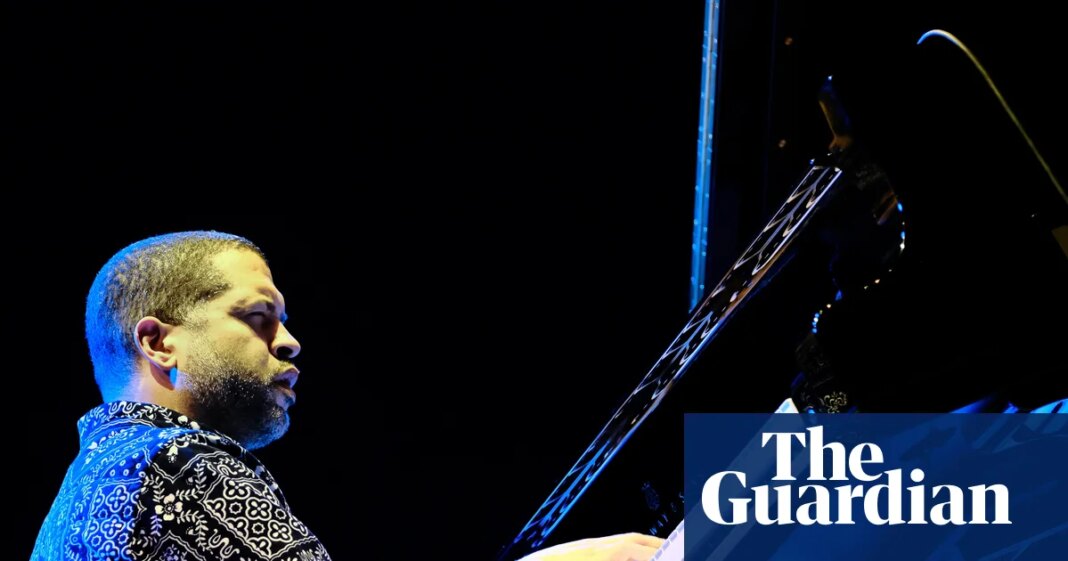
Jason Moran, a renowned jazz composer and pianist, got a strange call from a friend last month. The friend, bassist Burniss Earl Travis, was curious about Moran’s new record that he saw on the music streaming service Spotify.
“It has your name on it,” Travis told him. “But I don’t think it’s you.”
Moran said he doesn’t use Spotify or put his music on the platform, preferring only to use the site Bandcamp, so this didn’t track. After some investigating, he found an artist profile bearing his name on Spotify, which was populated with albums from his former label, Blue Note Records, which owns the rights to his early music. There he saw a new EP titled For You. Its album cover was done in a moody Japanese anime style and depicted a young woman sitting on the ground in the rain. He gave it a listen.
“There’s not even a piano player on this whole damn record,” Moran said with a laugh. He described the music as indie pop, saying: “It wasn’t even remotely close to anything I would make.” He set out to get the fake album taken down.
Moran is among a growing number of musicians who have been targeted on music streaming platforms by what appear to be AI bots masquerading as the real artists. It’s happened to at least a dozen famous jazz musicians, indie rock artists and even the rapper Drake. For the musicians having to deal with the deluge of AI slop, it’s frustrating, Moran said. The feeling is also surreal.
“It’s kinda like that Black Mirror episode with Salma Hayek,” he said, referencing an episode of the dystopian near-future TV series where a reality-show version of a character negatively affects the original’s life. “She doesn’t even have to be there in this episode, like they’re just using a version of her.”
Spotify has acknowledged the problem and the extent of AI slop on its platform, revealing last September that it had removed more than 75m “spammy tracks” over the previous 12 months. At that time, the company also said it was strengthening protections for musicians, including stronger rules around impersonation.
Last month, the company said in a blogpost that it was working on a new tool to “give artists more control over what shows up under their name” and that “protecting artist identity” is a top priority. The tool would let artists review and then approve or decline releases before they go live on the platform.
“Spotify employs a range of safeguards to protect artists, including systems designed to detect and prevent unauthorized content, human review, and reporting and takedown processes,” a company spokesperson said, adding that Spotify was the only streaming service to offer something like its new tool.
But for Moran, who’s the former artistic director for jazz at the Kennedy Center, these fixes aren’t enough, especially as AI content isn’t always internally flagged and the problem doesn’t seem to be slowing down. He’s concerned about additional work for artists like himself, who don’t put their music on Spotify, and for musicians who are no longer alive.
“How does John Coltrane verify or Billie Holiday verify that this new record is not some fake, you know, ‘1952 just-found concert from Paris’?” Moran said. “They have no way of doing that … there’s no way for them to object.”
The Spotify spokesperson said estate or rights holders for a deceased artist can opt into the company’s new tool if they have an account. For those artists who don’t have accounts, either alive or deceased, the spokesperson said, Spotify will continue to rely on its internal detection and accountability systems.
‘AI has become an accelerant’
After Travis tipped off Moran about the phony For You album, Moran posted a video about the debacle to his Instagram and Facebook feeds. He said a litany of artists reached out to him, saying they too had been victims of what appeared to be AI slop. Some of them said they had been dealing with it for years.
In the jazz genre alone, Moran said, impersonation by AI has struck pianist Benny Green, saxophonist Antonio Hart, drummer Nate Smith, the Australian band Hiatus Kaiyote and singers Dee Dee Bridgewater, Jazzmeia Horn and Freddy Cole, the brother of Nat King Cole.
“So, this thing is now moving around copying the names of a lot of important artists,” Moran said. “Just imagine if somebody put a new record out under Frank Ocean’s name. Believe me, people are going to stream it, even if it’s not Frank Ocean.”
Last October, NPR reported that the indie rock musicians Luke Temple and Uncle Tupelo had had their accounts hijacked by AI, as had the now deceased electro-pop artist Sophie and country music singer Blaze Foley. In a bizarre situation in December, the Australian psych-rock band King Gizzard and the Lizard Wizard removed their music from Spotify, only to see an AI impersonator called King Lizard Wizard fill the void with identical song titles and poorly imitated AI artwork.
Morgan Hayduk, a co-CEO of Beatdapp, which offers fraud detection specifically for music streaming, said that the problem isn’t isolated to Spotify; it also happens on Apple Music, YouTube and various other streaming platforms. His company estimates that 5% to 10% of all streams across the industry are fraudulent, which breaks down to a value of $1bn to $2bn per year.
That’s money that’s not flowing to legitimate artists, Hayduk said: “It’s material to the industry, and it’s material downstream to every artist and every person who supports artists who make a living off of their music.”
Last month, a man named Michael Smith pleaded guilty to defrauding music streaming platforms by flooding the services with thousands of AI-generated songs and then using automated bots to artificially boost the number of listens into the billions. According to federal prosecutors, Smith made more than $10m in royalty payments from the platforms over the course of his seven-year scheme.
Hayduk said fraudulent music streams have long been a scourge for the industry but generative AI has supercharged it. When music is played on streaming services, the creator makes a few pennies. But those pennies can rapidly multiply with enough clicks on enough songs. Hayduk said AI helps bad actors, like Smith, make a firehose of content very quickly, and any songs that are removed can easily be replenished.
“AI has become an accelerant,” he said.
Onus on the artists
Once Moran found the AI interloper on his account, he reached out to Spotify for help. That meant having an initial back-and-forth with a chatbot, which eventually led him to a conversation with a human. That person was able to verify Moran was the actual artist and make a claim on his behalf.
Seventy-two hours later, Moran got a message from Spotify: “Great news! We’ve now removed ‘For You’ from your artist profile.”
Moran was relieved the process was relatively painless, but it did take time.
“They allow it to just kind of sit there unless the artist finds it and checks it,” Moran said. “The demand that it puts on us is unfair in a lot of ways.”
Sometimes the bogus AI songs sound vaguely similar to the musician’s; sometimes they don’t. In other instances, albums from various artists appear on a musician’s page, which also happened to Moran and which Spotify says can occur due to a metadata mix-up. Just days after Spotify removed For You, another album he had not made was available for play on his profile. This one was by the real avant garde Belgian band Schntzl. That record has since disappeared from Moran’s profile.
Three weeks ago, For You re-emerged, however – this time on YouTube, casting itself as an album by Moran with the same moody anime artwork, indie pop sound and track list that showed up on Spotify. It’s gotten scant plays, roughly 20, but unlike what happened with Spotify, it doesn’t appear on Moran’s YouTube artist profile.
YouTube did not respond to a request for comment.
Adam Berkowitz, a PhD candidate at the University of Alabama who studies AI and copyright law in the music industry, said it can be tricky for streaming services to automatically yank albums off their platforms over possible copyright or impersonation issues.
“It gets a little complicated because all of a sudden, the private sector is enforcing law. And that’s just not how it’s supposed to be,” Berkowitz said. “It is the courts that enforce law.” While most artists, including Moran, have no intention of suing, it’s clear the courts would have a hard time keeping up with the pace of these issues. Ultimately, Berkowitz said, the onus will probably remain on artists to police their profiles.
The only platform Moran uploads his music to is Bandcamp. He said that service lets him tightly control what’s on his profile and the pricing, giving him more agency as an independent artist. In the world of improvisational jazz, Moran said, the idea of making music isn’t necessarily about cashing checks off record sales – it’s about creating art and providing that to people.
“One thing that [people] can never get charged for is the power of the songs,” he said.