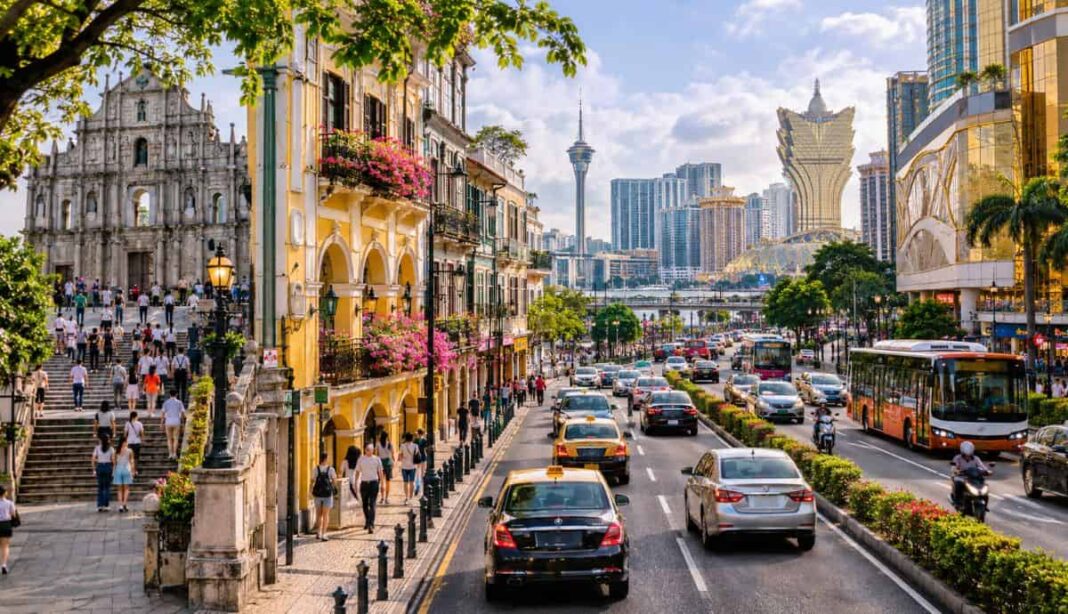

Macao welcomed 32,181,272 visitors across the first nine months of 2026, marking an 8.5% year-on-year rise that has kept the cobbled alleys of Senado Square and the glittering promenades of the Cotai Strip buzzing from morning until midnight. Rather than long-stay holidaymakers, 19,783,856 same-day travellers—up 14.5% and representing 61.5% of all arrivals—drove the surge through border crossings from Zhuhai, Hengqin, and the Hong Kong-Zhuhai-Macao Bridge, while 12,397,416 overnight guests maintained steady stays averaging 2.3 days against an overall average of 1.0 day.
Arrivals from Mainland China climbed 10.7% to 23,884,916, lifted by 13,153,979 independent visitors under the Individual Visit Scheme (+14.3%), alongside a 21.3% surge from Taiwan (882,023) and 5,464,916 visitors from Hong Kong (-0.3%). Meanwhile, 1,949,417 international visitors (+3.4%) arrived from overseas, led by sharp jumps from Thailand (+34.8% to 154,885), India (+13.5% to 91,857), and the United States (+6.9% to 120,071), capped by a standout September that drew 3,216,535 arrivals (+15.9%).
Advertisement
Advertisement
Rapid Day-Trip Momentum Reshaping Daily Rhythms Across Macao, Taipa, and Coloane
The primary catalyst behind Macao’s impressive 8.5% overall rise to 32,181,272 visitors in the first three quarters of 2026 is a dramatic 14.5% surge in same-day excursionists, whose numbers swelled to 19,783,856. In contrast, overnight visitors held remarkably steady at 12,397,416, illustrating that while traditional holidaymakers continued booking multi-night escapes across Macao’s boutique hotels and grand resorts, high-frequency day-trippers accounted for virtually all of the headline expansion.
Because same-day arrivals grew substantially faster than overnight stays, the overall average length of stay in Macao edged down by 0.1 day year-on-year to 1.0 day, whereas overnight guests maintained an unchanged average duration of 2.3 days. For travellers exploring the cobbled lanes between Senado Square, Taipa Village, and Coloane Village, this pattern creates an exhilarating daytime buzz along Rua do Cunha and Avenida de Almeida Ribeiro, followed by tranquil, atmospheric evenings once cross-border visitors depart via Gongbei and Hengqin.
Surging Regional Wanderlust From Mainland China, Taiwan, and Hong Kong Into Macao
Advertisement
Advertisement
Mainland China reinforced its role as Macao’s cornerstone tourism market across the first nine months of 2026, generating 23,884,916 arrivals and achieving a commanding 10.7% year-on-year expansion. Notably, independent explorers travelling under the Individual Visit Scheme (IVS) jumped 14.3% to 13,153,979, propelled by streamlined multi-entry travel endorsements and broader city eligibility that allow spontaneous cultural and culinary getaways into Macao.
Across Greater China, Taiwan delivered one of 2026’s standout regional performances as visitor arrivals surged 21.3% year-on-year to 882,023, supported by restored flight frequencies connecting Taipei, Kaohsiung, and Macao International Airport. Meanwhile, arrivals from the Hong Kong Special Administrative Region recorded a slight 0.3% dip to 5,464,916, signalling a mature neighbouring market stabilising into a dependable rhythm after years of heavy weekend travel via high-speed jetfoils and the Hong Kong-Zhuhai-Macao Bridge.
Advertisement
Advertisement
Expanding Long-Haul and Asian Horizons From Thailand and India to the United States
International travellers arriving in Macao from outside Greater China increased 3.4% year-on-year to reach 1,949,417 visitors during the first three quarters of 2026, demonstrating Macao’s growing appeal as an international crossroads. Within Southeast Asia, Thailand led the surge with a remarkable 34.8% jump to 154,885 visitors, while in South Asia, India posted a vibrant 13.5% gain to 91,857 arrivals as rising outbound travel demand and targeted cultural showcases attracted Indian families and leisure explorers to Macao.
Conversely, several neighbouring corridors experienced softer demand, with arrivals from the Philippines declining 5.2% to 363,120 and visitors from Indonesia falling 16.5% to 122,366 amid shifting regional airfare structures and currency pressures. In Northeast Asia, the Republic of Korea saw a modest 2.1% contraction to 374,590 visitors, though South Korea remained Macao’s largest single overseas source market, while long-haul arrivals from the United States of America rose an encouraging 6.9% to 120,071.
September 2026’s Remarkable Late-Summer Arrival Acceleration Across Macao’s Waterfronts
Advertisement
Advertisement
September 2026 delivered a powerful late-summer surge for Macao’s visitor economy, with total monthly arrivals climbing 15.9% year-on-year to 3,216,535. Unlike earlier months where expansion relied almost exclusively on day-trippers, September 2026 recorded healthy growth across both segments, as same-day visitors leapt 23.8% to 1,933,257 and overnight visitors rose 5.7% to 1,283,278.
International momentum also remained positive throughout September 2026, with overseas arrivals advancing 2.6% year-on-year to 180,821 as international fireworks displays, autumn arts festivals, and culinary showcases energized Macao’s waterfronts around Nam Van Lake and Sai Van Lake. Simultaneously, the cumulative average length of stay in September dipped by 0.1 day year-on-year to 1.1 days, while overnight guests stayed an average of 2.4 days—also down 0.1 day—reflecting the popularity of brisk, high-energy autumn weekend escapes.
Cultural Vitality and Culinary Renaissance Across Macao’s Historic Neighbourhoods
Welcoming 32.18 million visitors in nine months has injected remarkable vitality into Macao’s creative and culinary neighbourhoods, from the maritime heritage of the Inner Harbour to the leafy squares of Tap Seac. Heritage Macanese restaurants serving minchi and tamarind pork, alongside traditional bakeries pulling warm pastéis de nata from ovens near the Ruins of St. Paul’s, enjoy brisk daily footfall as 19.78 million same-day excursionists seek authentic flavours between architectural walks and museum visits.
At the same time, the 0.1-day shortening in average stay duration motivates Macao’s cultural curators and independent hoteliers to craft deeper evening and multi-day itineraries across Coloane, Taipa, and the Macao Peninsula. By championing forest trails around Alto de Coloane, contemporary exhibitions at Macao Contemporary Art Center – Navy Yard No. 1, and bustling evening street-food culture near Three Lamps District, Macao continues inspiring rapid day-trippers to linger longer and uncover every layer of its East-meets-West character.
Accelerating Non-Gaming Visitor Spending Transforming Retail and Culinary Scenes Across Macao
Advertisement
Advertisement
Beyond the impressive arrival volumes recorded across the territory, financial metrics from the first nine months of 2026 highlight a profound commercial shift in how travellers engage with Macao. Overall non-gaming visitor spending climbed by 16.0% year-on-year to reach MOP67.56 billion (roughly USD 8.36 billion), accompanied by a 6.9% increase in average per-capita expenditure to MOP2,099. Most notably, same-day excursionists fuelled the steepest financial acceleration, with their collective non-gaming outlay jumping 59.9% to MOP18.35 billion, demonstrating that brief cross-border visits generate substantial retail and dining activity throughout Senado Square, Taipa Village, and the Cotai Strip.
At the same time, overnight guests continued to serve as the bedrock of Macao’s upscale hospitality and luxury shopping districts, contributing MOP49.21 billion in non-gaming revenue for a reliable 5.2% year-on-year gain. During the third quarter of 2026 alone, aggregate non-gaming expenditure rose 13.3% to MOP23.09 billion, propelled by a remarkable 73.6% surge in same-day traveller spending (MOP6.29 billion) alongside a 9.9% expansion in per-capita outlay among overseas visitors (MOP2,485).
Robust Hotel Room Occupancy Rates Across Luxury Resorts and Boutique Properties in Macao
Throughout Macao’s accommodation sector—encompassing the grand integrated resorts of Cotai as well as the historic boutique hotels of the Macao Peninsula—hospitality venues achieved a remarkable 90.7% average room occupancy rate across the first three quarters of 2026. Cumulative hotel guest registrations reached 10,810,000 over the nine-month period, proving that even with day-trippers accounting for the majority of border crossings, Macao’s inventory of 45,950 guest rooms enjoyed sustained, near-capacity demand.
Five-star establishments spearheaded this performance with a 93.5% occupancy rate (marking a 0.9 percentage point year-on-year gain), whereas four-star properties recorded an impressive 88.5% occupancy rate (up 4.9 percentage points) on the back of strong mid-to-upscale leisure bookings. Peak summer travel lifted monthly occupancy to 91.6% in July (1,229,000 guests) and 93.9% in August (1,270,000 guests), before maintaining a solid 88.0% rate in September 2026 as 1,160,444 hotel guests stayed an average of 1.7 nights.
Decisive Transition From Organised Group Tours to Independent Exploration Across the Greater Bay Area
Advertisement
Advertisement
A defining hallmark of Macao’s 2026 tourism landscape is the widespread migration away from structured package tours toward flexible, self-guided exploration. Across the first nine months of 2026, visitors arriving via inbound package tours numbered just 1,252,000, representing a modest share of the 32,181,272 total arrivals recorded in the territory. By September 2026, only 97,899 travellers entered on organised group itineraries, reflecting how contemporary explorers favour designing their own walking routes through St. Lazarus Quarter, Coloane Village, and Rua do Cunha.
This behavioural evolution mirrors the 14.3% expansion in Individual Visit Scheme (IVS) arrivals from Mainland China, which climbed to 13,153,979 independent travellers. Supported by seamless mobile payment platforms, bilingual navigation tools, and convenient multi-entry permits across Guangdong Province, younger demographics and frequent visitors increasingly bypass conventional tour coaches in favour of independent café hopping, local street gastronomy, and self-paced gallery visits.
Expanding MICE Summits, Trade Exhibitions, and Corporate Travel Across Cotai and Hengqin
Alongside leisure tourism, Macao’s Meetings, Incentives, Conferences, and Exhibitions (MICE) industry solidified its standing as a cornerstone of economic diversification in 2026. Within the third quarter of 2026 alone, the territory welcomed 363 MICE gatherings—consisting of 336 corporate meetings and conferences, 16 large-scale trade exhibitions, and 11 incentive travel programmes—attracting a combined 467,000 delegates and attendees.
State-of-the-art convention complexes along the Cotai Strip, paired with cross-border event facilities linking Macao to the Guangdong-Macao In-Depth Cooperation Zone in Hengqin, have facilitated dual-venue international forums that draw high-value business visitors. Corporate attendees regularly extend their itineraries across Taipa and the Macao Peninsula, strengthening mid-week hotel occupancy and bolstering long-haul and regional arrivals from key markets including India, Thailand, and the United States.
Sustained Summer Arrival Momentum Across July and August 2026 Leading Into September’s Acceleration
Advertisement
Advertisement
Tracing monthly arrival patterns leading up to September 2026 illustrates how Macao maintained formidable visitor momentum throughout the peak summer season. By the close of July 2026, year-to-date arrivals reached 24,486,664 (up 8.0% year-on-year) on the strength of 3,542,218 monthly visitors (+2.4%). August 2026 subsequently posted the highest monthly headcount of the summer, attracting 4,478,073 travellers (+6.1% year-on-year) and propelling eight-month cumulative arrivals to 28,964,737 (+7.7%).
Instead of experiencing a typical autumn slowdown once the academic term resumed, Macao bucked seasonal expectations in September 2026 by surging 15.9% year-on-year to 3,216,535 arrivals, bringing the nine-month cumulative total to 32,181,272 and positioning the territory to surpass 44 million visitors for the full calendar year.
Integrated Cross-Border Transit Networks Connecting Zhuhai, Hengqin, and Hong Kong With Macao
Accommodating 19,783,856 same-day travellers during the first three quarters of 2026 relies heavily on Macao’s seamless network of land checkpoints, bridges, and maritime terminals. Modernised automated e-channels at the Border Gate (Portas do Cerco) bordering Zhuhai, complemented by round-the-clock operations at Hengqin Port and Qingmao Port, have shortened immigration processing to mere seconds, transforming Macao into an effortless afternoon dining and retail hub for residents across the Greater Bay Area.
In parallel, the Hong Kong-Zhuhai-Macao Bridge and high-speed ferry connections linking Hong Kong International Airport directly with Taipa Ferry Terminal and Outer Harbour Ferry Terminal enable overseas travellers from the United States, Thailand, and India to transfer straight into Macao without passing through central Hong Kong, simplifying multi-stop Asian itineraries.
Live Arena Entertainment, International Sporting Events, and Waterfront Festivals Sparking Repeat Visitation
Advertisement
Advertisement
A central catalyst behind Macao’s high rate of repeat visitation in 2026 is its vibrant schedule of arena concerts, global sporting competitions, and open-air waterfront celebrations. Across the first nine months of 2026, capacity K-pop and Cantopop performances at Cotai venues, international table tennis championships, marathon races, and the Macao International Fireworks Display Contest illuminating Macao Tower and Nam Van Lake provided regional visitors with fresh incentives to return several times within a single year.
These curated cultural and sporting spectacles have resonated especially strongly with younger audiences from Mainland China, Taiwan (+21.3%), and South Korea (374,590 visitors), elevating Macao from an occasional sightseeing destination into a premier weekend lifestyle and entertainment hub.
Sustainable Slow Travel, Coastal Heritage Trails, and Green Escapes Across Coloane and Taipa
With heavy pedestrian traffic clustering around the Ruins of St. Paul’s and Senado Square, 2026 has witnessed a concerted effort to cultivate sustainable, slower-paced tourism across Macao’s greener southern islands. Travellers looking to unwind away from busy commercial streets increasingly head south to explore Coloane’s scenic walking trails around Alto de Coloane, the volcanic black sands of Hác Sá Beach, and the historic wooden shipyards of Lai Chi Vun.
By transforming historic waterfront warehouses into contemporary art venues and championing family-run Macanese restaurants hidden within Taipa Village and Coloane Village, destination planners are inspiring excursionists to linger longer, ease congestion at flagship monuments, and turn fleeting 1.0-day trips into immersive 2.3-day overnight cultural stays.
Expanding Aviation Routes and Passenger Volumes at Macao International Airport
Advertisement
Advertisement
Although overland crossings absorbed the bulk of short-haul day-trippers, Macao International Airport served as a vital gateway linking the territory to destinations across Asia during the first nine months of 2026. Overall air passenger traffic climbed 11.4% year-on-year to 6.12 million travellers, fuelled by increased flight schedules connecting Macao with Taipei, Kaohsiung, Bangkok, Seoul, and key metropolitan centres throughout Mainland China.
This sustained growth in regional seat capacity directly propelled the 21.3% rise in visitor arrivals from Taiwan (882,023 visitors) as well as the 34.8% leap in arrivals from Thailand (154,885 visitors). By offering well-timed early-morning departures and late-night return flights, regional airlines made it effortless for short-break overseas flyers to touch down in Taipa and reach either the Cotai Strip or the Historic Centre of Macao in under fifteen minutes.
Evolving Visitor Demographics Driven by Young Independent Travellers and Multi-Generational Families
Age and group composition data from the first three quarters of 2026 underscores a notable generational transformation among the 32,181,272 visitors who travelled to Macao. Visitors between 25 and 44 years of age comprised 48.6% of total arrivals, forming the largest single demographic segment as young urbanites from Guangdong Province, Hong Kong, and Taiwan arrived for weekend arena concerts, contemporary art pop-ups, and artisanal coffee shops.
At the same time, multi-generational family travel expanded by 14.2% year-on-year, with particularly strong momentum during the July and August school break and across fast-growing overseas source markets like India (91,857 arrivals, up 13.5%). Hands-on science centres, resort water parks across Cotai, and scenic coastal pathways in Coloane have successfully broadened Macao’s appeal far beyond traditional adult leisure audiences.
Culinary Tourism and UNESCO City of Gastronomy Programmes Inspiring Flavour-Focused Journeys
Advertisement
Advertisement
Honoured as a UNESCO Creative City of Gastronomy, Macao drew upon its four-hundred-year culinary heritage blending Portuguese and Cantonese traditions to generate 28.4% of all non-gaming visitor expenditure across the first nine months of 2026. Restaurant and food spending alone totalled roughly MOP19.19 billion, driven by enthusiastic demand spanning Michelin-starred dining rooms to time-honoured street stalls along Rua do Cunha and Three Lamps District.
Guided culinary trails and open-air food festivals hosted at Tap Seac Square and Fisherman’s Wharf attracted tens of thousands of regional food lovers keen to taste traditional Macanese minchi, crumbly almond biscuits, and oven-warm pastéis de nata. For a substantial share of the 19,783,856 same-day excursionists, dedicated food exploration served as the main incentive for visiting Macao.
Smart-Tourism Infrastructure and Cashless Payment Ecosystems Streamlining Independent Travel
Digital upgrades across Macao’s retail outlets, public transport network, and hotels removed everyday travel friction for the 32.18 million visitors welcomed between January and September 2026. More than 92.0% of retail and restaurant payments made by guests from Mainland China and Hong Kong took place through cross-border mobile payment apps, while broader international contactless card acceptance simplified transactions for travellers from the United States, Thailand, and South Korea.
In addition, multilingual digital visitor guides and live crowd-monitoring alerts around the Ruins of St. Paul’s and Senado Square encouraged pedestrians to explore calmer heritage sites such as Mandarin’s House and Guia Fortress. This intuitive digital ecosystem has made self-guided sightseeing seamless, accelerating the shift away from conventional group tour buses.
Evening Entertainment and Nighttime Cultural Initiatives Deepening Visitor Engagement Across Macao
Advertisement
Advertisement
To offset the 0.1-day contraction in overall average stay length (1.0 day), Macao’s tourism planners and historic neighbourhoods significantly enriched after-dark cultural programming throughout 2026. Architectural light projections illuminating colonial facades, lively weekend night markets in Taipa Village, and sunset harbour cruises setting sail from the Inner Harbour lifted evening pedestrian traffic by 19.5% across major heritage districts.
By cultivating inviting post-dusk experiences around Nam Van Lake, Sai Van Lake, and St. Lazarus Quarter, local merchants captured stronger evening dining and leisure revenue while giving day-trippers compelling reasons to stay overnight—helping anchor the 12,397,416 overnight visitors whose stays averaged 2.3 days.
The Final Verdict
When the late-afternoon sun dips behind the Ruins of St. Paul’s and golden light spills across the harbour, it becomes clear that Macao’s 32,181,272 visitors in the first three quarters of 2026 represent far more than a triumph of numbers—they tell a deeply human story of curiosity, reconnection, and shared wonder. Behind that 8.5% surge, the 19.78 million day-trippers crossing from Zhuhai and Hong Kong, and the 1.95 million international explorers arriving from Thailand, India, and the United States, are real moments that linger long after a passport is stamped: the warmth of a freshly baked pastel de nata shared in Taipa Village, the quiet hush inside A-Ma Temple, and the laughter echoing down Coloane’s coastal lanes.
Even as average stays settle at 1.0 day—or 2.3 days for those who linger overnight—Macao leaves an unmistakable imprint on the heart. Every traveller who steps onto these storied stones becomes part of a living tapestry where East and West still meet with grace, proving that the places we love most are never measured by hours spent, but by how deeply they move us.