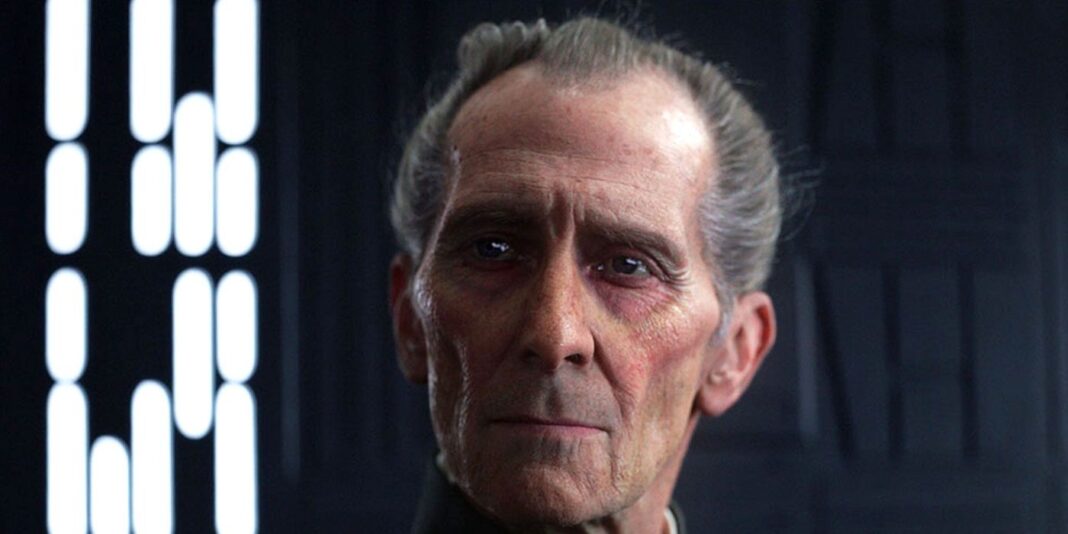
When Rogue One: A Star Wars Story premiered in 2016, one of its most talked-about achievements was the digital recreation of Peter Cushing as Grand Moff Tarkin. Cushing, who passed away in 1994, was brought back to the screen using what was seen as “revolutionary” technology, a blending of motion-captured performance and digital reconstruction of Cushing’s face from archival footage. While groundbreaking at the time, Rogue One co-script writer Tony Gilroy has revealed that the technology seen back then is now essentially obsolete.
Gilroy recently spoke to Empire magazine about working on the movie, which he reportedly also oversaw reshoots on, and explained that while the CGI recreation of Cushing’s character was seen as pushing boundaries at the time, it has very quickly been consigned to the trash as things have moved on. He said:
“What’s interesting is, all of the technology that went into Tarkin, that was like a Manhattan Project. All of that technology has been discarded. The moment machine-learning came in, they don’t do it that way at all 1732297786. It was like building steam-cars and building the best steam-car you could possibly ever do – then someone comes along and says, ‘We have gasoline that works a little bit better.’ Now it’s completely upended.”
The Controversy Around ‘Star Wars’ Use of Deceased Actors May Not Be Over
While it is coming up to a decade since Rogue One brought back Peter Cushing as Moff Tarkin, there have been many more actors brought back to screens after their deaths, and the subject continues to be a tricky subject to handle. Along with the growing popularity of de-aging of actors, putting the face of an actor no longer with us onto a digital template is often controversial and comes with mixed results. For many, using actors who are unable to agree to having their likeness in this way is a little icky.
For Tarkin’s scenes in Rogue One, actor Guy Henry provided the physical performance of the character, wearing motion-capture equipment to replicate Cushing’s mannerisms. Digital artists were then required to take hours of archive footage of Cushing and create a CGI “mask” to then be applied to Henry’s captured actions frame by frame.

Related
Christopher Reeve’s Family Had No Involvement in The Flash’s CGI Recreation of Superman
The family of Superman star Christopher Reeve say they have not seen his cameo in The Flash and were not consulted about his appearance.
The inclusion of Grand Moff Tarkin in Rogue One was significant for the story, as the character played a crucial role in the events leading up to Star Wars: A New Hope. There is also a belief that Gilroy’s new comments on the subject could be something he knows from experience about how far technology has come from potentially using it to bring Cushing back again in the upcoming second season of Andor. Although this has not been confirmed, the timeline of the series would allow Tarkin to be present, and if that is the case, then Gilroy would have seen a difference in the two creation processes.
As filmmakers continue to explore how technology can be used to enhance storytelling, particularly in big franchises with long timelines, Rogue One still stands as being a big step forward for visual technology. While what was cutting edge then may have lost its edge now, everything needs a first step, and Rogue One played a big part in how possible digital performances were and could be.

- Release Date
- December 14, 2016
- Runtime
- 133