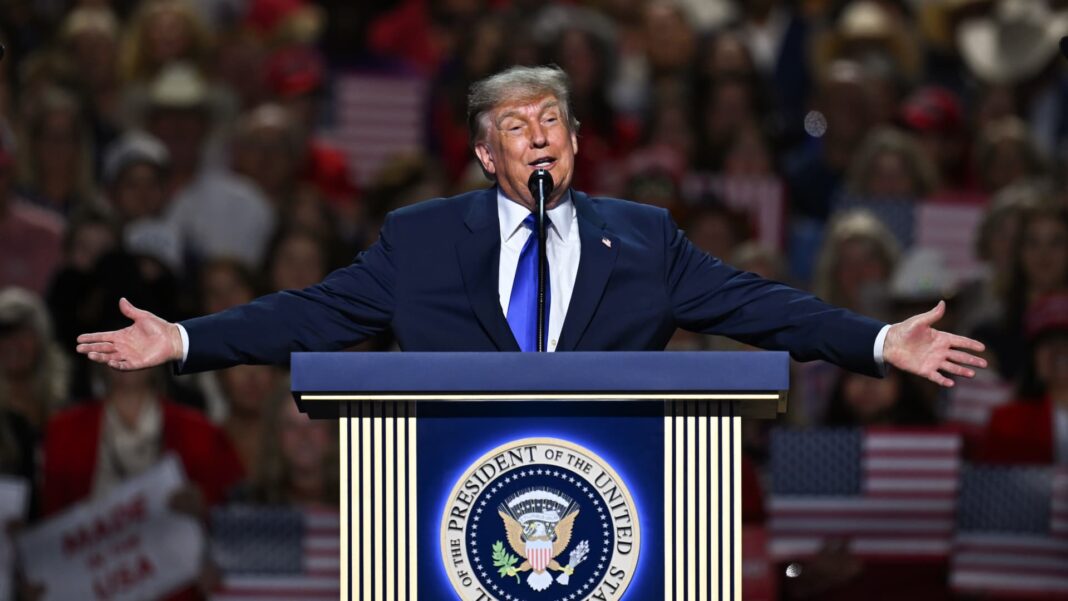
U.S. President Donald Trump speaks on stage on the first day of the 2026 Republican National Convention at the American Airlines Center on September 09, 2026 in Dallas, Texas.
Justin Sullivan | Getty Images News | Getty Images
Facing an uphill battle in the final weeks of an affordability-focused midterm election, President Donald Trump on Wednesday night made an audacious promise: Every adult American citizen will receive a $5,000 “dividend,” but only if Republicans are victorious in November.
While extremely light on details, the proposal quickly drew heat from critics on both sides of the aisle, including some of Trump’s own supporters. And it spurred questions of whether it would be illegal as a payment incentive to influence votes.
“I am hugely in favor of winning the midterms, and love much about this admin, but am strongly against bread and circus bribes,” Palantir co-founder and Republican donor Joe Lonsdale said on X.
At face value, the plan would be staggeringly expensive. There are roughly 245.3 million U.S. adult citizens, according to 2024 Census data. Giving them $5,000 apiece would cost north of $1.2 trillion.
That’s significantly more money than was distributed as part of Covid-era stimulus packages that have been blamed for exacerbating U.S. inflation, a top issue in the midterms. Less than a month ago, U.S. debt passed the $40 trillion mark for the first time.
“I would like to know how they would plan to pay” for the proposal, Rep. Chip Roy, R-Texas, a leader of the fiscally conservative Freedom Caucus, told Politico.

Some conservatives slammed the policy as an example of exactly the kind of socialism that Trump and the GOP warn Democrats will usher in if they regain power.
“Will post-conservative Republicans also try to defend Trump’s $5K ‘dividend’ socialist vote-buying scheme that would cost nearly $1 trillion?” former House Freedom Caucus Chair Bob Good said on X.
Also unclear is why Trump plans to withhold the promised payments until after the midterms, rather than just sending them out as soon as possible.
Asked in a Fox News interview to explain that decision, Trump said, “Because the Democrats can’t do it.”
“Because with them, it’s negative growth,” he said in a clip that aired Thursday afternoon. “With us, it’s so positive.”
Trump added that his tariff policies enabled the dividend plan, claiming they have helped bring $21 trillion in U.S. investment. That figure, and similarly huge numbers that Trump has claimed represent total investment in the U.S. during his presidency, have been repeatedly fact-checked as false. The investment tally cited on the White House’s own website, which has also been disputed, is nearly $10 trillion below Trump’s claim.
Vice President JD Vance also defended the proposed dividends by asserting that Trump’s tariffs have made them possible.
Tariffs “have generated a lot of revenues. They’ve helped us pay down debt,” Vance told Fox on Wednesday after Trump’s speech at the GOP midterm convention in Dallas. “What the president is just saying is, if you keep it going, to the American people, if you keep us in power and allow us to continue to do these things, then you’re gonna share in some of the benefit of this incredible wealth that we’re creating.”
Tariffs are taxes on imports that are paid by importers, not foreign entities. Importers generally pass along the costs to their customers. And the amount of revenue created by Trump’s heavy-handed tariff policies wouldn’t come close to covering the new dividend proposal.
The Penn Wharton Budget Model estimates Trump’s import duties have brought in around $300 billion in total between January 2025 and July 2026. But more than $100 billion of that has been refunded since February, when the Supreme Court struck down a swath of Trump’s tariffs as illegal.
Vance also told Fox the direct payments would be “for the American middle class,” seemingly adding parameters to the dividends that Trump had not mentioned.
Ballooning debt
The potential payout compares with the nearly $1.3 trillion the U.S. government has already spent on interest on the national debt in the fiscal year to date, and the almost $1.4 trillion committed to defense spending in 2026 with more requested due to the Iran war that Trump started.
The U.S. national deficit, which occurs when the federal government’s spending exceeds its revenues, is nearing $1.8 trillion for the fiscal year to date.
The government has spent more than $6 trillion between October and July, putting the deficit at around 5.8% of gross domestic product.
Meanwhile, U.S. government borrowing costs have risen sharply in recent weeks, amid concerns about sticky inflation, government Treasury buybacks and elevated national debt, which stood at 122.6% of GDP in the first quarter of the year.
What Trump said
Trump’s announcement, which came on Night 1 of the first-of-its-kind Republican midterm convention, included no explanation of how the plan would be financed.
“Here is my promise: if the Republicans win the House of Representatives and the United States Senate, both of them … because of our tremendous strength and success economically, I will issue a dividend to every adult citizen in the United States of America for $5,000,” Trump said.
He noted that “warrior dividend” checks totaling $1,776 were sent to U.S. military members last year, and also compared the new plan with Trump Accounts for babies.
But the military payments came from a congressionally approved military housing supplement, and the Trump Accounts were authorized in the massive tax-cutting and spending package Congress approved last year.
Trump also said in Wednesday’s speech that the $5,000 payments “must be spent in the United States of America,” a seemingly unenforceable condition.
Past presidential payments promised
The announcement also prompted critics to resurface other instances when Trump has floated doling out blanket payments to Americans.
Early into his second term, Trump backed the idea of a $5,000 “DOGE dividend.” The idea was to disburse savings achieved by cuts enacted by the now-defunct so-called Department of Government Efficiency — then led by Elon Musk — to the U.S. population, but it never materialized.
Trump’s proposed “tariff rebate,” a $2,000 payout funded by tariff revenue, also never came. The idea unraveled following the Supreme Court’s tariff ruling.
Legal questions
Trump’s latest announcement also quickly raised questions about whether such a policy — essentially, the promise of money in exchange for a preferred political outcome — would constitute a bribe under U.S. law.
“If the Republicans win, you win with us, and you get $5,000,” the president said in his Dallas speech.
Under U.S. federal law, offering or making a payment to induce someone to vote, withhold their vote, or vote for or against a candidate is a criminal offense, punishable by a fine, up to one year in prison, or both. A willful violation can carry up to two years’ imprisonment.
CNBC contacted the White House for clarification on the legal implications of Trump’s dividend proposal.
In July, a bipartisan panel found Musk likely broke state law by giving $1 million checks to voters in the 2025 Wisconsin Supreme Court election. The Wisconsin Elections Commission referred two complaints to the Brown County district attorney’s office. Prosecutors decided not to charge Musk.
Musk handed out checks in an effort to flip majority control of the court, spending millions backing Republican candidate Brad Schimel, who ultimately lost to Democrat-backed Susan Crawford.
Correction: More than $100 billion of Trump’s import duties has been refunded since February. An earlier version misstated the figure.