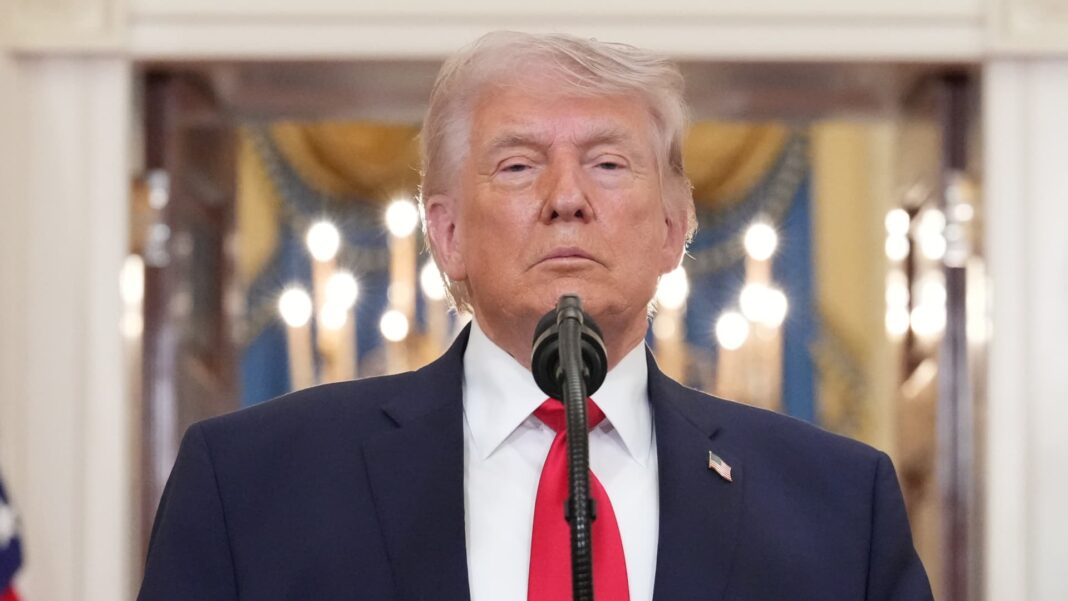
President Donald Trump pauses as he finishes speaking about the Iran war from the Cross Hall of the White House on Wednesday, April 1, 2026, in Washington.
Alex Brandon | Getty Images
President Donald Trump on Tuesday said he agreed to suspend planned attacks on Iranian infrastructure for two weeks, backing off his shocking threats to imminently order the destruction of Iran’s “whole civilization.”
The move, more than five weeks after the U.S. and Israel launched the war, was “subject to the Islamic Republic of Iran agreeing to the COMPLETE, IMMEDIATE, and SAFE OPENING of the Strait of Hormuz,” he wrote on Truth Social.
The decision was “based on conversations with Prime Minister Shehbaz Sharif and Field Marshal Asim Munir, of Pakistan,” Trump wrote.
“This will be a double sided CEASEFIRE!” he declared.
Oil prices plunged as much as 16% following the announcement, while U.S. stock futures shot up.
Iran Foreign Minister Abbas Araghchi said in a separate statement that ships will be able to safely pass through the strait for the two-week interval “via coordination with Iran’s Armed Forces and with due consideration of technical limitations.”
Trump’s announcement came less than two hours before his deadline on Iran to either make a deal that includes opening the strait — a vital artery for global oil transit — or else face major attacks on its civilian infrastructure.
The 8 p.m. ET deadline — which Trump set Sunday after demanding in a belligerent social media post that Iran “Open the Fuckin’ Strait” — had caused panic in the U.S. and around the world.
Trump escalated matters dramatically on Tuesday morning, writing in another post, “A whole civilization will die tonight, never to be brought back again.”
Sharif on Tuesday afternoon had asked Trump for a two-week extension of his deadline for Iran. He also asked Iran’s leadership to agree to open up the strait for two weeks “as a goodwill gesture.”

“We also urge all warring parties to observe a ceasefire everywhere for two weeks to allow diplomacy to achieve conclusive termination of war, in the interest of long-term peace and stability in the region,” Sharif wrote in an X post.
Both the U.S. and Iran framed the development as a win.
Trump, in his post announcing the two-week delay, claimed the U.S. had agreed to halt its planned attacks because “we have already met and exceeded all Military objectives, and are very far along with a definitive Agreement concerning Longterm PEACE with Iran, and PEACE in the Middle East.”
“We received a 10 point proposal from Iran, and believe it is a workable basis on which to negotiate,” Trump wrote.
“Almost all of the various points of past contention have been agreed to between the United States and Iran, but a two week period will allow the Agreement to be finalized and consummated,” he wrote.
Iran’s Mehr News Agency later Tuesday posted a statement from the secretariat of the Islamic Republic’s Supreme National Security Council declaring that the U.S. “has accepted these principles as the basis for negotiations and has surrendered to the will of the Iranian people.”
“If the surrender of the enemy in the field becomes a decisive political achievement in the negotiations, we will celebrate this great historical victory together, otherwise we will fight side by side in the field until all the demands of the Iranian nation are achieved,” read a translation of the statement.
Iran will hold negotiations with the U.S. in Islamabad, the capital of Pakistan, for two weeks beginning in the coming days, according to the statement.
Iran’s 10-point proposal includes withdrawing U.S. combat forces from all regional bases, lifting all sanctions, releasing Iranian assets frozen abroad and full payment of Iran’s war-related damages. It would also establish a protocol for controlled passage through the Strait of Hormuz.
Trump, on Monday, said a ceasefire proposal put forward by Iran was “not good enough.” It was not immediately clear what in the intervening hours led him to accept Iran’s proposal as a “workable basis” for negotiations.