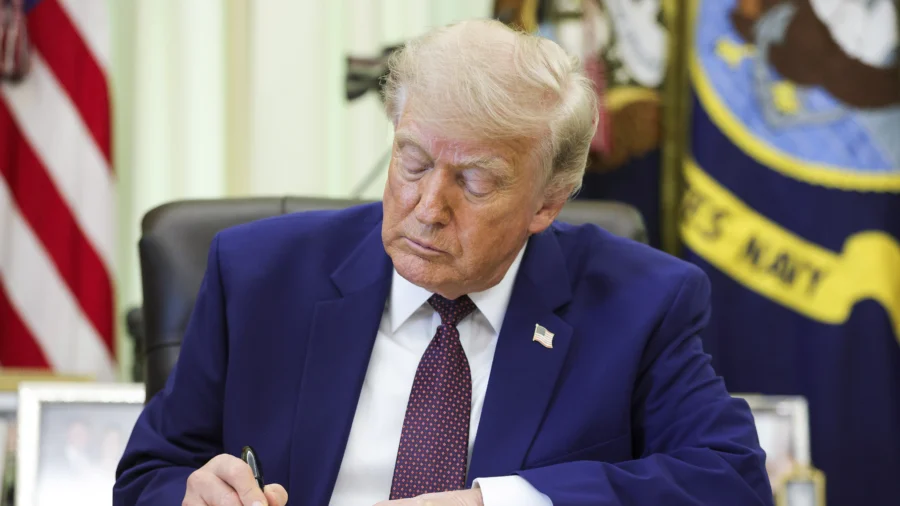
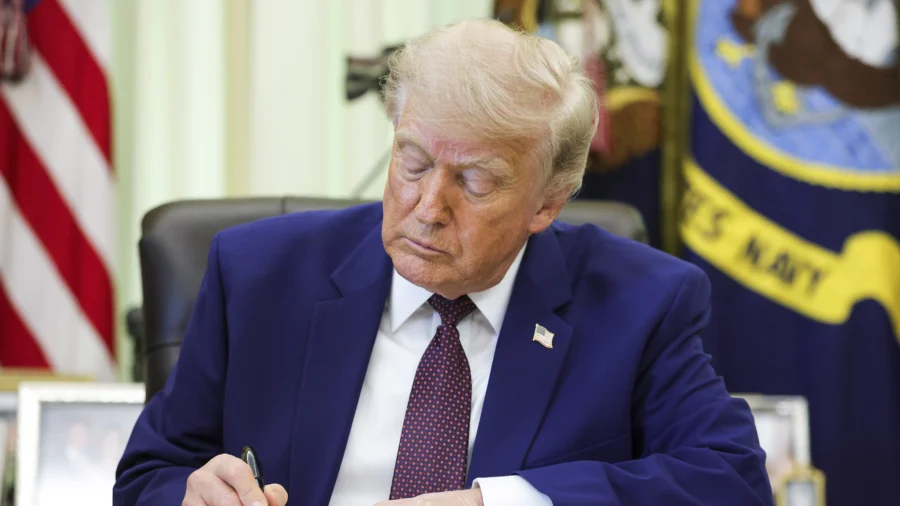
President Donald Trump issued a memo on June 5 aiming to accelerate the development and use of artificial intelligence for national security, while warning against using the technology for surveillance activities.
“Under my Administration, the United States can and will responsibly accelerate the use of AI across intelligence and warfighting domains in line with American values,” Trump said in the memo.
“We will streamline the acquisition and deployment of these technologies while maintaining rigorous oversight and building a secure and resilient supply chain that cannot be severed in times of conflict.”
The memo instructs Secretary of War Pete Hegseth to issue an updated directive on autonomous weapon systems, with annual reviews to account for AI’s rapidly evolving capabilities and to ensure the “deliberate adoption of AI systems that respect the chain of command and operational authorities.”
The national security enterprise must ensure that no commercial entity would be able to disable, degrade, or materially modify an AI system used by U.S. military forces without the government’s approval, it stated.
The memo also prohibits the use of AI technologies to “censor free speech, embed ideological bias, or conduct unauthorized or unlawful surveillance activities.”
“The use of AI by the national security enterprise must always be consistent with United States civil liberties and protections afforded by the Constitution and laws and regulations safeguarding the privacy of American citizens,” it stated, noting that commanders and heads of agencies would be responsible to ensure the technologies are used in accordance with the law.
The memo would rescind National Security Memorandum-25, a memo from the era of President Joe Biden that Trump said has “burdened American AI adoption with ideological mandates and fostered dangerous single-vendor dependencies that left our warfighters exposed.”
Anthropic cited concerns that the technology could be used for mass domestic surveillance or fully autonomous weapons, while the Pentagon has said it does not intend to use Claude for such purposes.
Those companies will then collaborate with the federal government to select “trusted partners” that would gain early access to the new models to “promote secure innovation and strengthen the cybersecurity of critical infrastructure,” according to the order.