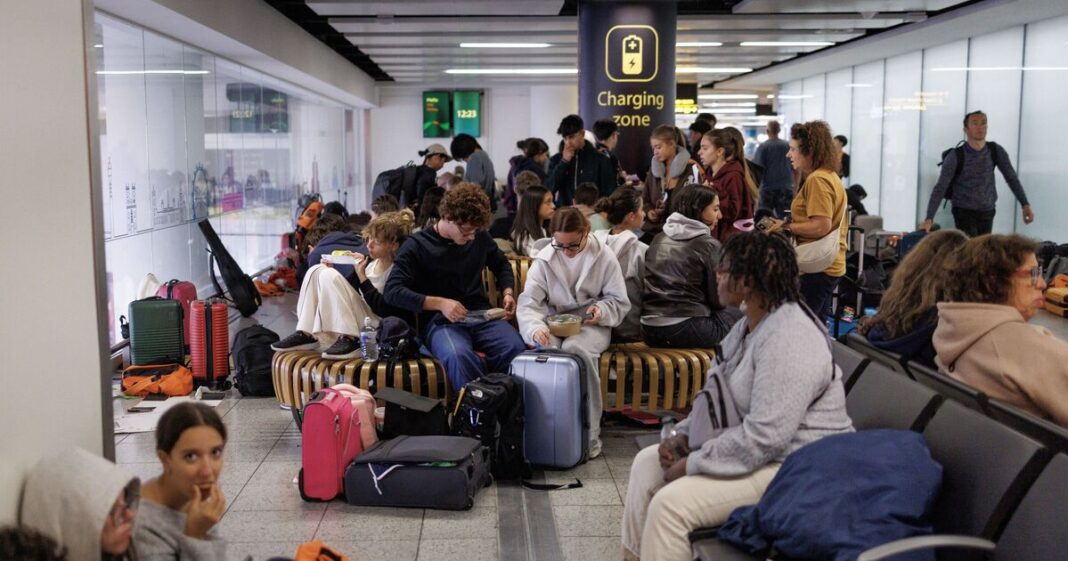

Passengers have faced delays and cancellations following the Nets disruption (Image: Getty)
Thousands of passengers have faced delays and cancellations following the disruption to the UK’s air traffic control system – but what are travellers actually entitled to when their journey is disrupted?
Air passenger rights are protected under UK261, the UK’s post-Brexit regulation adopted from EU law. It sets out airlines’ obligations to passengers when flights are delayed or cancelled, including when travellers may be entitled to assistance, a refund, alternative transport or financial compensation.
However, the rules around compensation are different from the rules around an airline’s duty to look after passengers during a disruption.

UK air traffic control reports disruption for departing flights due to ‘technical issue’ (Image: Getty)
What are passengers entitled to when a flight is delayed?
Liz Hunter, director at Money Expert, said airlines have legally binding obligations depending on the length of the delay and the distance of the flight.
“If your flight is delayed, the airline must provide free food and drink, access to phone calls and emails, and overnight accommodation plus transport if you’re delayed overnight,” she said.
The length of time passengers need to be delayed before this assistance kicks in depends on the distance of their flight.
For flights under 1,500km, assistance applies after two hours.
For flights between 1,500km and 3,500km, it applies after three hours.
For flights over 3,500km, passengers qualify after four hours.
If an airline is unable to provide the assistance, passengers should keep receipts for reasonable expenses they incur as a result of the disruption.
Will passengers receive compensation for the NATS disruption?
This is where the rules become more complicated.
Under UK261, fixed compensation can apply when a flight arrives at its destination more than three hours late, provided the disruption was within the airline’s control and the other qualifying conditions are met.
But passengers affected by the NATS disruption are unlikely to receive this type of compensation because air traffic control problems are generally considered to be outside an airline’s control.
Coby Benson, solicitor and passenger rights expert at Bott and Co Solicitors, said: “Air traffic control restrictions are generally considered an ‘extraordinary circumstance’, meaning passengers will not usually be entitled to compensation for delays or cancellations caused directly by ATC issues.”
Alicia Hempsted, travel insurance expert at MoneySuperMarket, similarly said passengers are only entitled to compensation where the airline was at fault.
She said circumstances outside the airline’s control can include security risks, bad weather and, in this case, a technical issue with air traffic control.
“While travellers can challenge the airline’s definition of extraordinary circumstances through the Civil Aviation Authority (CAA), it’s highly unlikely that an unprecedented technical issue with air traffic control would qualify,” she said.
Does that mean airlines can leave passengers stranded?
In a word, no.
Even if an airline is not responsible for the original cause of a disruption, it can still have obligations towards passengers.
Benson said airlines have a duty to take reasonable measures to minimise disruption and get passengers to their destinations as quickly as possible.
“That can mean rerouting passengers on alternative flights, including with another airline, rather than simply waiting for their own schedules to recover,” he said.
This is particularly important during widespread disruption, when delays can quickly have a knock-on effect across airports and airlines.
Benson said reports of airports running out of capacity as flights were unable to depart demonstrate how quickly disruption can “snowball”.
He added that airlines should not use the original NATS problem as a reason to leave passengers stranded when reasonable alternative travel options are available.
What if my flight is cancelled?
Hunter said: “If your flight is cancelled, you’re entitled to either a full refund or a replacement flight.”
If a delay reaches five hours or more, passengers can also decide not to travel.
Hunter said they are then entitled to a full refund, including connecting flights on the same booking, as well as a return flight to their original departure airport if they are partway through a journey.
Whether additional fixed compensation is payable following a cancellation depends on factors including how much notice the passenger received, the alternative flight offered and the reason for the cancellation.
Can travel insurance help?
Travel insurance may provide another route to recovering costs.
Hempsted said policies that include travel disruption cover may allow passengers to claim for financial losses caused by a delayed or cancelled trip.
However, she warned that this cover is not included as standard on every policy and the level of protection, conditions and exclusions vary.
McCulloch advised travellers to check their policy for definitions including “travel delay”, “missed departure”, “abandonment” and “travel disruption”.
He said this type of disruption can typically be covered by travel insurance for things such as reasonable additional accommodation, transport costs, missed connections and certain expenses caused by a lengthy delay, depending on the policy.
Michelle Cooper, Saga’s head of travel insurance, also said travel insurance can help with additional costs such as accommodation or alternative travel arrangements when passengers are left stranded because of circumstances beyond their control.
However, Hunter stressed that travel insurance should not be viewed as a replacement for the airline’s obligations.
“A common misconception is that travel insurance duplicates airline compensation. It doesn’t,” she said.
“Compensation and duty-of-care obligations above come from the airline. Travel insurance is designed to cover costs that fall outside those schemes entirely, such as missed connections, lost or delayed baggage, or emergency costs not linked to a qualifying delay.”
She advised passengers to claim from the airline first and then use their insurance to cover any remaining costs.
What should passengers do now?
McCulloch said travellers should check their flight status directly with their airline before heading to the airport.
Passengers affected by delays or cancellations should contact their airline first about their options, including refunds and alternative flights, while keeping receipts for any reasonable costs they incur.
They should also check their travel insurance policy and contact their insurer if they face additional costs that may be covered.
Even if the NATS disruption means passengers are unlikely to receive fixed compensation, travellers may still have important rights to assistance, refunds and alternative travel under UK261.