Key events
Economists predict UK inflation peak below 4%
Economists reckon UK inflation will peak below 4% in the coming months.
James Smith, developed markets economist at ING, expects a return to interest rate cuts next year.
“What’s striking about these latest figures is just how benign food inflation is right now,” he said.
It’s a key reason why headline CPI unexpectedly stayed at 2.8%, despite upward pressure from air fares and a quirk related to road tax. Food prices fell in May relative to April, a trend we’ve also seen in the eurozone and Eastern Europe. If anything, the latest producer price data suggests food inflation will continue to fall sharply over the next couple of months. That will gradually change, but it’s a reminder that the energy price spike is unlikely to reach its peak impact on food inflation until the first quarter of next year.
In general, it’s too early to see much impact from the Middle East crisis beyond fuel prices. Services inflation is bouncing around, partly due to the timing of Easter this year, but the Bank of England’s preferred gauge of “core services” – which excludes volatile and indexed categories – has been more stable just below 4%. The BoE’s own “Decision Maker Panel” of CFOs points to services inflation staying around current levels through the summer.
We’re still sceptical that the Middle East crisis will generate the widespread “second round” effects that policymakers fear. Evidence from twelve months ago, when a National Insurance (payroll tax) and minimum wage hike failed to do much to the inflation picture, suggests corporate pricing power is considerably weaker than it was during the last energy shock four years ago.
The same is true of worker bargaining power. Wage growth has been exceptionally weak over the past few months.
All of that suggests inflation is likely to stay below 4% – a key line in the sand for the BoE. It put a lot of emphasis last summer on analysis showing second round effects were more likely when inflation exceeded that level. A 13% rise in household energy bills this July is likely to take inflation towards 3.5% by September, but on current prices, we’re likely to see a 7% fall in those bills come October. That’s because natural gas futures for delivery in 6-12 months are at pre-war levels – and they are a key determinant of the energy regulator’s price cap.
Barring the Iran deal falling apart and oil prices spiking back above $100 a barrel – and natural gas costs soaring too – we think the Bank of England is set for a prolonged pause. We expect a 7-2 vote in favour of ‘no change’ tomorrow. We expect a return to rate cuts in 2027.
Japan’s Nikkei hits new closing high
Japan’s Nikkei, which soared through the 70,000-point mark for the first time ever on Tuesday and also traded at that level today, has ended the day at a new closing high of 69,902.25, up 0.7% (versus 69,404.5 points on Tuesday, also a record).
The Straits Times index in Singapore jumped 1.3% while China’s CSI 300 was up 0.8% and Hong Kong’s Hang Seng lost 0.8%.
In London, the FTSE 100 index is up about 7 points at 10,502, while other European markets were also little changed.
In bond markets, the yield (or interest rate) on the 10-year UK government bond, known as gilt, dropped almost four basis points to 4.75%, the lowest in a month.
Financial markets are pricing in just a 2.6% chance of an interest rate hike from the Bank of England tomorrow, with economists and traders widely expecting policymakers to sit on their hands while they digest the latest inflation figures and assess the impact of the Iran war, and the peace agreement.
Markets are also widely expecting no change in interest rates in July, while the chances of a September rate increase are almost 50-50. A November hike could still be on the cards, though, with the probability estimated at 61.6%.
Rob Wood, chief economist at Pantheon Macroeconomics, said:
The inflation figures will support the monetary policy committee’s highly likely decision to keep Bank Rate on hold this week and make a July hike less likely. Granted there will be another consumer prices index as well as other economic releases before the July decision, but the drop in oil prices after the US-Iran agreed an extended ceasefire had in any case led us to remove our forecast for a rate hike. We now expect Bank Rate on hold through end-2027.
Looking ahead, we still expect inflation to accelerate in the coming months as supply chain pressures feed through to goods, while energy utilities’ contribution to inflation will rise. Meanwhile, underlying services inflation—stripping out volatile and government-set prices— was still above inflation target consistent rates in May and slowing only very gradually.
Granted, we expect motor fuel prices to boost inflation by around 20 basis points less now than we did last week and survey measures that had suggested a sharp rise in underlying services inflation will probably also ease somewhat in part as firms have more scope to absorb higher costs in margins if they trust that the ceasefire will last. Even so, a chunk of inflation is locked in the system now. We look for inflation to peak at 3.4% in November, down from 3.6% before the deal.
Suren Thiru, chief economist at the Institute of Chartered Accountants in England and Wales, said:
While inflation was unexpectedly unchanged in May, aided by lower food costs, these figures have been surpassed somewhat by fresh hopes of easing inflation following the US-Iran peace deal.
Rising services inflation may well sharpen Bank of England fears that the Iran conflict has embedded price pressures more widely across the economy, though a deteriorating labour market will help curb any second-round effects.
Although the US-Iran peace deal has arrived too late to stop higher energy bills and food costs triggering a summer inflation spike, if oil prices continue sinking then a peak well below 4% is becoming increasingly plausible.
Even with hostilities seemingly over, the UK faces a painful hangover from the Iran conflict, with energy and other supply chains likely to take months to normalise, delaying any meaningful easing in inflation until late 2026.
May’s softer than expected data means an interest rate hold on Thursday is now nailed on, especially as the US–Iran peace agreement has raised hopes that, if the deal holds, inflation could ease without the need for further policy tightening.
Despite the easing to food inflation to 2.2% last month, the lowest since December 2024, Karen Betts, chief executive of the Food and Drink Federation, warned that food inflation could still head higher in the coming months.
It’s good to see an easing of food inflation in May, but consumer prices still don’t reflect the inflation caused by the closure of the Strait of Hormuz. It generally takes several months for the increased costs paid by farmers, processors and manufacturers to filter into raised prices at the tills, not least because of the widespread use of long-term contracts for energy and ingredients. But manufacturer input costs are rising, including for transport, packaging and energy, and we expect food inflation to pick up this year and into next.
Uncertainty is the new norm for food producers, which is driving up the overall cost of food production. This makes it all the more important that government acts where it can – to prioritise food manufacturers for energy support and by prioritising and rationalising regulation, freeing businesses to invest in vital long-term resilience.
Prices rose the fastest for beef and veal (9.4%), offal (9.2%), preserved fruit (9.0%) and confectionary products (8.8%).
Prices fell for 15 categories, with the largest drops for flours (-6.1%), olive oil (-4.2%) and jams and marmalades (-3.0%).
Transport costs rose at an annual rate of 6.8%, up from 4.5% in April and the highest since December 2022.
The main effects came from air fares, motor fuels, and sea fares, together with the correction of an error in the Vehicle Excise Duty (VED) series in 2025.
Air fares rose 10.3% between April and May, compared with a fall of 5% a year earlier, due to the different timing of Easter and school holidays. European flights in particular went up in price.
Sea fares increased 3.4% In May, compared with a fall of 10.2% a year earlier, which may also have been affected by the timing of Easter, the ONS said.
The average price of petrol rose 0.6p a litre between April and May, compared with a drop of 2.1p a litre a year earlier, to an average price of 157.4p a litre – the highest since November 2022.
Meat (particularly beef and cooked ham), dairy (particularly cheese), vegetables, and fish became cheaper, while oils and fats went up in price.
Grant Fitner, chief economist at the ONS, said:
Inflation held steady in May as various price movements offset each other. The main upward movement came from transport, with air fares, vehicle taxes and petrol prices all pushing up inflation.
These were offset by lower food prices, with decreases in inflation seen across a range of meat, dairy and vegetable items compared to last month, as well as the cost of domestic heating oil, which fell back after climbing in recent months.
The annual cost of raw materials continued to increase, led by rises in the cost of chemicals, while the increase in the cost of goods leaving factories slowed, partly due to a drop in the cost of domestically produced cars.
The chancellor, Rachel Reeves, said:
While the war in the Middle East pushes prices up globally, we have got the right economic plan and inflation has held steady.
We’re protecting families and businesses from rising costs, with cuts in energy bills and freezes in fuel duty and rail fares. This is the right economic plan to build a stronger more secure Britain.
Introduction: UK inflation unexpectedly stays at 2.8% with higher transport costs offset by slower food price rises
Good morning, and welcome to our rolling coverage of business, the financial markets and the world economy.
It’s inflation day in the UK! The annual inflation rate unexpectedy stayed at 2.8% last month, as the impact of the Iran war was not as bad as feared.
The figures were released by the Office for National Statistics. Economists had expected a rise to 3%. Last month, the annual growth rate slowed to 2.8%, as lower energy bills announced by the chancellor at the lasts budget too effect.
Higher transport prices, from air fares, fuel and sea fares, were offset by a slowdown in the pace of price increases for food.
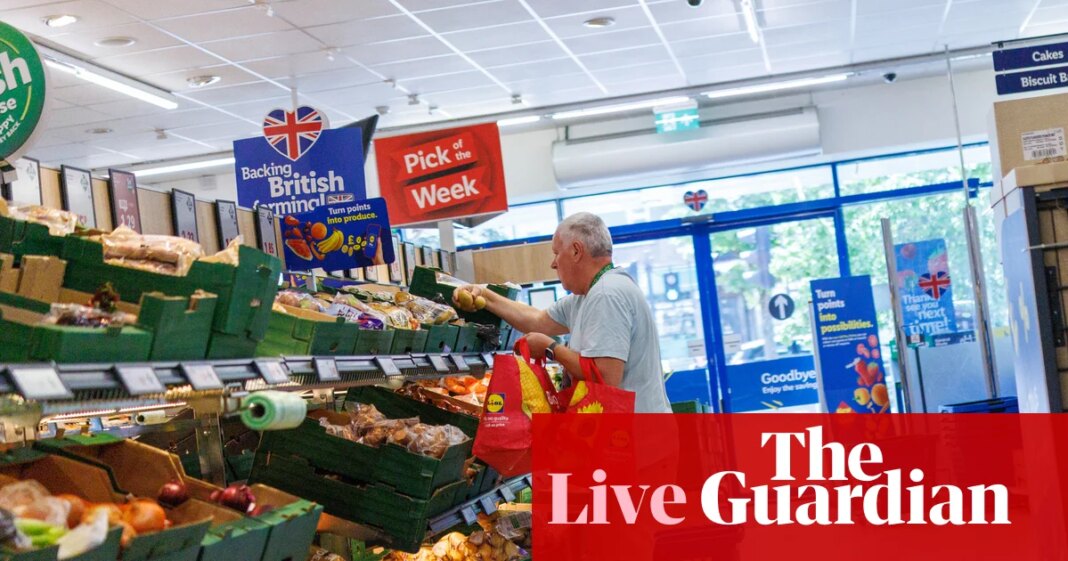
Food prices rose by 2.2% in the 12 months to May down from 3% in April, and marking the lowest rate since December 2024.
Core inflation, which strips out volatile items like energy, food, alcohol and tobacco, inched up to an annual rate of 2.6% in May, from 2.5% in April.
Services inflation, which is also closely watched by the Bank of England, jumped to 3.7% in May, from 3.2% in April.
Inflation remains above the government’s 2% target set for the Bank of England, but it is expected to keep interest rates on hold at its meeting on Thursday, to assess the impact of the Iran war.
Economists hope the agreement reached between Donald Trump and the Iranian regime at the start of the week will lead to the reopening of the strait of Hormuz, which has driven oil prices sharply higher since late February, with knock-on effects for a wide range of materials and goods.
Oil prices continue to fall, and are currently down 0.7% to $78.4 a barrel for Brent crude. West Texas Intermediate dropped 0.8% to $75.41 a barrel. Both benchmarks fell about 5% for a second day on Tuesday to three-month lows, amid optimism around the peace agreement.
Asian markets were mostly higher, and Japan’s Nikkei hit another record high, despite its central bank raising interest rates on Tuesday. The benchmark stock index rose 0.76% to 69,943, after trading above 70,000.
The US Federal Reserve is also expected to leave interest rates on hold at its meeting tonight.
The Agenda
-
9.30am BST: UK House prices and rents
-
10am BST: Eurozone inflation final for May
-
1.30pm BST: US retail sales for May
-
7pm BST: US Federal Reserve interest rate decision (no change expected)