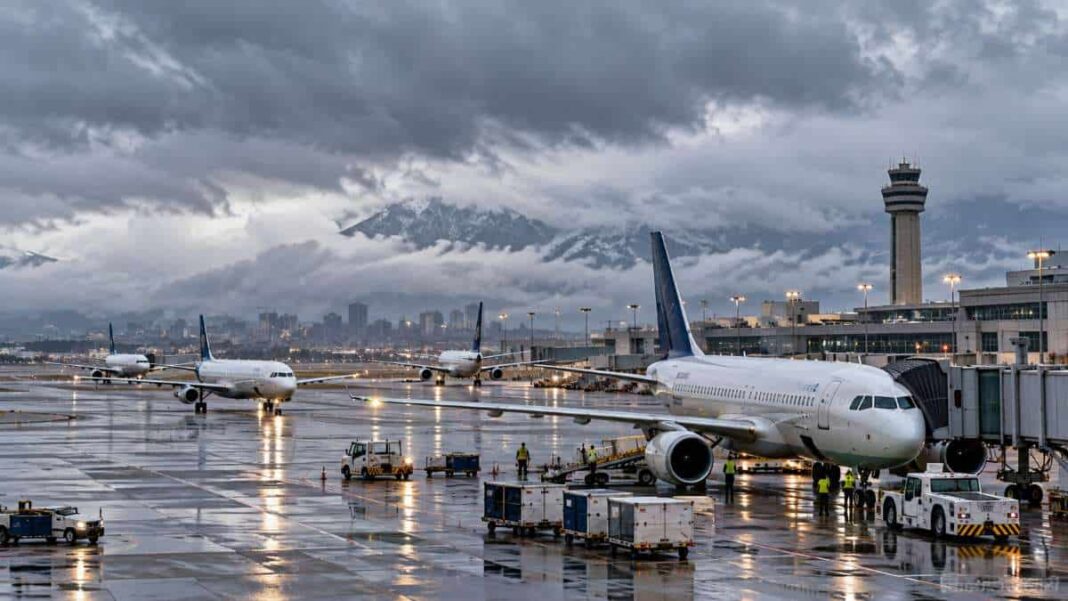

The United States moves alongside growing aviation concerns as the Federal Aviation Administration (FAA) warns of potential delays at three major airports amid challenging weather conditions. Denver International Airport, San Diego International Airport, and Seattle-Tacoma International Airport face possible operational disruption as low cloud ceilings and reduced visibility raise concerns for air traffic management. Meanwhile, FlightAware reported 784 delayed flights and 32 cancellations involving flights within, into, or out of the country as of 11 a.m. EDT on 27 October 2026. However, these figures represent a changing snapshot, and the FAA warning does not mean every reported disruption resulted from adverse weather. As airlines and airport authorities monitor conditions, travellers could face schedule changes and uncertainty over connecting journeys. Travel And Tour World examines the official FAA advisory, explains why low clouds can affect flight operations, and explores what passengers should know before heading to the airport. Read the full story for the essential details behind this developing aviation concern.
FAA Warns of Weather-Related Airport Delays as Low Clouds Threaten Denver, San Diego and Seattle Flights
The Federal Aviation Administration (FAA) has warned of potential air traffic disruption at several US airports on Tuesday, 27 October 2026, as low cloud ceilings and reduced visibility threaten normal flight operations. Denver International Airport and Seattle-Tacoma International Airport face specific weather-related operational concerns, while San Diego International Airport is also listed for a possible ground stop or delay programme.
The FAA’s Air Traffic Control System Command Centre included the risks in its operations plan for 27 October. The advisory identified low ceilings and visibility in Denver, low ceilings in Seattle-Tacoma, and the possibility of a ground stop or delay programme in San Diego later in the day. These measures were planned contingencies, not confirmation that restrictions had already been imposed at all three airports.
The warning comes as flight disruption is being reported across the country. FlightAware recorded 784 delayed flights and 32 cancellations within, into, or out of the United States as of 11 a.m. Eastern Daylight Time on Tuesday. The service also reported 8,316 delays and 564 cancellations worldwide at the same time. These figures represent a live snapshot and may change as airlines update their schedules and operational conditions evolve.
Advertisement
Advertisement
Although the FAA’s weather warning highlights potential pressure on airport operations, the available evidence does not establish that low clouds caused every delay or cancellation reported by FlightAware. The distinction matters for travellers trying to understand whether their own flights are affected and for airlines managing schedules across multiple airports.
Anup Kumar Keshan, Founder and Editor-in-Chief of Travel And Tour World, said, “Weather-related disruptions highlight the importance of real-time aviation updates and effective airport operations. Travellers flying through Denver, San Diego and Seattle should monitor airline notifications closely, as low clouds and reduced visibility may affect schedules and connecting journeys.”
Advertisement
Advertisement
FAA identifies weather risks at key US airports
The FAA’s operations plan provides an early indication of where weather or other operational constraints could affect the movement of aircraft. Its 27 October advisory identified Denver as a location where both low cloud ceilings and reduced visibility could create challenges. Seattle-Tacoma was also listed for low ceilings.
The advisory outlined possible traffic-management measures at several airports. A ground stop or delay programme was possible at Denver after 1200 UTC, at San Diego after 1500 UTC and at Seattle-Tacoma after 1600 UTC. These times are expressed in Coordinated Universal Time, which is used for aviation operations.
Advertisement
Advertisement
A possible ground stop means air traffic managers may need to prevent selected aircraft from departing towards an affected airport for a period. A ground delay programme can instead regulate departure times so that arriving traffic remains within the airport’s capacity. The exact response depends on conditions and the operational decisions made by air traffic managers.
The FAA’s plan is intended to support operational planning. It does not guarantee that a particular restriction will take effect, nor does it establish that every flight using an airport will experience a delay.
For passengers, the warning is best understood as a sign of possible disruption rather than a prediction that all services will be affected. Travellers should continue to check their flight status with their airline, particularly when connecting through one of the airports identified in the advisory.
Denver faces low ceilings and reduced visibility
Denver International Airport is among the locations receiving particular attention in the FAA’s operational assessment. The advisory identifies both low ceilings and visibility restrictions as potential constraints on traffic.
Advertisement
Advertisement
A cloud ceiling refers to the height of the lowest cloud layer reported as broken or overcast, or the vertical visibility when the sky is obscured. When that layer sits close to the ground, pilots may have fewer opportunities to conduct an approach using visual references. They may need to rely on approved instrument procedures, subject to the aircraft’s equipment, the crew’s qualifications, and the conditions at the airport.
Reduced visibility can also affect how aircraft approach, land, and move around an airport. Air traffic controllers may need to adjust the spacing between arriving aircraft or manage the flow of departures to maintain safe and orderly operations.
These adjustments can reduce the number of aircraft an airport handles over a given period. Even when flights continue operating, the result may be a slower arrival or departure process.
The FAA’s advisory listed a possible ground stop or delay programme at Denver after 1200 UTC. This was a planned possibility, not evidence that a restriction necessarily began at that time.
The airport’s operational picture can also change quickly as weather improves or deteriorates. For that reason, a forecast warning should not be treated as a final assessment of the day’s disruption. Passengers travelling through Denver should use their airline’s flight updates alongside the FAA’s airport-status information.
Seattle-Tacoma faces low cloud concerns
Seattle-Tacoma International Airport was also identified in the FAA’s 27 October operations plan because of low cloud ceilings. The agency listed a possible ground stop or delay programme after 1600 UTC.
Advertisement
Advertisement
Low clouds can complicate the management of arrivals and departures, particularly when visibility and cloud height limit the use of visual approaches. Aircraft can continue to operate in many such conditions, provided they meet the applicable operational requirements. However, the airport may need to handle traffic at a different rate from normal.
The FAA’s warning does not mean that Seattle-Tacoma was certain to experience a ground stop. It indicates that air traffic managers were considering the possibility of traffic-management measures if conditions required them.
The distinction is important because operational forecasts can change during the day. A planned measure may be introduced, adjusted or cancelled depending on the latest weather observations, traffic demand, and airport capacity.
Seattle-Tacoma also has a separate operational consideration in the FAA’s planning information: runway 16C/34C was listed as closed through 15 November 2026. That runway restriction is distinct from the low-ceiling warning. The available information does not quantify how much either factor contributed to the national delay figures.
Passengers connecting through Seattle-Tacoma should therefore check their own flight details rather than assume that all departures and arrivals will be affected equally.
San Diego included in possible traffic-management measures
San Diego International Airport also appears in the FAA’s operations plan, but its status requires a careful distinction.
Advertisement
Advertisement
The advisory listed a possible ground stop or delay programme at San Diego after 1500 UTC. However, the specific terminal weather constraints in the same plan identify Denver for low ceilings and visibility, and Seattle-Tacoma for low ceilings. The plan does not explicitly list San Diego under those two weather constraints.
Consequently, the available government evidence supports reporting San Diego as an airport where traffic-management measures were possible. It does not, on its own, establish that low clouds were the cause of that possibility.
This difference matters when interpreting airport warnings. Air traffic restrictions can be considered for several operational reasons, including traffic demand, weather and other constraints. A planned delay programme should not automatically be attributed to a particular weather condition unless the relevant authority establishes that link.
For travellers using San Diego, the practical advice remains the same: monitor the airline’s departure and arrival information and check for any official airport or FAA updates before travelling to the terminal.
Why low cloud ceilings can slow airport operations
Cloud ceilings and visibility are important factors in aviation because they affect the conditions under which aircraft can approach, land, depart and move on the ground.
The National Weather Service explains that instrument flight rules, or IFR, apply when the weather prevents pilots from seeing far enough to operate under visual flight rules. Its guidance identifies IFR conditions as a ceiling below 1,000 feet above ground level and/or visibility of less than three miles. These thresholds help explain why low cloud and visibility reports matter to aviation operations. They do not mean that every flight encountering such conditions will be delayed.
Advertisement
Advertisement
When cloud ceilings fall, pilots may need to use instrument approach procedures rather than rely on visual references. These procedures allow aircraft to navigate towards an airport using approved instruments and guidance systems, subject to the relevant weather minimums and operational requirements.
However, instrument procedures do not remove every operational constraint. Aircraft may need greater spacing during approaches, and air traffic managers may reduce the rate at which aircraft arrive. If arrivals slow, aircraft waiting to depart may also face changes to their schedules.
Ground movement can be affected as well. In low visibility, controllers and pilots must maintain appropriate awareness of aircraft and vehicles moving around taxiways and runways. The FAA’s Aeronautical Information Manual includes guidance on taxiing during low-visibility conditions and the need for careful attention to movement instructions.
These procedures are designed to preserve safety. A slower operational pace is not, by itself, evidence of an unsafe flight or an airport closure. It reflects the need to manage aircraft movements within the conditions and limits that apply at the time.
How airport delays can affect connecting passengers
A delay at one airport can affect travellers beyond the location where the disruption begins. Modern airline schedules rely on aircraft, crews and passengers moving through interconnected networks. When a flight arrives late, the aircraft may have less time to prepare for its next service.
Passengers travelling on connecting itineraries can also face tighter transfer windows. If an inbound flight arrives later than scheduled, travellers may have less time to reach their onward departure. Whether they can still make the connection depends on the actual arrival time, airport layout, boarding deadlines and airline arrangements.
Advertisement
Advertisement
These knock-on effects are possible, but the FAA’s weather advisory does not quantify how many passengers or connections were affected at Denver, Seattle-Tacoma or San Diego on 27 October.
The wider FlightAware snapshot indicates that disruption was being recorded across US-related services and internationally. Nevertheless, the totals alone do not show which airports contributed the most delays, which airlines were most affected, or what proportion of cancellations resulted from weather.
Those questions require more detailed flight-level information. It would be misleading to infer the cause of each cancellation from the national totals or to suggest that the three airports named in the FAA plan account for all reported disruption.
For travellers, the most useful approach is to monitor each flight separately, especially when an itinerary includes a connection. An airport-wide warning provides useful context, but the airline’s current flight status is more relevant to an individual booking.
Flight disruption figures remain subject to change
FlightAware reported 784 delays and 32 cancellations involving flights within, into, or out of the United States as of 11 a.m. EDT on 27 October. Its worldwide totals at that point stood at 8,316 delays and 564 cancellations.
These figures should be treated as a time-specific snapshot rather than the final count for the day. Flight tracking totals change as flights depart, arrive, get cancelled, or receive updated status information. The number recorded at one point in the morning may therefore differ from the final daily total.
Advertisement
Advertisement
The national figures also cover a much wider network than the three airports highlighted in the FAA’s operations plan. They should not be presented as a measure of the direct impact of low clouds at Denver, Seattle-Tacoma or San Diego.
The FAA’s own operational information serves a different purpose. Its planning advisories identify anticipated constraints and possible traffic-management actions, helping air traffic managers prepare for conditions that could affect normal operations. They are not a substitute for a complete national tally of delays and cancellations.
Taken together, the two sources provide complementary information: FlightAware offers a snapshot of reported disruption, while the FAA identifies operational risks and potential responses at specific locations.
What travellers should do before heading to the airport
Passengers scheduled to travel through Denver, Seattle-Tacoma or San Diego should check their airline’s latest flight information before leaving for the airport. A flight that was scheduled to operate normally earlier in the day may receive an updated departure time if conditions change.
Travellers with connecting flights should pay particular attention to the status of their inbound service and the departure time of their onward flight. If a delay threatens a connection, they should contact the airline through its official channels to discuss the available options.
Passengers should also distinguish between an airport warning and a confirmed disruption to their own service. A possible ground stop or delay programme does not mean that every flight will be held, cancelled or diverted. Conditions may vary across the airport’s operations and throughout the day.
Advertisement
Advertisement
Outlook: Weather remains a key operational factor
The FAA’s 27 October operations plan highlights the importance of monitoring local weather conditions when assessing potential disruption across the US aviation network. Denver faces concerns involving both low cloud ceilings and visibility, while Seattle-Tacoma is being monitored for low ceilings. San Diego is listed for a possible traffic-management programme, although the advisory does not explicitly identify low clouds as its cause.
The planned measures underline how air traffic management can respond to changing conditions before they develop into wider operational problems. They do not establish that restrictions took effect at every airport, and they cannot explain all the delays and cancellations recorded across the country.
With flight disruption totals continuing to change during the day, the clearest picture comes from combining official FAA advisories with current airline updates and carefully time-stamped flight-tracking information. For passengers, checking those sources before departure and remaining alert to schedule changes is the most practical way to respond to the possibility of weather-related disruption.