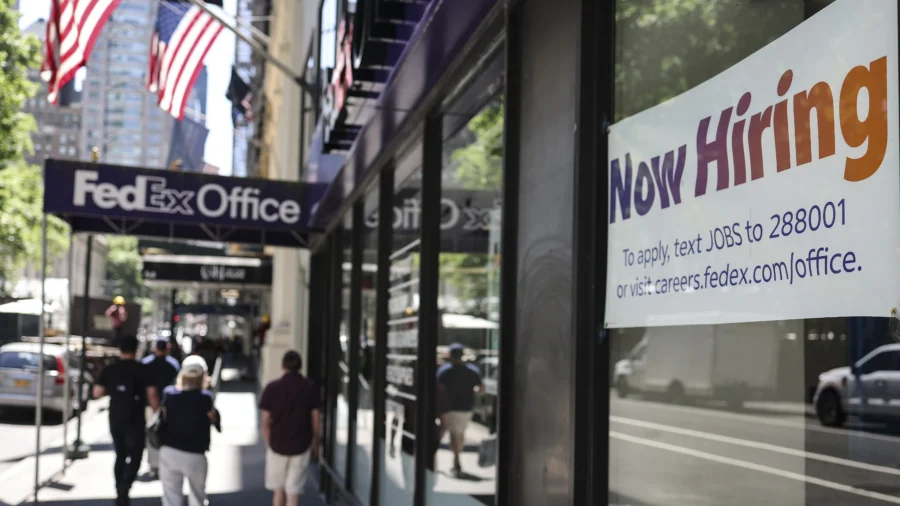
U.S. private employers added a smaller-than-expected number of jobs last month, furthering the trend of “choppy hiring” in the labor market, according to new data from payroll processor ADP.
Private payrolls grew by 38,000 in August, from an upwardly revised 46,000 in July, according to the report released on Sept. 2.
This marked the slowest pace of job growth since January and came in below the consensus estimate of 47,000.
While private-sector job creation has been positive all year, growth has softened since the springtime hiring spree.
August’s payroll gains were led by education and health services (45,000), followed by leisure and hospitality (16,000), construction (12,000), and financial activities (6,000).
Health services have accounted for a sizable share of employment over the past two years due to the nation’s aging population.
Additionally, the rebound in leisure and hospitality positions could be a good sign for the labor market after the FIFA World Cup festivities left town. According to the U.S. Bureau of Labor Statistics’ July nonfarm payrolls report, the sector lost 40,000 jobs.
Various industries trimmed their headcount, particularly manufacturing (17,000) and professional and business services (16,000), according to the ADP report.
A majority of the increase was fueled by big business—large companies with 500 or more employees—as payrolls expanded by 34,000. Small companies—those with fewer than 50 employees—edged higher by just 3,000.
Wages offer the clearest window into this year’s “choppy hiring” trend, says Nela Richardson, ADP’s chief economist.
“To understand hiring patterns, you have to look deeply into where pay growth is accelerating, where it’s slowing, and for whom,” Richardson said in a statement.
“Once-predictable wage growth has been overtaken by the complexities of demographic change, persistent inflation, and AI’s effects on jobs.”
Wage gains held steady in August. Base pay for all private-sector workers rose 3.2 percent year over year, and gross pay was up 4.7 percent on an annualized basis.
The gap between job-stayers and job-changers remained wide. The base pay for job-stayers increased 3 percent year over year, compared to the 4.7 percent for job-changers.
Prelude to Jobs Report
Private-sector payrolls data is a prelude to the week’s main event—the August jobs report, which will be released on Sept. 4.
Economists forecast the U.S. economy created 58,000 new jobs in August, a possible rebound from the previous month’s loss of 23,000 jobs. The unemployment rate is also expected to hold steady at 4.1 percent.
As long as the Bureau of Labor Statistics does not post a back-to-back negative reading, Wall Street will be content, says Jay Woods, chief market strategist at Freedom Capital Markets.
“The one thing [Wall] Street needs to avoid is another negative payroll print or a sharp rise in unemployment that suddenly raises recession concerns,” Woods said in a note emailed to The Epoch Times.
“The hope is for modest job creation, stable unemployment, and contained wage growth.”
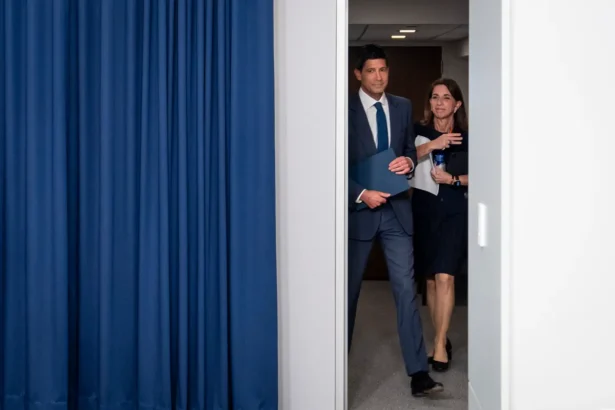
Federal Reserve Chairman Kevin Warsh arrives to speak at a press conference in Washington on July 29, 2026. Madalina Kilroy/The Epoch Times
Other labor market indicators suggest demand for workers is robust, layoffs are minimal, and hiring has been subdued.
Two other key metrics will be released a day before the highly anticipated jobs report: planned layoffs and weekly unemployment claims.
Put together, this week’s numbers could have implications for Federal Reserve policy.
Traders have again started pricing in the Fed’s raising interest rates at the Sept. 15–16 Federal Open Market Committee policy meeting, according to the CME FedWatch Tool.
“Listening to the Fed talk, there are still concerns about inflation,” Edward Rosenberg, head of ETFs at Strategy Shares, said in a note emailed to The Epoch Times.
Looking ahead to next week’s consumer price index, the 12-month annual inflation rate is also expected to remain above 3 percent. Excluding food and energy prices, core inflation is projected to hold at 2.4 percent.
“At the Fed’s last meeting (July 29), officials specifically cited uncertainty from the Iran conflict as a reason for holding rates steady. Inflation and oil are directly linked in the Fed’s own reasoning,” Rosenberg said.
The Federal Reserve playbook suggests policymakers should not raise interest rates in the middle of an oil price shock—and energy markets have been surging as of late.
A barrel of U.S. crude oil is around $90 on the New York Mercantile Exchange. The global Brent benchmark is close to $95 in overseas trading.