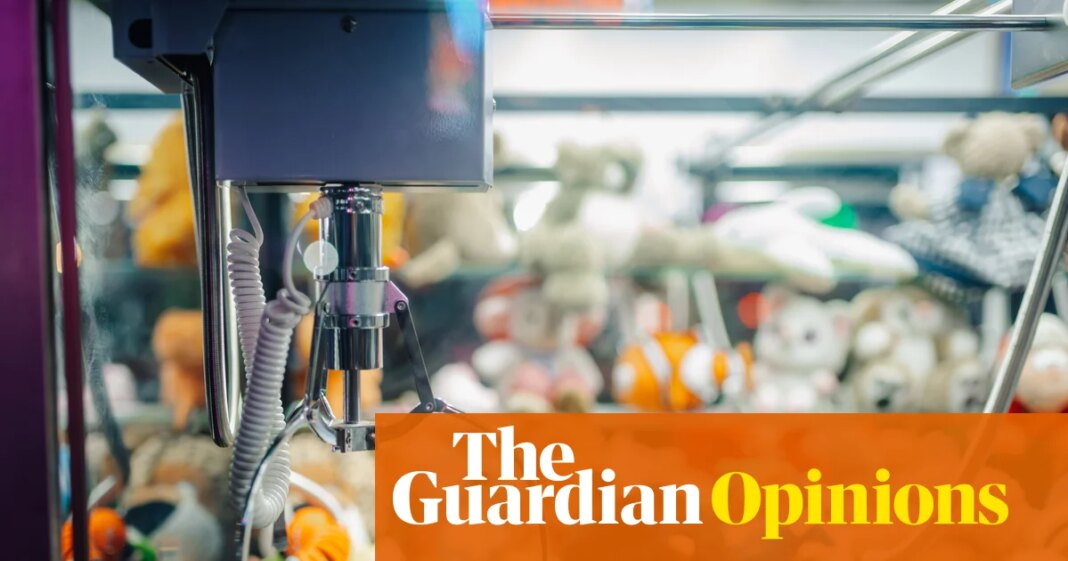
About a decade ago, the financial crash was almost a decade old. Unrelatedly, my kids were under 10, so I was spending a lot more time in arcades. There’s a particular game involving a metal claw – it goes by the name of claw-game. You put in a pound, and try to manipulate the claw to grab a toy that is worth nothing like a pound. You would take that as the price of a bit of family fun, except the claw never grabbed a toy.
The frustration for a six-year-old was immense, every lost pound making the probably flammable stuffed hamster more urgently desirable. But it was way worse for me, because I was clinging on to some residual 80s idea of arcade-honour. Surely, after pound #7, the machine would just give you a sodding toy? That would represent an astronomical return, lessen the possibility of an adult kicking the machine to death and assure a returning market of maybe 10% of the dumbest or most spineless parents. But no, nada. No toys, ever.
So it wasn’t a good game, but it was starting to feel like a really good metaphor for the economy. This was in the twilight period between 2015 and Brexit, after which politics stopped troubling itself with day-to-day liveability. Previously, if you studied hard you got a job, then if you worked hard, you could afford to live; and in the fullness of time, if you met another person who worked hard, you could have a family and afford to feed them – this was basically the honour-code of capitalism. But it was breaking down and nobody wanted to admit it.
Trade unions noticed: the TUC crunched the numbers in 2014 and found that only one in 40 new jobs were full time. The geographer Danny Dorling noticed that a fifth of people needed a cash benefit to make rent, and average house prices were nearly nine times average salaries in England and Wales. The NHS noticed, in the same year, inasmuch as the number of children with vitamin D deficiency and rickets had tripled since 2009. A lot of people privately thought, “This whole thing is rigged,” though, as far as I know, I alone noticed the irresistible likeness to the Ramsgate arcade.
Scroll forward a decade and people are much more public about their noticing – but expectations have changed and with them, the language. We talk about a cost of living crisis, but we don’t cast ourselves as agents in the economy, whose wages aren’t keeping pace with prices. Rather, we’re a bunch of luckless dopes to whom bad things keep happening. The New Economics Foundation thinktank, with Best for Britain, has dropped into these new times an “attainability index”. It takes the wage data from the past 20 years and calculates how many hours you would have to work to attain a set of things: a holiday, a night out, an outfit, a car.
The figures aren’t at all surprising. Low-paid workers have their wages mostly eaten up by essentials. Social participation is sporadic, holidays out of reach. A secondary school teacher looks as though they are doing OK, because they would only have to work 23 hours to afford a ticket to a festival. But that would assume they are not going to do any other discretionary spending whatsoever.
Just about the only things that have gone down in price in real terms, over the past 20 years, are gym memberships, budget clothes and meal deals, which makes sense. In all the crazy supermarket moments of this decade, the remarkable value of a prawn mayo sandwich, as long as you get some crisps and a Red Bull at the same time, has often felt like the only thing standing between us and revolution.
The important thing isn’t the numbers (no offence, researchers, your data is beautiful) but the fact that everyone is experiencing the same degradation. The pilot of 2026 is as far removed in his or her housing prospects from the pilot of 2006, as is the chef or the accountant from theirs. So much political rhetoric goes into the creation of rivalrous silos – the woke v the anti-woke, the liberal elite v the left-behind – all of it constructed to mask the fact that everybody’s expectations have been thwarted for two decades straight. Realising this might shunt the discourse out of phase “get mad” into phase “get even”.
Zoe Williams is a Guardian columnist
On Tuesday 1 December 2026, join your favourite Guardian writers for an evening of candid conversations, witty remarks and surprises as we look back on the year-defining stories of 2026. With Zoe Williams, John Crace, Pippa Crerar, Jonathan Liew and Lucy Mangan.
Book tickets here or at guardian.live