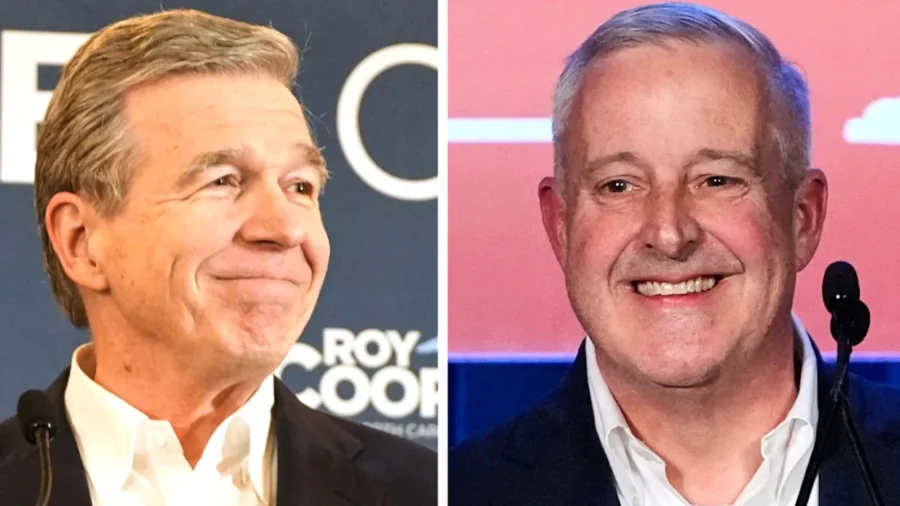
The Senate matchup for the general election in North Carolina has been set, with former Republican National Committee chairman Michael Whatley and former Gov. Roy Cooper to be placed on the ballot in November in a race that could determine which party controls the upper congressional chamber.
Whatley won the GOP primary, while Cooper won the Democratic primary on March 3.
With around 39 percent of the votes counted, the Associated Press declared Whatley the winner of his race at 8:40 p.m. ET, with Whatley leading with around 64 percent of the vote at the time. Cooper was declared the winner in his race at 8:39 p.m. With 37 percent of the vote counted, Cooper is leading with 92.4 percent of the vote.
Whoever wins in the general election will succeed Sen. Thom Tillis (R-N.C.), who opted not to run for reelection due to disagreements with President Donald Trump.
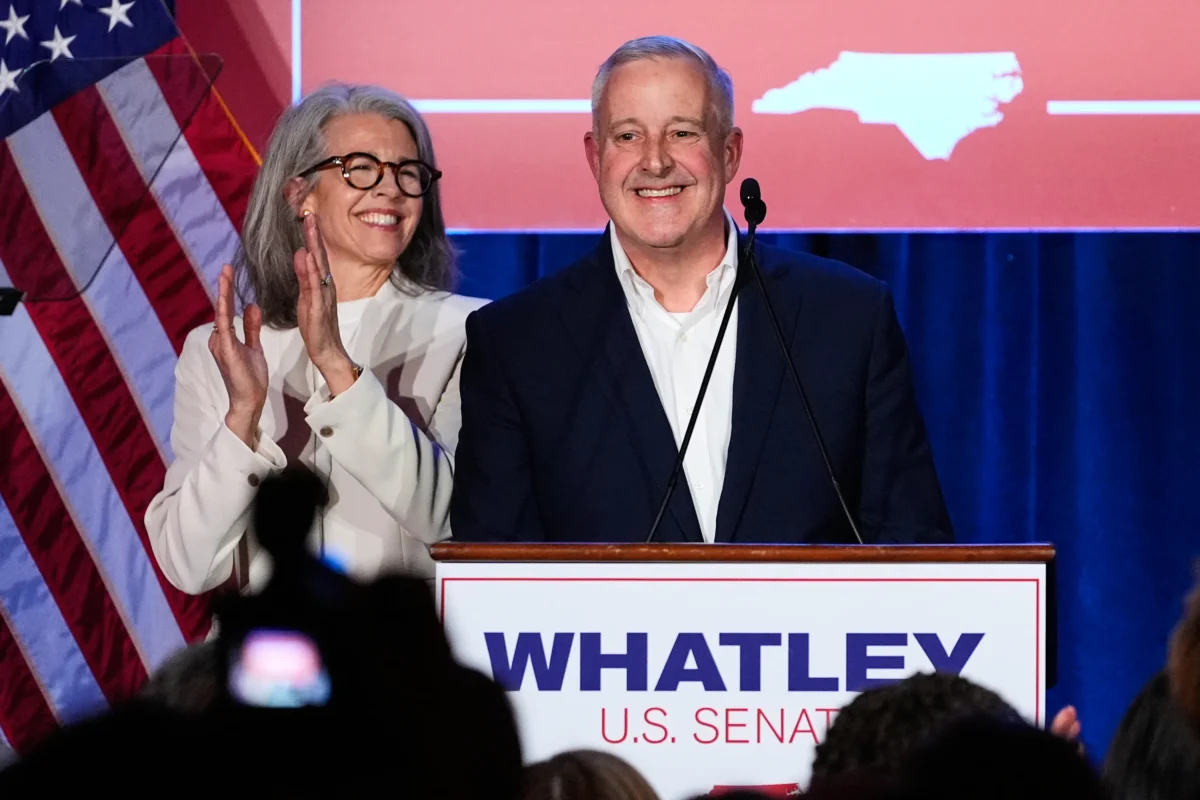
North Carolina Republican Senate candidate former RNC Chairman Michael Whatley speaks at a primary election night watch party in Charlotte, N.C., on March 3, 2026. Erik Verduzco/AP Photo
Endorsed by Trump, Whatley ran on getting North Carolina “back on track,” helping families make ends meet, creating jobs, and improving public safety.
Whatley was part of the legal team for Republican presidential candidate George W. Bush during the 2000 election. He was also a staffer with the U.S. Senate’s Clean Air, Climate Change, and Nuclear Safety Subcommittee.
Between June 8, 2019, and March 8, 2024, Whatley led the North Carolina Republican Party.
During his tenure, the GOP reclaimed a supermajority in both chambers of the state legislature.
He had a 14–0 record in judicial races as the state’s Supreme Court flipped to the conservatives. However, the party lost the 2020 gubernatorial race when Cooper won reelection.
Following Ronna McDaniel stepping down as Republican National Committee chair, Whatley stepped in to fill the role after being endorsed by Trump for the position.
Under his leadership, the GOP won back the White House and Senate and kept its majority in the House.
He served between March 8, 2024, and August 22, 2025, and was succeeded by former Florida state Sen. Joe Gruters.
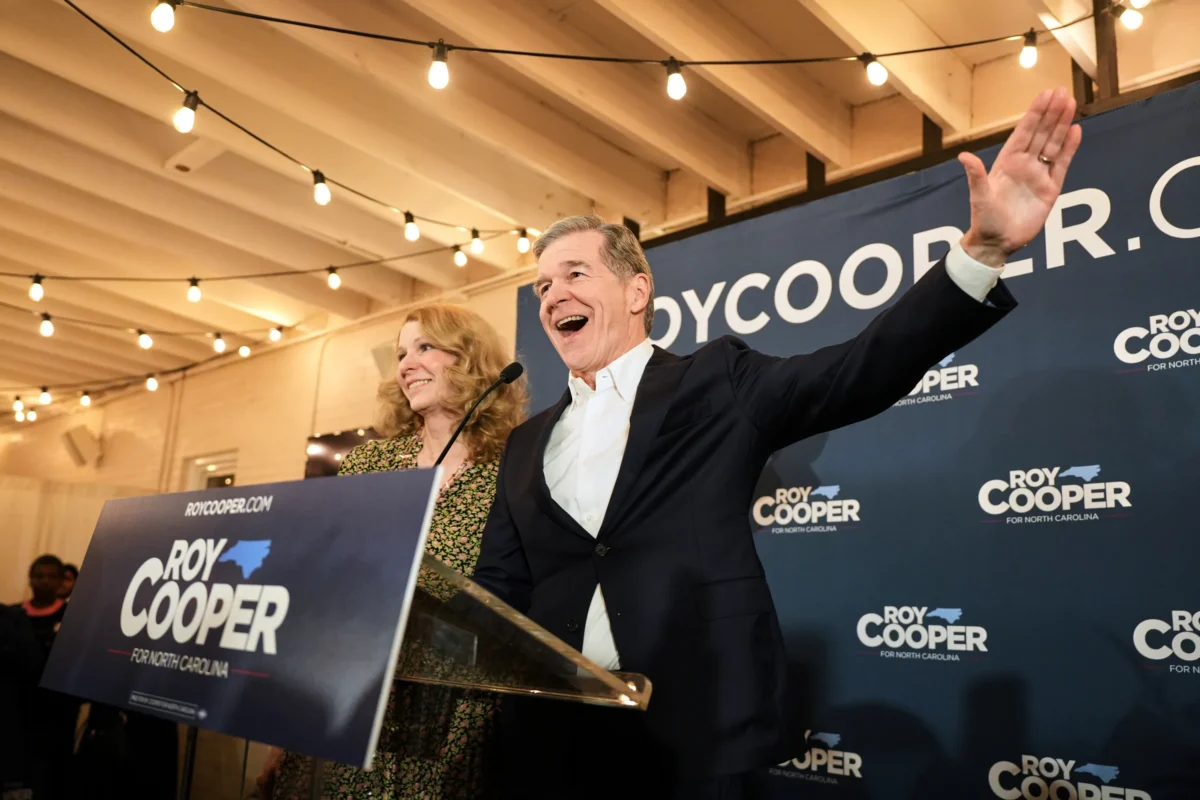
North Carolina Democratic Senate candidate former Gov. Roy Cooper speaks at a primary election night watch party in Raleigh, N.C., on March 3, 2026. Matt Ramey/AP Photo
Cooper was governor between 2017 and 2025, leading the state through a period of rapid growth marked by business expansion, job creation, expanded health care coverage, and investments in public education, according to his campaign website.
He previously served as North Carolina’s attorney general between 2001 and 2017 and served in both chambers of the state legislature between 1987 and 2001.
During his time in the legislature, he was the majority leader of the state senate.
During his campaign, he talked about affordability and a ban on congressional stock trading.
Along with Whatley, candidates who ran for the GOP nomination included business owner Margot Dupre, U.S. Army veteran and entrepreneur Richard Dansie, Navy JAG veteran and attorney Donald Brown, GOP activist Elizabeth Temple, National Alliance for Education Reform Executive Director Michele Morrow, and U.S. Air Force veteran Thomas Johnson.
Candidates who competed for the Democratic nomination alongside Cooper included businessman Daryl Farrow, U.S. Marine Corps veteran Justin Dues, Robert Colon, attorney Marcus Williams, and pastor and former N.C. State football player Orrick Quick.