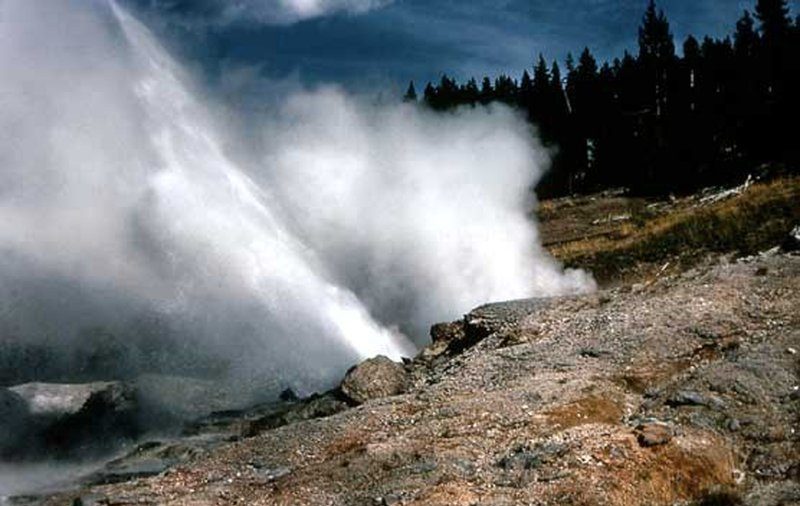
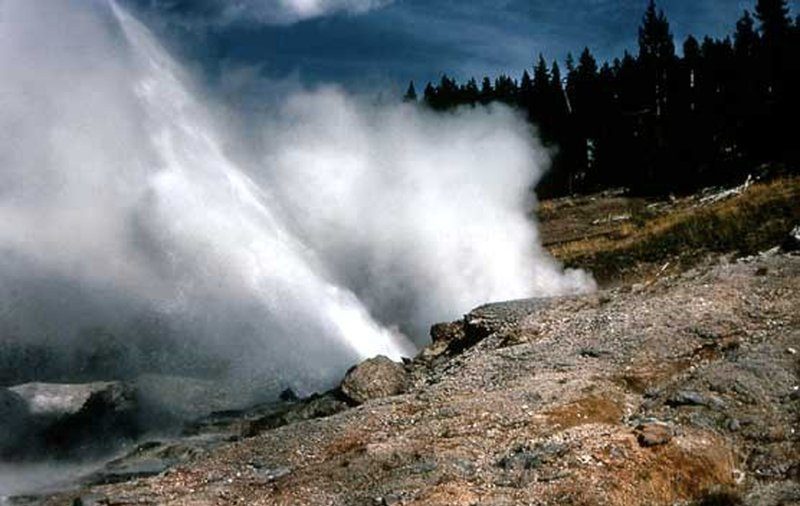
After more than five years of silence, Yellowstone National Park’s Echinus Geyser—the world’s largest acidic geyser—has begun erupting again.
The geyser, located in the Back Basin of Norris Geyser Basin about 660 feet from Steamboat Geyser, last erupted in December 2020. Its renewed activity began in early February, marking the first consistent series of eruptions in years, according to Michael Poland, a U.S. Geological Survey geophysicist and scientist-in-charge of the Yellowstone Volcano Observatory (YVO).
According to Poland in a March 2 Yellowstone Caldera Chronicles column, the first recorded eruption this year occurred on Feb. 7, followed by bursts on Feb. 9, 12, and 15. By mid-February, the geyser began erupting every two to five hours, sending jets of hot water 20 to 30 feet high for two to three minutes at a time.
“After eruption, the water level decreases significantly and doesn’t return to normal for about an hour,” Poland wrote.
A Rare Kind of Geyser
Unlike most of Yellowstone’s neutral or alkaline hot springs, Echinus Geyser is notable for its acidic chemistry—more akin to orange juice or vinegar than sulfuric acid. That acidity stems from the mixing of acidic gases with neutral waters, a combination that gives the geyser’s pool its distinctive red mineral rim and silica-coated, spiny rocks. The feature was named in 1878 by mineralogist Albert Charles Peale, who thought the rocks resembled sea urchins, animals classified as echinoderms.
Acidic geysers are uncommon because acid tends to dissolve the rock that forms a geyser’s plumbing system. At Echinus, though, the acidity is not enough to dissolve the rock.
In the 1970s, Echinus Geyser was one of Norris Basin’s main attractions, erupting regularly at 40-to-80-minute intervals. During the 1980s and 1990s, eruptions sometimes lasted more than 90 minutes and reached heights of about 75 feet. Visitors could sit on benches or view from multi-tiered platforms built during that era—a time when eruptions were so reliable that park staff occasionally posted predictions.
By the early 2000s, however, eruptions faded. Data from a temperature-monitoring system installed in 2010 reported only 15 sporadic eruptions through early 2011, with activity nearly vanishing by the mid-2010s. Then in late 2017, the geyser briefly revived, erupting every few hours between October and November before falling dormant again.
Back in Action
The pattern unfolding this February bears resemblance to that short-lived 2017 awakening, according to Poland.
Instrument data show recurring thermal “spikes” indicating either surges or full eruptions—the former producing smaller increases to around 104 to 122 degrees Fahrenheit, while the latter marks sharp climbs near 158 degrees Fahrenheit. Those temperature spikes, viewable through real-time graphs on the Yellowstone Volcano Observatory’s website, are clear evidence of renewed activity.
Whether the current eruptions will continue into summer remains uncertain.
“It’s probably not too likely given the geyser’s tendency to wake up for a month or two before going back to sleep,” Poland wrote, noting that no confirmed eruptions occurred during the final days of February.