
ALLENTOWN, Pa. — Mortgage rates are climbing sharply, home prices continue to gain and inflation in the broader economy is hitting consumers, leading housing affordability to weigh heavily on both renters and potential homebuyers.
In Pennsylvania — a swing state where House races could help decide control of the next U.S. Congress — renting or owning a home is cheaper than the national average, but the share of income needed to do either has also risen along with the rest of the country. In 2019, it took 20% of the median income to rent a home and 18% to own. Today it’s 22% and 24%, respectively, according to Cotality.
“For that person trying to get an apartment, person moving from an apartment to a starter home, starter home to a larger home, each and every one of those cohorts is reporting that it’s a challenge right now, and it’s something that is weighing on them in a very important political place,” Lehigh University political science professor Christopher Borick said.
Americans, especially renters, feel financially stretched by housing costs, according to a new CNBC and SurveyMonkey Quarterly Money Survey, released Oct. 5. It found one in five Americans who rent or have a mortgage spend at least half of their pre-tax income on housing, while 49% spend between 25% and 49%. Standard guidelines from banks and lenders say consumers should spend 28% to 30% of their income on housing.
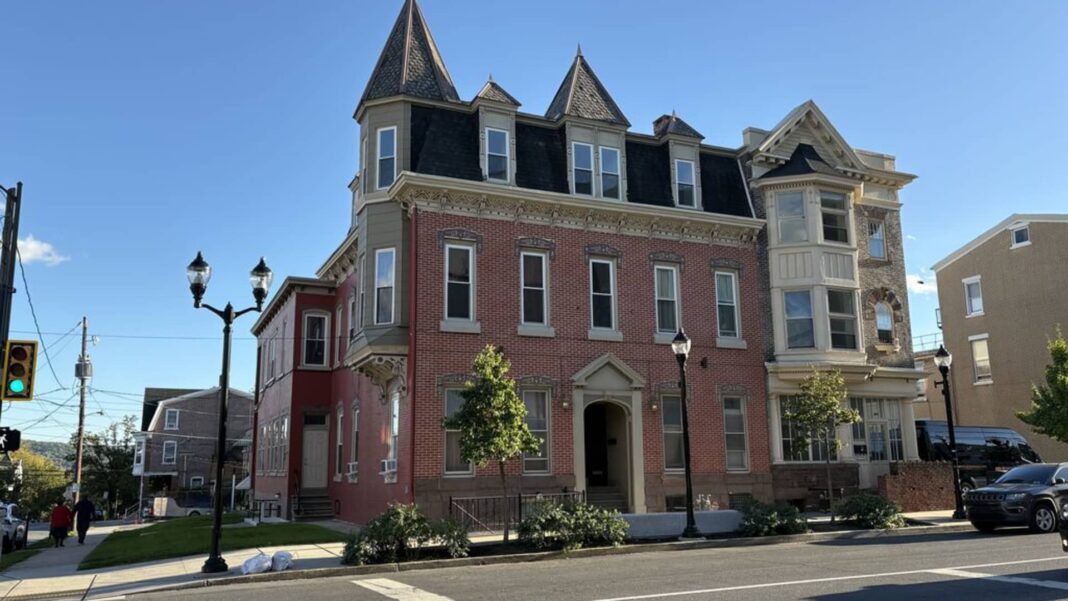
Allentown, Pennsylvania.
Laura Garrison | CNBC
The cost of housing is now the top political issue — even higher than the cost of food or protecting democracy — among U.S. voters aged 18 to 34, according to the most recent CNBC All-America Economic survey.
Going into the midterm election, the average rate on the popular 30-year fixed mortgage has jumped well over 7.5%, according to Mortgage News Daily. It hit a low of 5.99% days before the war with Iran started. For buyers of a median-priced home of around $450,000, that means an increase of roughly $300 in the monthly payment since earlier this year.
Home prices, while cooling from their big gains in the first years of the Covid pandemic, were still up 1.8% in August year over year, according to the latest read from Cotality. Home prices are up close to 60% since the start of the pandemic. Combined with sharply higher mortgage rates, potential buyers are increasingly sidelined. Sales of existing homes in August were down from the year before, coming in at an annualized rate below 4 million.
“This figure of 4 million is about as low as we can go. It tells you there is an extreme affordability problem,” said Norm Miller, a real estate economist and professor emeritus at the University of San Diego’s Knauss School of Business.
The share of median income needed to rent or buy a home has increased nationwide, with homeownership seeing the biggest leap. In 2019, it took a national average of 24% of the median income to rent and 21% to own, according to Cotality. Today, it takes 26% of the median income to rent and 28% to own. For some markets, especially metropolitan areas on both coasts, those numbers are significantly higher.
A separate report from Apartment List finds 52% of the nation’s renters are cost-burdened, meaning they spend more than 30% of their income on housing. This spiked dramatically from 2019 to 2022, as rent prices rose sharply in the first years of the pandemic. More than 22 million households in the U.S. are rent-burdened, a new record.
The Lehigh Valley, Pennsylvania’s 7th Congressional District, where 19% of residents are young, is one of several toss-up races in the state. It ranks 8th nationally among House races where young voters could most influence the midterm elections, according to Tufts University’s CIRCLE Youth Electoral Significance Index.
In that district, a household needs $67,481 per year to afford a typical two-bedroom rental without spending more than 30% of income on housing. The corresponding “housing wage” is $32.44 an hour, according to the most recent National Low Income Housing Coalition’s congressional-district profile.
“We’ve seen a change in the landscape in terms of the cost of housing, access to rental markets, that has really leveraged some of the other broader concerns that we’ve seen in the area of affordability in a pretty potent way,” Borick said. “So when you talk to voters and residents in the area, and you ask them about the things that are driving their concerns right now, housing is always really close to the top of the list.”
Jessica Heller, 33, is a newlywed. She and her husband are renting from a friend in Allentown at a reduced rate. Even with a six-figure salary, she said they aren’t hopeful homeownership is in their near future.
“Unless I’m putting $50,000 down — but like where do you get that money — your mortgage’s still going to be like 2, 3, 4 thousand a month,” Heller said. “And in Allentown, some of the most rundown homes are still selling for $400,000. It’s like we’re not able to get like a starter home and invest into it.”
Most renters want to own a home, but few expect to, as nearly three in four Americans say buying a home has become more difficult in the last five years, according to CNBC and SurveyMonkey findings. The results also showed nearly one in four renters don’t ever plan to buy a home, with down payments and limited income as the top barriers.
Incumbent Congressman Ryan Mackenzie, a Republican, is up against Democrat Bob Brooks. Mackenzie touts his support for affordable housing tax credits passed in the 2025 budget bill. In January, he co-sponsored the Make American Housing Affordable Act, which would establish a tax credit for homebuyers on their primary home. That bill has yet to see a vote.
“Housing affordability is one of the top concerns of families across the Lehigh Valley and the Poconos. After enduring years of skyrocketing housing costs, first-time homebuyers deserve relief,” Mackenzie wrote in a release.
Real estate in Allentown, Pa.
Laura Garrison | CNBC
Brooks has also made housing affordability a top priority.
“We need to build more starter homes, crack down on corporate landlords and rent gouging, and expand programs that help first-time homebuyers get their start. And yes, sometimes cut rules and red tape that make it harder and more expensive to get homes built,” he said on his website.
In their district, 54% of renters are spending more than 30% of their income on rent, according to the U.S. Census. Home prices in Allentown are up nearly 4% compared with a year ago, according to Zillow. Allentown, in particular, has seen big increases in rent and home prices, as former residents of New York City and Philadelphia have moved there seeking, ironically, more affordable housing.
“If you look at a market like the Allentown metro, it takes almost 60% of the average renter’s household income to consider homeownership for the median home in that particular market, and that’s a little bit above the national average,” Miller said.
Blake Fontaine, 26, is still living at home with his mother in Easton. Fontaine said he makes a six-figure salary at ADP, one of the area’s larger employers. He’s saved some money and would like to move out, he said, but can’t stomach the costs.
“When I started looking at the prices on houses, it completely made me backtrack,” said Fontaine, who said he will not vote in the upcoming election. “It’s like I’m gonna pay $500,000 for the same thing my mom paid $100,000. Makes no sense.”
In another toss-up district, Pennsylvania’s 10th, Republican incumbent Scott Perry faces Democrat Janelle Stelson. Perry was the only member of Congress from Pennsylvania to vote against the bipartisan affordable housing bill, the 21st Century ROAD to Housing Act, which was signed into law in July.
“For over 50 years, the federal government has thrown money at housing — which has caused the current housing crisis,” Perry wrote in a social media post. “The more money we throw at it, the more expensive it gets.”
His rival Stelson has a housing affordability plan that includes expanding small-dollar home loans and cutting home construction regulation.
“I will vote to repeal the tariffs [Pennsylvania] Congressman Scott Perry supports on lumber and drywall that are driving up the cost of every home we build,” Stelson said at a campaign event in front of a new apartment complex in Carlisle, Pennsylvania.
Pennsylvania has an outsized number of municipalities, adding to local zoning complaints from builders nationally and, as Lehigh University’s Borick calls it, a vast array of municipal rules.
“I don’t necessarily know in the short term, or even in the near short term, that you’re going to see the changes that would really affect consumer sentiment in terms of this particular area of affordability,” he said.