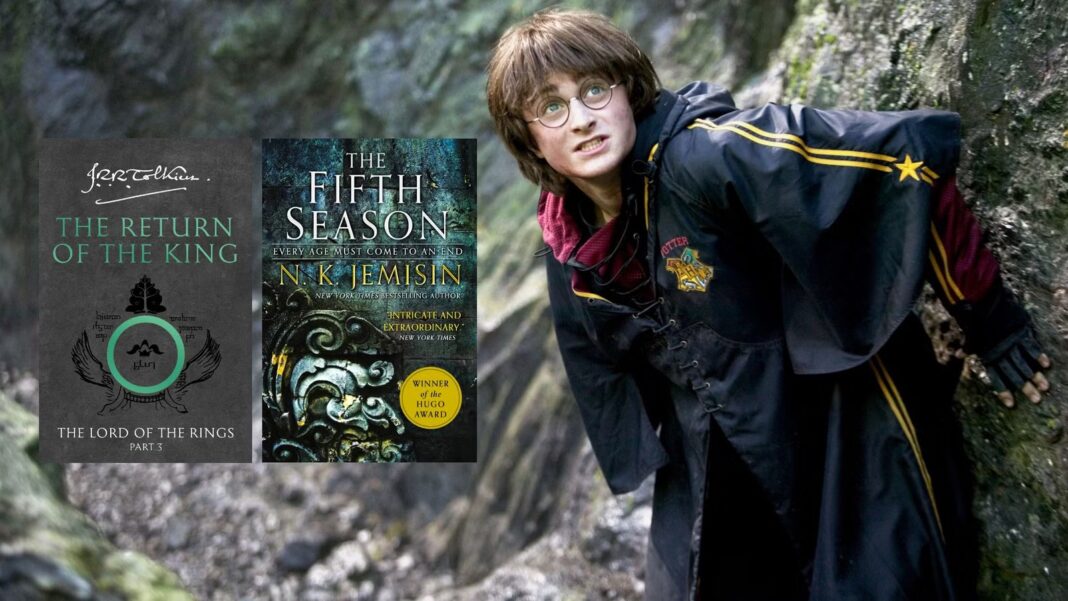
If you’re anything like me, there’s a good chance that Harry Potter was one of the books that made you fall in love with fantasy. For a lot of readers, returning to Hogwarts feels like going back to your childhood home. Staying up too late with a flashlight under the blanket and arguing with friends over which house you’ll actually get sorted to… that stuff doesn’t just fade because you grow up and read more books. It holds a special place in a lot of hearts, mine included, and nothing on this list is taking that away from us.
But here’s the thing about growing up and reading more books: the genre keeps going, and it goes to places Hogwarts never could. Fantasy has been around for longer than Harry Potter, and the genre has only grown more ambitious since the book arrived. It has room for moral complexity, brutal consequences, and ideas that a children’s series was never designed to carry. So this isn’t a dig at the books. It is a reminder that, if Harry Potter is where your fantasy journey started, there’s a bigger world waiting for you.
Why You Should Trust Me: I’ve spent nearly four years writing about film and television for MovieWeb, with a particular interest in fantasy, science fiction, and action thrillers. Harry Potter was my gateway into the genre too, so I’m not coming at this from a place of superiority. I’ve read all 10 of these book series in full, and my goal is to show how much further fantasy can go.
‘The Kingkiller Chronicle’ by Patrick Rothfuss
The Magic School Story for People Who Outgrew Hogwarts

Read This If: You loved the idea of a magic school but wanted the stakes and the prose to grow up alongside you. Rothfuss has a real gift for language, atmosphere, music, mystery, and the feeling that a story is being passed down like a legend. The Name of the Wind and The Wise Man’s Fear follow Kvothe as he builds the larger-than-life reputation that surrounds him, and the books are filled with stories within stories. The magic also has more variety than the familiar wand-and-spell approach of Harry Potter. Sympathy works like a magical science, with the laws of physics backing it, while Naming offers something that’s hard to explain.
Skip This If: The only reason The Kingkiller Chronicle is at the bottom of the list like this is that the main story is unfinished. I can praise the writing, world-building, atmosphere, and magic all day, but a fantasy series has to actually give readers the complete journey, and Kingkiller doesn’t. So you might want to hold off starting this one.
‘His Dark Materials’ by Philip Pullman
A Children’s Fantasy That Isn’t Afraid to Ask Big Questions
Read This If: Philip Pullman’s His Dark Materials is a rare children’s fantasy story that decides it would also like to have a serious conversation about religion, free will, and growing up. The trilogy follows Lyra and Will across parallel worlds, mixing witches, armored bears, and other fantastical ideas with questions that become increasingly mature as the story develops. That gives it an edge over Harry Potter for me. J.K. Rowling’s books certainly become darker as they progress, but Pullman binds those questions into the foundation of the series.
Skip This If: You want your fantasy to feel comforting. His Dark Materials can be beautiful, funny, strange, and adventurous, but it’s not always interested in making you feel safe. The further the trilogy goes, the more it asks you to process difficult ideas and concepts.
‘The Wheel of Time’ by Robert Jordan
Features an Entire World With Its Own History
Read This If: If you think Harry Potter made its magical world feel enormous, The Wheel of Time takes that idea and practically drops it from a helicopter. Robert Jordan’s fourteen-book series builds an epic fantasy world filled with different religions, cultures, magical traditions, prophecies, and histories. Brandon Sanderson completed the expansive story after Jordan’s 2007 death. Hogwarts is wonderfully detailed, but it’s just one part of a huge magical backdrop. Jordan, on the other hand, delivers a world that has been turning for thousands of years before the main characters arrive.
Skip This If: You’re intimidated by long commitments. Fourteen books is a real undertaking, and the notoriously slow middle stretch of the series has tested even devoted readers, so go in knowing what you’re signing up for.
‘The First Law’ by Joe Abercrombie
Grimdark Fantasy With a Little More Bite

Read This If: Harry Potter loves the chosen one trope and heroic traditions, but Joe Abercrombie’s First Law trilogy debunks the idea and makes you wonder what would happen if everyone was terrible. The trilogy, beginning with The Blade Itself, leans into grimdark fantasy, violence, dark humor, and characters you cannot categorize as heroes or villains. That immediately makes it a very different reading experience. Logen Ninefingers, Glokta, and Jezal all believe they’re capable of change, and Abercrombie spends the whole trilogy testing whether that’s actually true. It’s brutal, it’s frequently funny in ways that catch you off guard, and nobody gets a clean ending.
Skip This If: You want lovable magical creatures, cozy common rooms, or heroes who make you feel better about humanity. The First Law has plenty of charm, but it keeps it in a very dark room. The violence is harsh, the humor is mean, and the characters are rarely rewarded for having good intentions.
‘The Stormlight Archive’ by Brandon Sanderson
Magic With the Scope of an Entire Planet’s Ecosystem

Read This If: You want a fantasy series that is willing to sit with mental health, trauma, and depression as seriously as it explores the magic system. Kaladin’s arc dealing with depression and PTSD gives the series an emotional weight that goes well past anything Harry Potter does — and that’s accounting for the occasional dark moments. Sanderson has also described the series as a love letter to epic fantasy, which feels pretty accurate once you see how much world-building he has packed into it. For me, that ambition is where Stormlight really beats Harry Potter.
Skip This If: You want a quick, easy read. These books are easily a thousand pages each, and the sheer density of world-building and character threads can be a lot to track if you’re not ready to commit.
‘The Realm of the Elderlings’ by Robin Hobb
Characters Who Feel Uncomfortably Real

Read This If: The actual point of this story is the protagonist’s pain. Robin Hobb’s Realm of the Elderlings doesn’t try to beat Harry Potter by giving readers bigger battles or more impressive spells. It goes in the opposite direction. Hobb crafts her fantasy around complicated relationships, themes of loss and betrayal, and relatable characters. The magic here, the Skill and the Wit, takes a real toll on the people using it every time it’s called on. By the time you’re a few books deep, you’ll understand why so many readers describe this series as the one that wrecked them emotionally.
Skip This If: You want your fantasy fast-moving and plot-driven. Hobb is famously known to write slow, introspective, character-first books. So if you need constant external stakes to stay hooked, the pace will test you before it pays off.
‘A Song of Ice and Fire’ by George R.R. Martin
Proved Fantasy Didn’t Need a Clear Line Between Good and Evil
Read This If: I don’t really need to justify this one, but if I have to talk about something I really admire about George R.R. Martin’s A Song of Ice and Fire, it’s the political complexity of the series. In these books, nobody’s safe and nobody’s purely righteous. Martin builds a world where every character has understandable motivations, even the ones doing terrible things, and where power struggles matter as much as any battle. It’s a far cry from Harry Potter’s clean division between good and evil, and that moral murkiness is a big part of why ASOIAF became a genre-defining fantasy in its own right.
Skip This If: You want to read a finished series. The last two books still haven’t come out, and if you got burned by the ending of HBO’s Game of Thrones or hate waiting on unresolved plotlines, it’s something worth considering beforehand.
‘The Earthsea Cycle’ by Ursula K. Le Guin
The Wizard School That Was Already Old News Decades Before Hogwarts Existed

Read This If: Not everyone knows that Hogwarts has a direct literary ancestor. Well, Ursula K. Le Guin wrote about a magical school for wizards, named it Roke, and filled it up with rival students and a headmaster figure, nearly 30 years before Harry Potter existed. She used the setup to explore a subject Rowling’s series mostly skipped: the real danger of unchecked power and the discipline it takes to use magic responsibly. Le Guin does not keep adding bigger spells to make the fantasy magical. She makes sure power has consequences, so that sometimes, the wisest thing a character can do is choose not to use it. That restraint is a huge reason Earthsea ranks above A Song of Ice and Fire for me.
Skip This If: You need your fantasy to constantly remind you how epic it is. Earthsea is quieter than Harry Potter, A Song of Ice and Fire, and almost every other fantasy series above it. If you’re looking for big magical battles and high-stakes action, this series is going to feel slow.
‘The Broken Earth’ by N.K. Jemisin
Fantasy That Uses Its Premise to Talk About Real Oppression

Read This If: I’m not dismissing Harry Potter’s attempts at social commentary, where the series explores topics like blood purity and house-elves. But you’ve got to admit that the series pulled its punches. On the other hand, Jemisin creates an entire society around fearing and enslaving people born with the power to control seismic energy. She never lets the reader look away from what that costs the people living it. The trilogy became the first in history to win the Hugo Award for Best Novel three years running, once for each book. That’s not why it ranks #2, but it does say something about how successfully it pushed the boundaries of modern speculative fiction.
Skip This If: You want fantasy to feel like an escape. The Broken Earth can be beautiful, but it is not gentle. The books deal with trauma, oppression, environmental destruction, family, and survival, and they never soften their edges. The series also spans three different timelines that eventually connect, but it demands patience, especially at the beginning.
‘The Lord of the Rings’ by J.R.R. Tolkien
This is Where Modern Fantasy Really Came From
Read This If: It almost feels unfair to put The Lord of the Rings at #1 because so much of what we love about modern fantasy exists partly because Tolkien showed future writers what the genre was capable of. Harry Potter may have been a childhood gateway into fantasy for an entire generation, but Tolkien constructed the road that led to it. He created histories, languages, cultures, peoples, songs, maps, and entire ages of history to envelop the events of The Lord of the Rings. Even the smallest details felt like fragments of a much larger lore. The writing is also part of the experience, obviously. Tolkien’s prose can be slower than Rowling’s, but there is a sense of history that makes Middle-earth feel legendary.
Skip This If: You want a quick, cozy fantasy. Tolkien takes his time, spends plenty of pages describing landscape, and expects you to settle into the rhythm of Middle-earth. It’s not the easiest fantasy read, but if you give it time, the experience is extraordinary.