The 2026 NFL Draft is underway. Months of scouting, planning and — for some teams — aggressive trading led to these three days. All 32 franchises are now adding rookies to their rosters throughout the seven-round event, and every selection is ripe for scrutiny.
Every pick on Thursday and Friday fell under our watchful eye as we analyzed the value, fit and talent caliber associated with each selection. A whopping eight trades further complicated the equation in Round 1, while a run on tight ends and a couple of eyebrow-raising quarterback picks defined the second and third rounds. We’re back Saturday for the final four rounds.
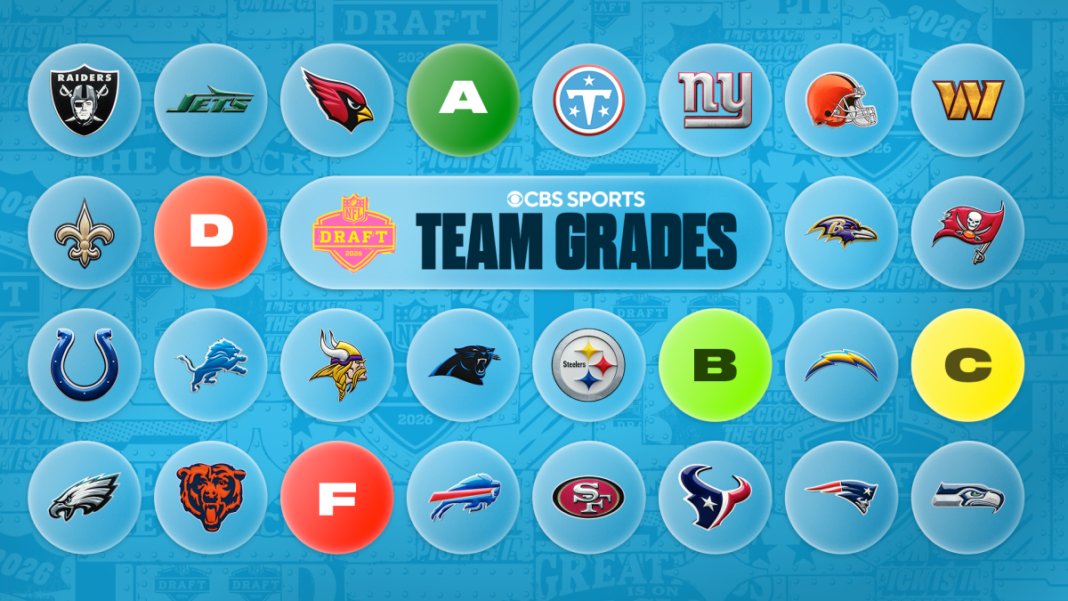
Using an internal formula based on our analysts’ individual pick grades, we’re handing out team-by-team grades to assess how effectively each franchise uses its draft capital. Early rounds carry more weight than later selections, and picks at the top of the board are valued more heavily than those at the back end of each round.
This page tracks how each team is building its class in real time, with team grades updating after every selection.
Individual pick grades are determined by two CBS Sports NFL Draft analysts. Mike Renner handled the first three rounds, while Josh Edwards now takes over on Saturday for Rounds 4–7.
Here are our team-by-team grades for the 2026 NFL Draft.
2026 NFL Draft essentials

Arizona Cardinals — B-
| Pick | Player | Grade |
|---|---|---|
| R1 (3) | Jeremiyah Love — RB, Notre Dame | C+ |
| R2 (34) | Chase Bisontis — IOL, Texas A&M | A |
| R3 (65) | Carson Beck — QB, Miami | D |
| R4 (104) | Kaleb Proctor — DT, Southeastern Louisiana | B |
| R5 (143) | Reggie Virgil — WR, Texas Tech | B |
| R6 (183) | ||
| R7 (217) |
Arizona had a clear plan in this draft: Build a running game. The Cardinals went running back–interior lineman with their first two picks. But then they took a quarterback. That’s not a shock, but what is questionable is taking Carson Beck rather than making a move for Ty Simpson in Round 1.
Beck’s arm is a real concern following a senior year at Miami in which he struggled to hit some deep throws. His UCL injury at the end of his Georgia career also clouds his long-term future. That’s not quite the sure thing a team would prefer when taking what it hopes is a franchise signal-caller.
Earlier, the Cardinals were about as aggressive as they could have been at No. 3. They made Jeremiyah Love the first running back selected in the top five since Saquon Barkley went second overall in 2018. They are now heavily invested in the position even though they don’t have a long-term quarterback, which makes this a “C+” pick, according to Renner. That is no knock on Love, though. Many analysts view him as the best player in the draft, and he has superstar potential.
Atlanta Falcons — B+
| Pick | Player | Grade |
|---|---|---|
| R2 (48) | Avieon Terrell — CB, Clemson | A+ |
| R3 (79) | Zachariah Branch — WR, Georgia | A |
| R4 (134) | Kendal Daniels — LB, Oklahoma | D |
| R6 (215) | ||
| R7 (231) |
It took until the midway point of the second round, but the Falcons are finally on the board. And they are responsible for arguably the best feel-good story of the draft. In selecting Avieon Terrell, the cornerback group is now familial. Terrell joins brother A.J. in the unit and could share the starting lineup with him in very short order.
Also, Zachariah Branch won’t have to go far to begin his pro career. He developed into a more well-rounded receiver at Georgia following an early breakout at USC, where he showcased incredible athleticism. He’ll be a fun weapon in an offense already loaded with star power.
Things went a little sideways for the Falcons in Round 4, when their grade dipped from an “A+” to a “B+” with one pick. The Kendal Daniels selection is a tricky one because Josh Edwards described him as “a player without a position” and suggested he may have to start his career on special teams.
Baltimore Ravens — B+
| Pick | Player | Grade |
|---|---|---|
| R1 (14) | Olaivavega Ioane — IOL, Penn State | A |
| R2 (45) | Zion Young — EDGE, Missouri | C+ |
| R3 (80) | Ja’Kobi Lane — WR, USC | B- |
| R4 (115) | Elijah Sarratt — WR, Indiana | B+ |
| R4 (133) | Matthew Hibner — TE, SMU | C |
| R5 (162) | Chandler Rivers — CB, Duke | A- |
| R5 (173) | Josh Cuevas — TE, Alabama | B |
| R5 (174) | Adam Randall — RB, Clemson | B- |
| R6 (211) | ||
| R7 (250) | ||
| R7 (253) |
The interior of the Ravens’ offensive line is in flux after Tyler Linderbaum departed in free agency. Bolstering the guard and center spots is paramount as Baltimore enters the Jesse Minter era, and it kicked off that new phase with a home-run pick that addresses the need. Olaivavega Ioane might be the best pure lineman in the class and will immediately help open lanes for Lamar Jackson and Derrick Henry in what should remain one of the NFL’s premier rushing attacks.
Baltimore then continued to revamp its edge rusher group in Round 2. The nixed Maxx Crosby trade and successful Trey Hendrickson acquisition made the Ravens’ defensive end group one of the most talked-about units in the NFL this offseason, and Zion Young is the latest addition. He is more of a run-stopper than a pass rusher, so the Ravens could move him inside. If not, it’s a “C+” pick, according to Renner.
Ja’Kobi Lane and Elijah Sarratt went consecutively on Baltimore’s board to provide an influx of weapons for Lamar Jackson. Renner called Lane a “project” receiver, but at 6-foot-4, he could force his way into the rotation as a rookie since he’s such an imposing target. Sarratt is not a short receiver, either, at 6-foot-2. Another tall weapon arrived in Round 4 in the form of tight end Matthew Hibner, who will replace Isaiah Likely.

Buffalo Bills — B
| Pick | Player | Grade |
|---|---|---|
| R2 (36) | T.J. Parker — EDGE, Clemson | B- |
| R2 (62) | Davison Igbinosun — CB, Ohio State | C+ |
| R4 (102) | Jude Bowry — OT, Boston College | A |
| R4 (125) | Skyler Bell — WR, UConn | B |
| R4 (126) | Kaleb Elarms-Orr — LB, TCU | C+ |
| R5 (167) | Jalon Kilgore — S, South Carolina | A- |
| R5 (168) | ||
| R7 (220) |
The Bills finally got on the board in Round 2 after trading out of the first round. The expectation was that, once they went on the clock, they would select a defensive player. That played out with each of their first two picks. T.J. Parker bolsters the defensive front while Davison Igbinosun helps the secondary. Both units must improve if Buffalo wants to break through and get the most out of Josh Allen and its elite offense.
Buffalo then opened Day 3 by trading back one spot and using the second pick of the fourth round on an offensive lineman. Jude Bowry brings some depth to a group that lost David Edwards in free agency.
It also went back-to-back in the draft order in the fourth round. Picks 125 and 126 filled team needs at the right value, as Josh Edwards projected the Bills to select Skyler Bell at No. 126 in his fourth-round mock draft.
Carolina Panthers — A-
| Pick | Player | Grade |
|---|---|---|
| R1 (19) | Monroe Freeling — OT, Georgia | B+ |
| R2 (49) | Lee Hunter — DT, Texas Tech | A+ |
| R3 (83) | Chris Brazzell II — WR, Tennessee | A- |
| R4 (129) | Will Lee III — CB, Texas A&M | B- |
| R5 (158) | Sam Hecht — IOL, Kansas State | A |
| R5 (151) | Zakee Wheatley — S, Penn State | A- |
| R6 (200) |
Since the Panthers clearly want to see things through with Bryce Young, it makes sense to build the offense around him. Adding more protection with a first-round offensive tackle was a logical step in that direction, as was the Chris Brazzell II pick at No. 83.
Carolina had been strongly tied to tight end Kenyon Sadiq at No. 19, and while giving Young another receiving option in the first round rather than the third would have been splashier, there is nothing wrong with taking Monroe Freeling in that spot. He might be a bit of a project, though.
Lee Hunter, on the other hand, is no project. He was an absolute force at Texas Tech last year and at UCF the three seasons prior. The Panthers found an excellent run-stopper on Day 2 with what is their best pick of the draft.
Chicago Bears — B-
| Pick | Player | Grade |
|---|---|---|
| R1 (25) | Dillon Thieneman — S, Oregon | B |
| R2 (57) | Logan Jones — C, Iowa | D+ |
| R2 (69) | Sam Roush — TE, Stanford | A |
| R3 (89) | Zavion Thomas — WR, LSU | C+ |
| R4 (124) | Malik Muhammad — CB, Texas | B+ |
| R5 (166) | Keyshaun Elliott — LB, Arizona State | B- |
| R7 (239) | ||
| R7 (241) |
The Bears had not taken a defensive player in the first round since 2018, which was the longest stretch of any team. The expectation was that the streak would end, but the question was whether they would address the defensive front or continue to rebuild their secondary after a free-agent exodus. The latter came to fruition when Dillon Thieneman was available to them at No. 25. He is a Day 1 starter for a team with a hole at safety.
Logan Jones is a less conventional pick, to say the least. Renner gave it a “D+” because of Jones’ weaknesses in pass protection. Yes, he will help Chicago maintain its imposing run game and will have time to develop behind Garrett Bradbury. But that makes it even more questionable: Why use second-round capital on a backup center, especially when better options were on the board?
At face value, the Sam Roush pick also looks strange considering Colston Loveland is already on board. But Roush is a blocker by trade and will not step on Loveland’s toes. It’s an excellent acquisition for a team looking to further flex its run-game ability and was the Bears’ best pick of the first three rounds.

Cincinnati Bengals — A-
| Pick | Player | Grade |
|---|---|---|
| R2 (41) | Cashius Howell — EDGE, Texas A&M | A+ |
| R3 (72) | Tacario Davis — CB, Washington | B- |
| R4 (128) | Connor Lew — C, Auburn | A |
| R4 (140) | Colbie Young — WR, Georgia | C+ |
| R6 (189) | ||
| R6 (199) | ||
| R7 (221) | ||
| R7 (226) |
Even though they traded out of the first round, the Bengals still secured an exciting replacement for Trey Hendrickson. No one is going to fully replicate the production Hendrickson provided off the edge over the last few years, but Cashius Howell dominated SEC offensive tackles during his Texas A&M career and could be in for a prolific pro career, even though his arms measured concerningly small.
Even more defensive help is on the way in the form of Tacario Davis, the other Day 2 pick. Cincinnati had to get better defensively in this draft and addressed both the front and secondary with their two Friday selections. Mission accomplished.
On Day 3, the Bengals took center Connor Lew — whom Josh Edwards called the best prospect available and his favorite center in the class (prior to his 2025 season-ending torn ACL at Auburn). He could be the team’s long-term answer at the position, and finding that in the fourth round is a major win.
Cleveland Browns — A
| Pick | Player | Grade |
|---|---|---|
| R1 (9) | Spencer Fano — OT, Utah | A+ |
| R1 (24) | KC Concepcion — WR, Texas A&M | A+ |
| R2 (39) | Denzel Boston — WR, Washington | A |
| R3 (58) | Emmanuel McNeil-Warren — S, Toledo | A+ |
| R3 (86) | Austin Barber — OT, Florida | A- |
| R5 (146) | Parker Brailsford — IOL, Alabama | A- |
| R5 (149) | Justin Jefferson — LB, Alabama | B- |
| R5 (170) | Joe Royer — TE, Cincinnati | B- |
| R7 (248) |
Cleveland wanted to come out of the first round with an offensive lineman and a receiver, and it did just that. And then it repeated the feat on Day 2.
Shoring up the line is a necessity if the Browns are ever to develop a franchise quarterback. Renner said they got the cleanest offensive line prospect in the draft in Spencer Fano, and then they grabbed Austin Barber three rounds later and Parker Brailsford in Round 5. That’s one box checked.
Surrounding said quarterback with playmakers is also a non-negotiable. Enter KC Concepcion and Denzel Boston. Box No. 2 is also checked.
It wasn’t until their seventh pick that the Browns received a grade other an an “A.” The Justin Jefferson selection is an upside play, and that’s fine for an already loaded defense.
Dallas Cowboys — B+
| Pick | Player | Grade |
|---|---|---|
| R1 (11) | Caleb Downs — S, Ohio State | A |
| R1 (23) | Malachi Lawrence — EDGE, UCF | C |
| R3 (92) | Jaishawn Barham — EDGE, Michigan | A |
| R4 (112) | Drew Shelton — OT, Penn State | A- |
| R4 (114) | Devin Moore — CB, Florida | B+ |
| R4 (137) | LT Overton — EDGE, Alabama | B+ |
| R7 (218) |
The talk of draft season was that the Cowboys would trade up if one of their favorite defensive prospects was there for the taking. They were also identified as a trade-down candidate with their No. 20 pick. Jerry Jones made both of those predictions come to life — all while securing a couple of terrific defensive prospects to fill his team’s glaring needs.
Caleb Downs remaining on the board outside the top 10 was the catalyst for a transaction with the Dolphins. He has the potential to be a long-term leader of this defense.
All kinds of help is on the way in the edge rusher unit. This group was a glaring weakness following the Micah Parsons trade and became the focal point of Dallas’ draft plans. Malachi Lawrence was available at No. 23 after the Cowboys made an intra-division swap with the Eagles, Jaishawn Barham came off the board the following day and LT Overton made it three consecutive days with an edge rusher pick.
Denver Broncos — B+
| Pick | Player | Grade |
|---|---|---|
| R3 (66) | Tyler Onyedim — DT, Texas A&M | B- |
| R4 (108) | Jonah Coleman — RB, Washington | B+ |
| R4 (111) | Kage Casey — OT, Boise State | A |
| R5 (152) | Justin Joly — TE, NC State | B |
| R6 (182) | ||
| R7 (246) | ||
| R7 (256) | ||
| R7 (257) |
Early in Round 3, the Broncos became the final team to make its first selection. They did not have a first-rounder entering the draft and moved out of Round 2 in a Friday trade. With the No. 66 pick, they refueled their already stout defense with lineman Tyler Onyedim, who will not fully replace Jonathan Franklin-Myers but adds a fresh body to that group.
All but one of Denver’s picks are Day 3 selections, and the first is a fun one. Jonah Coleman brings a lot of the same skills as R.J. Harvey, whom the Broncos selected a year ago, as a versatile running back with experience making electric plays as a receiver. Kage Casey and Justin Joly bring some edge protection with the latter also boasting the ability to stretch the field as a receiving tight end.
Detroit Lions — B
| Pick | Player | Grade |
|---|---|---|
| R1 (17) | Blake Miller — OT, Clemson | C |
| R2 (44) | Derrick Moore — EDGE, Michigan | A- |
| R4 (118) | Jimmy Rolder — LB, Michigan | B+ |
| R5 (157) | Keith Abney II — CB, Arizona State | A- |
| R5 (168) | Kendrick Law — WR, Kentucky | B+ |
| R6 (205) | ||
| R6 (213) | ||
| R7 (222) |
If mock draft season taught us anything about the Lions, it was that it would be a shock to see them take anything besides an offensive lineman in the first round. Blake Miller emerged as the guy at No. 17, and it’s hard not to love the pick. Not only does Detroit fill a glaring need at one of the tackle spots, but it can now move forward with its plan to shift Penei Sewell from the right side to the left. Miller exclusively played right tackle at Clemson and can now hit the ground running at that same position in the NFL. Renner, however, does not love prioritizing fit over taking the best player available and gave the Lions a “C” as a result.
The Lions rebounded in the second round by trading up for Derrick Moore. There is now a real hometown feel on Detroit’s defensive front with a pair of Michigan products in Moore and Aidan Hutchinson holding down the edge and Jimmy Rolder operating behind them at linebacker.
Green Bay Packers — A-
| Pick | Player | Grade |
|---|---|---|
| R2 (52) | Brandon Cisse — CB, South Carolina | A- |
| R3 (77) | Chris McClellan — DT, Missouri | A- |
| R4 (120) | Dani Dennis-Sutton — EDGE, Penn State | A- |
| R4 (153) | Jager Burton — IOL, Kentucky | B- |
| R6 (201) | ||
| R7 (236) | ||
| R7 (255) |
Both of the Packers’ first two picks came off the board in line with Renner’s prospect rankings, so there are no qualms to be had with the value they found in Brandon Cisse and Chris McClellan, both of whom fill defensive needs.
Cisse is still just 20 years old, so the Packers have plenty of time to mold him into the kind of cornerback they want. Renner raved about the fit, noting that Green Bay tasks its corners with heavy off-zone coverage, which is Cisse’s strength. That’s a pretty nice pick for a team that had to wait until the 50s to make its first selection.
Dani Dennis-Sutton made it three straight “A-” picks to open the draft before that streak ended with the Jager Burton move. The Kentucky product brings some positional flexibility to the Packers’ offensive line, though.

Houston Texans — B
| Pick | Player | Grade |
|---|---|---|
| R1 (26) | Keylan Rutledge — IOL, Georgia | A- |
| R2 (36) | Kayden McDonald — DT, Ohio State | A+ |
| R2 (59) | Marlin Klein — TE, Michigan | D- |
| R4 (106) | Febechi Nwaiwu — G, Oklahoma | C- |
| R4 (123) | Wade Woodaz — LB, Clemson | B |
| R5 (141) | Kamari Ramsey — S, USC | B+ |
| R7 (243) |
The Texans were in a trading mood. They moved up for both of their first two picks, first for Keylan Rutledge and on Day 2 for Kayden McDonald.
They might not have needed to trade up in order to grab Rutledge, as most prognosticators tabbed him as a second-round pick. That doesn’t make it a poor selection, though. The Texans are in the midst of a total offensive line overhaul and still had a little bit of work to do on the interior. They found what is arguably the second-best guard in the class and got aggressive in taking him, and then they took another guard on Day 3 in Febechi Nwaiwu.
Moving up for McDonald is more understandable. It was slightly surprising to see him remain on the board after the first round, and he is a tremendous fit on an already beastly defensive front. As a terrific run-stopper, he is the perfect complement to Will Anderson Jr. and Danielle Hunter, who comprise an electric pass rush.
Then the Texans made what Renner called the most head-scratching pick of the entire draft. “The Texans not only have a ton of recently drafted tight ends on their roster, but they also have Dalton Schultz and the recently signed Foster Moreau,” Renner said after they selected Marlin Klein.

Indianapolis Colts — A-
| Pick | Player | Grade |
|---|---|---|
| R2 (53) | CJ Allen — LB, Georgia | A |
| R3 (78) | A.J. Haulcy — S, LSU | A |
| R4 (113) | Jalen Farmer — G, Kentucky | B+ |
| R4 (135) | Bryce Boettcher — LB, Oregon | A- |
| R5 (156) | George Gumbs Jr. — EDGE, Florida | B |
| R6 (214) | ||
| R7 (237) | ||
| R7 (254) |
The Colts addressed their defensive needs on Days 2 and 3 after watching from the sidelines on Thursday. That has to feel good for Lou Anarumo after his group put up some real stinkers in the second half of last season.
Inside linebacker help was a necessity for Indianapolis, and it found some in the second and fourth rounds. If not for positional value, Allen would have been a first-round pick. For him to still be on the board at 53 was a win. Allen is a hard hitter who will help establish a tough culture on the defensive unit. And if recent history tells us anything, it’s that there is nothing wrong with taking a linebacker out of Georgia.
Bryce Boettcher is just as exciting. He has two-sport experience after playing both baseball and football at Oregon and boasts a motor that separates him from most prospects in this class.
Jacksonville Jaguars — B-
| Pick | Player | Grade |
|---|---|---|
| R2 (56) | Nate Boerkircher — TE, Texas A&M | C |
| R3 (81) | Albert Regis — DT, Texas A&M | C+ |
| R3 (88) | Emmanuel Pregnon — G, Oregon | A |
| R3 (100) | Jalen Huskey — S, Maryland | C+ |
| R4 (119) | Wesley Williams — EDGE, Duke | C |
| R5 (164) | Tanner Koziol — TE, Houston | B+ |
| R5 (166) | ||
| R6 (203) | ||
| R7 (233) | ||
| R7 (240) | ||
| R7 (245) |
Back-to-back Texas A&M products joined the Jaguars to open their draft, and the first of them was a bit puzzling.
Nate Boerkircher is a strong blocker, which should help him carve out playing time early in his career. But the Jaguars already have Brenton Strange in the room and could have used their second-round pick to address more pressing needs. This is the team’s first selection of the draft, and it feels like Boerkircher was a name they circled ahead of time as someone likely to be available regardless of what happened from picks Nos. 1-55.
Not only that, but Boerkircher was also the first of two tight ends the Jaguars took. Tanner Koziol is more of a receiving threat than Boerkircher, so at least they didn’t take identical prospects.
Jacksonville did ace its Emmanuel Pregnon pick in Round 3. The offensive line is far from the Jaguars’ weakest position, but how could they pass on a guard who some thought could have flown off the board on Day 1? That’s an awesome depth addition.

Kansas City Chiefs — B+
| Pick | Player | Grade |
|---|---|---|
| R1 (6) | Mansoor Delane — CB, LSU | B- |
| R1 (29) | Peter Woods — DT, Clemson | A+ |
| R2 (40) | R Mason Thomas — EDGE, Oklahoma | A |
| R4 (109) | Jadon Canady — CB, Oregon | B- |
| R5 (161) | Emmett Johnson — RB, Nebraska | B |
| R5 (176) | Cyrus Allen — WR, Cincinnati | B- |
| R6 (210) |
The Chiefs entered Thursday with two first-round picks and closed it with two defensive players. There’s no elite help on the way for Patrick Mahomes on his side of the ball, but it’s hard not to like what Kansas City accomplished.
The mass exodus from the secondary this offseason made cornerback a key need — so much so that the Chiefs traded up from No. 9 to select Mansoor Delane. The trade with the Browns opened the door for GM Brett Veach to take a player Renner calls the “safest pick at corner in this draft class.” The only knock against this pick is that Kansas City gave up a third-rounder in the trade. Grabbing Peter Woods toward the end of the round as an eventual successor to Chris Jones was the cherry on top.
That wasn’t the end of the defensive haul, though. Each of the Chiefs’ first four acquisitions hail from that side of the ball. R Mason Thomas joined the group on Friday, continuing a surge of talent along the defensive front that also includes a pair of Day 2 picks from last year in Omarr Norman-Lott and Ashton Gillotte. And Jadon Canady on Saturday became the team’s second cornerback selected.
The AFC West behemoth finally took an offensive player in Round 5. The Chiefs ecognized this offseason that the running game needed a complete overhaul, and after paying up for Kenneth Walker III in free agency, they drafted Emmett Johnson, the reigning Big Ten rushing champion.
Las Vegas Raiders — A
| Pick | Player | Grade |
|---|---|---|
| R1 (1) | Fernando Mendoza — QB, Indiana | A |
| R2 (38) | Treydan Stukes — S, Arizona | A |
| R3 (67) | Keyron Crawford — EDGE, Auburn | A |
| R3 (91) | Trey Zuhn III — C, Texas A&M | A+ |
| R4 (101) | Jermod McCoy — CB, Tennessee | A+ |
| R4 (122) | Mike Washington Jr. — RB, Arkansas | A |
| R5 (150) | Dalton Johnson — S, Arizona | C+ |
| R5 (175) | Hezekiah Masses — CB, California | B+ |
| R6 (185) | ||
| R6 (208) |
It would have been the surprise of all surprises if the Raiders did anything with the No. 1 pick other than select Fernando Mendoza. There is no drama here, and as such, it’s an “A” for Las Vegas right out of the gate. Klint Kubiak has his quarterback of the future.
The draft really started for Las Vegas in Round 2. Treydan Stukes was the first pick the Raiders had to make on the fly. Stukes gained traction among the draft community as the spring progressed, and while he is popular among analysts, the fact that he came off the board before Emmanuel McNeil-Warren is a surprise.
The Raiders then made it six straight “A” picks with the additions of Keyron Crawford, Trey Zuhn III, Jermod McCoy and Mike Washington Jr. The McCoy pick delivers unbelievable value, as he might be the best cornerback in the class if he is healthy. The ACL tear that cost him the entire 2025 season is a red flag and prompted the biggest slide for any prospect in the draft, but if he is at full strength upon arrival in Las Vegas, he is an absolute steal at No. 101.
The “A” streak finally came to an end with their seventh pick, safety Dalton Johnson.

Los Angeles Chargers — B
| Pick | Player | Grade |
|---|---|---|
| R1 (22) | Akheem Mesidor — EDGE, Miami | B+ |
| R2 (63) | Jake Slaughter — C, Florida | C+ |
| R4 (105) | Brenen Thompson — WR, Mississippi State | C+ |
| R4 (117) | Travis Burke — OT, Memphis | B |
| R4 (131) | Genesis Smith — S, Arizona | B |
| R5 (145) | Nick Barnett — DL, South Carolina | A |
| R6 (202) | ||
| R6 (204) | ||
| R6 (206) |
The Chargers need help on the interior offensive line in the worst way, and they waited until Day 2 to find it. That might not be the worst move from a positional value perspective. Plus, it’s not like they won’t benefit from some edge help. Akheem Mesidor makes a lot of sense for a team that just lost Odafe Oweh and will eventually need to replace Khalil Mack.
Jake Slaughter is that offensive line help. The Florida center was a stalwart throughout his college career and should be an excellent pro. The question is why Los Angeles took a center rather than a guard after signing Tyler Biadasz to a three-year deal.
After filling the two obvious needs on the edge and offensive line, the Chargers picked up another downfield weapon for Justin Herbert. Brenen Thompson ran a 4.26-second 40-yard dash at the combine and is about as fast of a player as you’ll ever see go off the board on Day 3. Imagining this speedy receiver in Mike McDaniel’s offense is tantalizing. The Chargers’ offensive coordinator is going to have a field day getting him involved in the system.

Los Angeles Rams — A-
| Pick | Player | Grade |
|---|---|---|
| R1 (13) | Ty Simpson — QB, Alabama | A |
| R2 (61) | Max Klare — TE, Ohio State | B+ |
| R3 (93) | Keagen Trost — OT, Missouri | A |
| R6 (207) | ||
| R7 (232) | ||
| R7 (251) | ||
| R7 (252) |
The Rams only had three picks in the first five rounds and used them all on offensive players.
On one hand, finding the heir to Matthew Stafford makes a lot of sense. On the other, drafting Ty Simpson on Day 1 is a bit of a head-scratcher. The No. 13 pick feels early for a prospect who was no sure thing to go in the first round. This will likely be one of the most scrutinized selections of the entire draft.
Renner is high on Simpson, though, and tabbed it as an A-grade pick.
“Simpson showed high-end ability last season before injuries started piling up,” Renner said. “He understands how to attack tight windows and play with the anticipation necessary to translate to the NFL. I also think he gets underrated physically, as he’s got very light feet in the pocket and an NFL-caliber arm. The Rams don’t plan on picking this high until Matthew Stafford retires, and now they have their transition plan.”
Miami Dolphins — B+
| Pick | Player | Grade |
|---|---|---|
| R1 (12) | Kadyn Proctor — OT, Alabama | A+ |
| R1 (27) | Chris Johnson — CB, San Diego State | A |
| R2 (43) | Jacob Rodriguez — LB, Texas Tech | A |
| R3 (75) | Caleb Douglas — WR, Texas Tech | D+ |
| R3 (87) | Will Kacmarek — TE, Ohio State | B |
| R3 (94) | Chris Bell — WR, Louisville | A- |
| R4 (130) | Trey Moore — EDGE, Texas | B |
| R4 (138) | Kyle Louis — LB, Pittsburgh | B- |
| R5 (158) | Michael Taaffe — S, Texas | B |
| R5 (177) | Kevin Coleman Jr. — WR, Missouri | B |
| R5 (180) | ||
| R7 (227) | ||
| R7 (238) |
Miami had needs across the board heading into the draft, which afforded it the ability to take the best player available with each selection. That’s one of the perks of being squarely entrenched in a rebuild.
The Dolphins signed what might be their franchise quarterback in Malik Willis in free agency, and now they have more protection for him in the form of Kadyn Proctor. He was a polarizing prospect in the pre-draft process because of his size — a major asset that could also limit him if he isn’t able to play at a manageable weight. If Miami gets the best version of him, he can stick at left tackle and become a building block of this rebuild.
On defense, Chris Johnson could be a lockdown corner for years to come, while Jacob Rodriguez was the best defensive player in college football last year. That’s a pretty exciting pair of players.
The first whiff of Miami’s draft came in Round 3 with the Caleb Douglas pick. Renner called it “one of the biggest reaches of the draft so far, not only on my board, but also on the consensus board where he was outside the top-200.”
Minnesota Vikings — B-
| Pick | Player | Grade |
|---|---|---|
| R1 (18) | Caleb Banks — DL, Florida | D |
| R2 (51) | Jake Golday — LB, Cincinnati | A |
| R3 (82) | Domonique Orange — DT, Iowa State | B+ |
| R3 (97) | Caleb Tiernan — OT, Northwestern | A |
| R3 (98) | Jakobe Thomas — S, Miami | C+ |
| R5 (159) | Max Bredeson — TE, Michigan | C+ |
| R5 (163) | Charles Demmings — CB, Stephen F. Austin | B- |
| R7 (234) | ||
| R7 (235) |
One has to wonder if the Vikings are really getting the right amount of value out of this draft having taken two defensive tackles in the first two rounds.
Boosting that group is a necessity since the Vikings traded Jonathan Greenard to the Eagles on Day 2, but it’s unconventional nonetheless. There had been buzz about a potential trade since before the start of the league year in March, and it finally came to fruition in the middle of the second round. The deal also gave Minnesota a third third-round pick at No. 98.
Minnesota must not have any concerns about Caleb Banks’ foot, because using the No. 18 pick on a defensive lineman who has battled multiple injuries over the past year is otherwise a questionable move. Two surgeries since the start of the 2025 college football season, including one as recently as the combine, made Banks a candidate to fall out of the first round entirely. Instead, Minnesota took a gamble and will hope he delivers on his potential as a massive force on the defensive interior.
New England Patriots — A-
| Pick | Player | Grade |
|---|---|---|
| R1 (28) | Caleb Lomu — OT, Utah | A+ |
| R2 (55) | Gabe Jacas — EDGE, Illinois | A |
| R3 (95) | Eli Raridon — TE, Notre Dame | B |
| R5 (171) | Karon Prunty — CB, Wake Forest | C- |
| R6 (191) | ||
| R6 (198) | ||
| R6 (212) | ||
| R7 (247) |
Eliot Wolf has an aggressive draft plan this year. He traded up to make each of his first two picks, first for Caleb Lomu and on Day 2 for Gabe Jacas.
Might this draft be a sign of things to come for Will Campbell? Just one year after the Patriots selected him No. 4 overall, they took another left tackle in the first round. Campbell struggled at times as a rookie, especially in the playoffs, and now that Lomu is in the picture, the Patriots could move him inside to a guard spot. At the same time, the Lomu pick might have nothing to do with Campbell at all. Morgan Moses is 35 and likely not long for the starting job at right tackle, and Lomu could simply be his successor.
Selecting an edge rusher in the second round is a more straightforward move, as the Patriots need to create more pocket pressure if they want to return to the Super Bowl.

New Orleans Saints — B+
| Pick | Player | Grade |
|---|---|---|
| R1 (8) | Jordyn Tyson — WR, Arizona State | B+ |
| R2 (42) | Christen Miller — DT, Georgia | B+ |
| R3 (73) | Oscar Delp — TE, Georgia | B+ |
| R4 (132) | Jeremiah Wright — G, Auburn | C+ |
| R4 (136) | Bryce Lance — WR, North Dakota State | A- |
| R5 (172) | Lorenzo Styles Jr. — S, Ohio State | B |
| R6 (190) | ||
| R7 (219) |
The discourse around Jordyn Tyson’s injury history didn’t stop the Saints from making him a top-10 pick. Torn knee ligaments, a broken collarbone and, most recently, a hamstring issue raised concerns about his ability to stay on the field, but the talent is undeniable. As long as he stays healthy, he will be an excellent weapon for Tyler Shough as the quarterback enters his first full year as New Orleans’ starter. There’s a fun young core growing in this offense.
On Day 2, attention shifted to the defensive side of the ball when the Saints scooped up lineman Christen Miller. Renner called him “one of the safer run defenders in the class,” and he offers the versatility to play on the edge or kick inside to tackle. They also grabbed their No. 2 tight end in Oscar Delp, making it back-to-back Georgia players making the short trip to New Orleans.
Bryce Lance joined the class as a second receiver pickup in Round 4, further emphasizing the Saints’ commitment to Shough and giving him all the tools he needs to be successful. And in Round 5, Lorenzo Styles Jr. became the second of the Styles brothers to hear his name called after Sonny Styles landed with the Commanders at No. 7 overall.
New York Giants — A
| Pick | Player | Grade |
|---|---|---|
| R1 (5) | Arvell Reese — EDGE, Ohio State | A+ |
| R1 (10) | Francis Mauigoa — OT, Miami | A- |
| R2 (37) | Colton Hood — CB, Tennessee | B+ |
| R3 (74) | Malachi Fields — WR, Notre Dame | A |
| R6 (186) | ||
| R6 (192) | ||
| R6 (193) |
The only team with two top-10 picks came out of the first round a big winner, and it continued its hot start to the draft Friday when it grabbed Colton Hood. Trading into the third round for some necessary receiver help was a nice splash, too.
Defensively, New York’s front seven just got even more fearsome. The initial thought with the Reese selection was that the Giants were preparing to trade Kayvon Thibodeaux, but that is not the plan, per ESPN. With both of them in town, along with the rest of the existing group of defenders, the Giants will be a problem for opposing offenses if they can find a replacement for Dexter Lawrence in the trenches.
Speaking of the trenches, adding protection for Jaxson Dart in the form of Francis Mauigoa is another tremendous use of a first-round pick. Renner projects him to move inside to one of the guard spots for now, which will also help Cam Skattebo and the running game.
New York Jets — B+
| Pick | Player | Grade |
|---|---|---|
| R1 (2) | David Bailey — EDGE, Texas Tech | C- |
| R1 (16) | Kenyon Sadiq — TE, Oregon | B+ |
| R1 (30) | Omar Cooper Jr. — WR, Indiana | A+ |
| R2 (50) | D’Angelo Ponds — CB, Indiana | A+ |
| R4 (103) | Darrell Jackson Jr. — DT, Florida State | B |
| R4 (110) | Cade Klubnik — QB, Clemson | B+ |
| R4 (128) | ||
| R4 (140) | ||
| R7 (228) | ||
| R7 (242) |
Jets fans ought to have mixed feelings about how the first round unfolded. It started with a couple of iffy picks and closed with a bang.
Renner noted the Jets already have an edge defender with inconsistent run-stopping skills in Will McDonald IV, so adding another in David Bailey might not raise the defense’s ceiling as much as some think. Kenyon Sadiq is also the second tight end the Jets have selected in as many years after taking Mason Taylor in the second round in 2025.
Trading up for a third first-round pick arguably saved the day. That Omar Cooper Jr. was still available at No. 30 was a blessing for the Jets in their search to stack offensive playmakers. Cooper was widely mocked in the upper half of the first round but instead found a home just before the end of Day 1 in New York, where he will be an immediate starter opposite Garrett Wilson.
A busy Day 1 led to a quiet Day 2, as New York only had one pick. It made excellent use of it, though. D’Angelo Ponds was a multi-year standout on a national champion Indiana team and might be the Jets’ Sauce Gardner replacement. One of the team’s most intriguing picks came on Saturday with the Round 4 acquisition of Cade Klubnik. He is not the plug-and-play franchise quarterback that might be available to the Jets early in next year’s draft, but he nevertheless brings some youth and possible upside to the signal-caller group in what is effectively a one-year transition period at the position.
Philadelphia Eagles — A-
| Pick | Player | Grade |
|---|---|---|
| R1 (20) | Makai Lemon — WR, USC | A |
| R2 (54) | Eli Stowers — TE, Vanderbilt | B |
| R3 (68) | Markel Bell — OT, Miami | B+ |
| R5 (178) | Cole Payton — QB, North Dakota State | A- |
| R6 (197) | ||
| R7 (244) |
Trading up to select a receiver effectively cements the idea that A.J. Brown is on the way out. The Eagles will reportedly ship their star pass-catcher to the Patriots later this offseason, so it makes sense to find a replacement. It was far from a guarantee that Lemon, the reigning Biletnikoff Award winner as college football’s top wide receiver, would be available this late in the first round, so moving up three spots to get him is justifiable and makes this a great value pick.
Selecting a tight end one day later only strengthens that narrative. The Eagles are loading up on weapons for Jalen Hurts. Drafting Eli Stowers also creates a succession plan for Dallas Goedert, who may not have more than one year left.
The Eagles might also have a Lane Johnson successor lined up in Markel Bell, who joins the team as the tallest tackle in the draft class at 6-foot-9.
Oh, and stop me if you’ve heard this before, but the Eagles drafted a North Dakota State quarterback. Cole Payton will not be expected to turn in a Carson Wentz-like career, but as a prolific southpaw, he is a fun fifth-round pick nonetheless. Philly’s quarterback room is pretty loaded already, so Payton is nothing more than a third-stringer as a rookie.

Pittsburgh Steelers — B+
| Pick | Player | Grade |
|---|---|---|
| R1 (21) | Max Iheanachor — OT, Arizona State | B+ |
| R2 (47) | Germie Bernard — WR, Alabama | A+ |
| R3 (76) | Drew Allar — QB, Penn State | B |
| R3 (85) | Daylen Everette — CB, Georgia | A |
| R3 (96) | Gennings Dunker — IOL, Iowa | B- |
| R4 (121) | Kaden Wetjen — WR, Iowa | C |
| R5 (169) | Riley Nowakowski — TE, Indiana | B |
| R7 (224) | ||
| R7 (230) | ||
| R7 (249) |
Considering he has just five years of football experience, Max Iheanachor was best suited for a team already set at tackle but needing one in the years to come. The Steelers fit that model with Broderick Jones and Troy Fautanu entrenched in their spots. This isn’t the kind of pick that will invigorate a fan base; it’s one that sets Pittsburgh up for long-term success, which is this franchise’s M.O.
The Iheanachor pick looks even better now that the Steelers also have a standout wide receiver in their class. They thought they had one in Round 1 but instead had to wait until Day 2 to get him, and Germie Bernard ought to be worth the wait. He was productive at both Washington and Alabama, albeit unheralded, as he was often the understudy to the numerous stars at those schools.
Let’s be honest, though; the pick Steelers fans will be talking about the most is the one at No. 76, where Drew Allar came off the board. What does this mean for Aaron Rodgers? Might he really not come back for 2026? And if he doesn’t, is Allar truly a future starter in this league? His timidity at Penn State held him back from reaching his ceiling, but perhaps with a better supporting cast in the NFL he will finally tap into his high potential.
San Francisco 49ers — B-
| Pick | Player | Grade |
|---|---|---|
| R2 (33) | De’Zhaun Stribling — WR, Ole Miss | C+ |
| R3 (70) | Romello Height — EDGE, Texas Tech | A |
| R3 (90) | Kaelon Black — RB, Indiana | D+ |
| R4 (107) | Gracen Halton — DT, Oklahoma | C+ |
| R4 (127) | Carver Willis — G, Washington | B- |
| R4 (139) | Ephesians Prysock — CB, Washington | B- |
| R5 (154) | Jaden Dugger — LB, Louisiana | C+ |
| R5 (179) | Enrique Cruz Jr. — OT, Kansas | B- |
The 49ers fielded calls for the No. 33 pick all day Friday, according to multiple reports, but elected to keep the second round’s first pick when they did not receive an enticing enough offer. They used it to continue reshaping their receiving corps with the selection of De’Zhaun Stribling. The Ole Miss product joins Mike Evans as a newcomer in a new-look group — one that seems certain to lose Brandon Aiyuk and has already said goodbye to Jauan Jennings.
Rounds 3 and 4 are where the 49ers addressed their significant need on the defensive front. Romello Height was one of many disruptors on the dominant Texas Tech line last year and is both a depth addition and an upside pick for a team that could not stay healthy on the edge in 2025. Gracen Halton, meanwhile, bolsters the interior.
The third round was also where they made a less-than-inspiring pick at running back. In a perfect world, Kaelon Black will be nothing more than a backup to Christian McCaffrey for the next few years.
Seattle Seahawks — B+
| Pick | Player | Grade |
|---|---|---|
| R1 (32) | Jadarian Price — RB, Notre Dame | B- |
| R2 (64) | Bud Clark — S, TCU | A |
| R3 (99) | Julian Neal — CB, Arkansas | B+ |
| R5 (148) | Beau Stephens — IOL, Iowa | B- |
| R6 (216) |
In a vacuum, the first round is probably a bit early to take the No. 2 running back in this class. It works for the Seahawks, however, because they’re in a unique position as the reigning Super Bowl champions with very few needs.
Running back is the most glaring of those deficiencies with Kenneth Walker III out the door and Zach Charbonnet likely to miss a sizable chunk of 2026 as he recovers from a torn ACL. Seattle could afford to reach a bit to round out what it hopes is another championship roster, and Price is such a talented ball carrier that nobody batted an eye at the selection.
The safety and cornerback additions addressed the Seahawks’ two next-biggest deficiencies. That’s textbook drafting.
Tampa Bay Buccaneers — A-
| Pick | Player | Grade |
|---|---|---|
| R1 (15) | Rueben Bain Jr. — EDGE, Miami | A+ |
| R2 (46) | Josiah Trotter — LB, Missouri | A |
| R3 (84) | Ted Hurst — WR, Georgia State | B- |
| R4 (116) | Keionte Scott — CB, Miami | B |
| R5 (155) | DeMonte Capehart — DL, Clemson | B |
| R5 (160) | Billy Schrauth — IOL, Notre Dame | A |
| R6 (195) | ||
| R7 (229) |
Defense is the focus of this draft for Tampa Bay, which went with an edge rusher and linebacker in consecutive picks to open the weekend. That’s not a bad move for a team that lost Lavonte David to retirement.
Arm length is the only knock against Rueben Bain Jr., but it was a big enough question mark to drop him low enough on the board for the Buccaneers to scoop him up at No. 15. While he has some of the shortest arms we’ve ever seen from a first-round edge rusher, that didn’t stop him from terrorizing offenses last year as the most disruptive defensive end in college football. He arrives in Tampa Bay as the answer to the franchise’s biggest weakness: disrupting opposing quarterbacks.
The first dose of offense came in the third round. Is Ted Hurst the next Mike Evans? He has a similar stature at 6-foot-4 and boasts 4.42 speed, so it’s not out of the question, although it’s unfair to put that lofty of a projection on the Georgia State product.
Tennessee Titans — B+
| Pick | Player | Grade |
|---|---|---|
| R1 (4) | Carnell Tate — WR, Ohio State | B |
| R1 (31) | Keldric Faulk — EDGE, Auburn | B+ |
| R3 (60) | Anthony Hill Jr. — LB, Texas | A- |
| R5 (142) | Fernando Carmona — IOL, Arkansas | C |
| R5 (165) | Nicholas Singleton — RB, Penn State | A |
| R6 (184) | ||
| R6 (194) | ||
| R7 (225) |
The Titans saw the bevy of teams with two first-round picks and decided to get in on the action. A late trade with the Bills gave them the No. 31 pick, which they used to further reconstruct Robert Saleh’s defensive front by taking Keldric Faulk.
Earlier, it was no surprise to see Carnell Tate go in the top 10, but few would have thought the Titans would be the team to land him. That doesn’t make it a bad pick for Tennessee, though. With Jeremiyah Love off the board, the Titans shifted their focus from running back to wide receiver in the search for weapons to pair with Cam Ward. That’s exactly what they got in Tate, who could become the second-year quarterback’s favorite target as a rookie.
Saleh finally got his running back on Day 3. Nicholas Singleton is not the same kind of runner as Love but was a longtime college star thanks to his combination of size (6-foot) and speed (4.35 seconds in the 40-yard dash). He will be a really fun ballcarrier who can take some pressure off Ward and the passing game.

Washington Commanders — A
|
R1 (7) |
Sonny Styles — LB, Ohio State |
A |
|
R3 (71) |
Antonio Williams — WR, Clemson |
A+ |
|
R5 (147) |
Joshua Josephs — EDGE, Tennessee |
B+ |
|
R6 (187) |
||
|
R6 (209) |
||
|
R7 (223) |
The Commanders have their Von Miller replacement. The veteran linebacker remains a free agent, and selecting the best player at his position in the draft suggests Washington is content to let him walk. There is always a positional value discussion when it comes to taking inside linebackers in the first round, but Styles has been widely considered a top-10 talent since his remarkable showing at the combine.
Washington also identified a new weapon for Jayden Daniels. With Terry McLaurin returning as the only sure thing in the receiving corps, the Commanders needed to come out of this draft with a plus receiver to inject some young excitement into the group. They got that in Antonio Williams, who played in the slot at Clemson and will get open at a high rate in this offense.