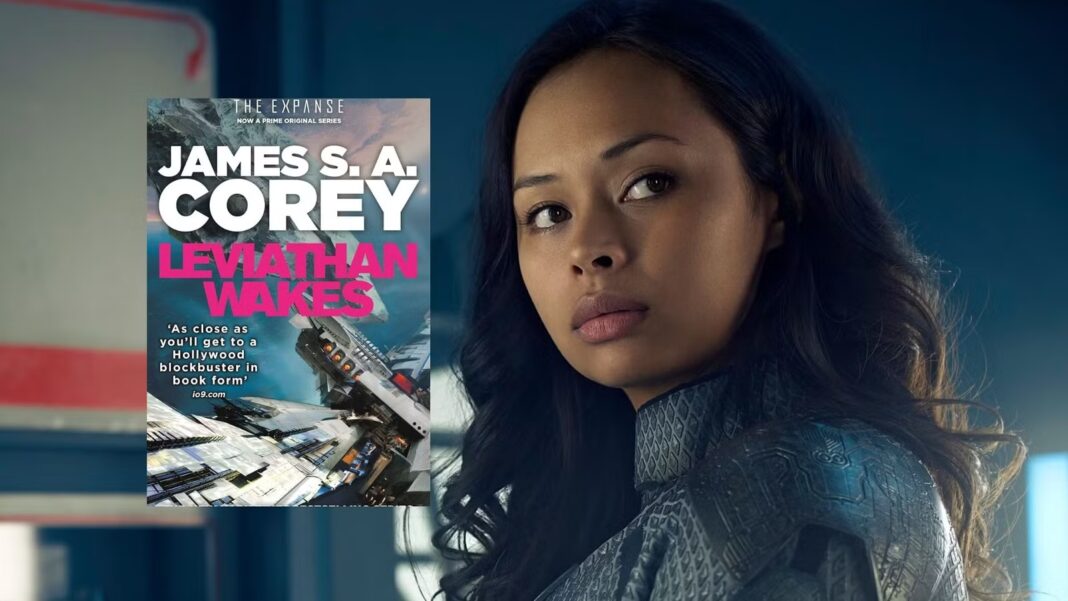
The Expanse spent six seasons proving science fiction doesn’t need to choose between smart storytelling and mainstream appeal. Audiences will consume hard sci-fi if you just let them. No dumbed-down physics, no aliens who speak perfect English, no villain twirling a mustache for the cameras. Just believable science, characters with traits that resemble actual people, and a universe that sticks to its own rules regardless of how convenient or inconvenient it is for the plot. The Expanse became one of the best sci-fi shows of the 21st century precisely because of all this.
Since it ended in 2022 with a Season 6 that boasts 96% on Rotten Tomatoes, I keep waiting for another studio to try that formula again on a different book. Instead, I’ve watched them chase something bigger and flashier when there’s a stack of genre novels that are arguably better suited to prestige television. Some would make sprawling multi-season epics. Others could become outstanding limited series. Here are eight sci-fi books I’d hand to a showrunner tomorrow if I could.
Why You Should Trust Me: I’ve covered TV and film for MovieWeb for nearly four years now, and streaming sci-fi and thriller adaptations make up a big chunk of my beat. I’ve written extensively on shows like Stranger Things, Reacher, Jack Ryan, Bosch, Silo and The Boys, tracking what separates an adaptation that respects its source material from one that just borrows the title. I’m also a huge fan of The Expanse, and it’s the benchmark I use for grounded, character-driven space opera.
Honorable Mentions
- The Culture Novels by Iain M. Banks almost made this list, but Amazon already has Consider Phlebas in active development, with Chloé Zhao attached to direct, after an earlier version of the project collapsed in 2020. It’s a genuine loss for anyone who wanted a fresh pick, but the Culture’s sprawling post-scarcity utopia is about as close as sci-fi prose gets to Expanse-level scope, so it’s worth watching regardless.
- Old Man’s War by John Scalzi is in a similar spot. Steven Spielberg is attached to a movie version which sounds exciting until you remember this is a story about elderly recruits getting their consciousness transplanted into engineered super-soldier bodies, spread across a series of several books and multiple POVs. That’s a lot of ground for one movie, so I would still argue it deserves the TV treatment. A single film is going to have to leave out most of the interesting stuff.
‘Red Mars’ Trilogy by Kim Stanley Robinson
The Terraforming Saga Already Got a Straight-to-Series Order and Still Died

Read This If: Spike TV actually greenlit this one in 2015, with J. Michael Straczynski (Babylon 5) running the writers’ room and a premiere date locked for January 2017. Then showrunner Peter Noah abruptly exited in early 2016, the network said it was only pausing, and the whole thing vanished. Spike doesn’t even exist anymore, having rebranded as Paramount Network in 2018. What Robinson wrote is a hundred-person colonization mission that splinters into competing factions over decades, with the settlers arguing whether to preserve Mars untouched or reshape it entirely. It’s basically what The Expanse did with Belters and Martians and Earthers, except Robinson got there first.
Skip This If: Robinson writes like a scientist first and novelist second, which means long stretches of the book are dedicated to planetary science, soil chemistry, and committee meetings about constitutional government. If you need things constantly moving forward on every page, the book might frustrate you. It’s also probably why Spike’s attempt fell apart in the first place. Back then, TV wasn’t relying on slow-burning stories, and I’d bet the adaptation tried to force action scenes into the material.
‘Ancillary Justice’ by Ann Leckie
Leckie’s Hive-Mind Warship Almost Had Keira Knightley Attached To It

Read This If: Fox Television Studios optioned this back in 2014, and reports later surfaced that Jonathan Nolan’s team and Keira Knightley circled a version of it before Leckie confirmed on her own blog that the deal never came through. Ancillary Justice’s disorienting premise explains why the book is a tough sell and also why it would be extraordinary if someone actually pulled it off. Breq is the last surviving fragment of an AI that once controlled a warship as well as thousands of soldiers’ bodies as extensions of itself. She’s hunting the ruler of a galaxy-spanning empire that doesn’t distinguish gender at all. It’s a puzzle box, but at the same time, it’s one of the most rewarding modern sci-fi novels I’ve ever read.
Skip This If: I genuinely love Ancillary Justice, but Leckie’s prose style takes its time revealing what’s actually happening. Plus, the empire’s refusal to gender its subjects means you will spend the first 100 pages recalibrating how you perceive every character. Some readers find that thrilling. Others put the book down before things click into place. There’s also very little traditional action for a big chunk of the story, since most of the tension comes from Breq’s internal calculations.
‘Blindsight’ by Peter Watts
Hard Science Fiction Doesn’t Get More Thought-Provoking Than This

Read This If: Every now and then, I finish a book and spend the next week thinking about its ideas and world-building and characters. Blindsight is one of those books. Watts has no interest in giving readers an easy first-contact adventure. He’s much more interested in asking uncomfortable questions about intelligence, consciousness, and what it means to be human. I remember rereading entire passages because I wanted to make sure I’d fully understood what he was arguing. That intellectual ambition is why Blindsight would translate into an excellent TV series. It won’t be easy, but television has become much better at trusting its audience, and a faithful adaptation would spark the same kind of discussions The Expanse did.
Skip This If: Watts is a marine biologist by training, and it shows in how densely he packs neuroscience and evolutionary theory into the text. Obviously, this isn’t a book you pick for casual reading, and a faithful adaptation would ask a mainstream audience to keep up with ideas. The narrator is also detached almost to the point of being unreadable as a person, which is kind of the point Watts is making about him, but it’s a difficult translation.
‘Children of Time’ by Adrian Tchaikovsky
An Evolutionary Epic That Was Practically Made for Streaming

Read This If: I don’t think I’ve ever described Children of Time without immediately following it with, “Just trust me on this.” That’s because the premise is bizarre. The novel follows the last generation of humanity fleeing a dying Earth in cryosleep, unaware that the planet they’re heading toward has spent thousands of years developing a fully realized civilization of uplifted, sentient spiders. Summit Entertainment and Lionsgate optioned this back in 2017 with Colby Day attached to write a film, and the project has been dormant ever since, even as Tchaikovsky kept expanding the universe through more books. Overall, because it’s packed with fascinating scientific ideas, it could surprise people the way The Expanse once did.
Skip This If: Tchaikovsky jumps forward by generations at a time on the spider side of the story, which means you’re constantly meeting and losing characters to evolution as time marches on. If you get attached to individuals instead of the civilization as a whole, that narrative structure will wear on you. The human side of the plot is also intentionally the less interesting half of the book, so understand that you won’t be on board from the start.
‘Spin’ Trilogy by Robert Charles Wilson
Wilson’s Hugo Winner Got Two Separate Adaptation Attempts

Read This If: Universal Cable Productions optioned this in 2014 as an event series, and when that didn’t pan out, Syfy announced its own six-hour miniseries version in 2015 with Jim Uhls, the screenwriter behind Fight Club, attached to write it. Neither one ever reached a camera. The setup explains why people keep trying, though. One night, the stars vanish and are replaced by a featureless black barrier around the entire planet. Time outside the barrier is moving roughly a billion times faster than time on Earth, meaning millennia can pass in the sky as the three main characters grow up. The dramatic irony of that premise is the kind of slow-burn mystery box that a limited series could stretch out better. And it would also scratch a similar itch for fans of The Expanse.
Skip This If: The central love triangle between the three leads gets a lot of narrative real estate, and it can feel melodramatic against the scale of everything happening around them. The sequels, Axis and Vortex, also wander pretty far from the original mystery in ways. So, a showrunner adapting all three would need a plan for keeping the momentum from sagging in the later episodes.
‘Revelation Space’ by Alastair Reynolds
Reynolds Built an Entire Galaxy of Extinct Civilizations

Read This If: Every chapter of Revelation Space feels like it belongs to a much larger universe, and I mean that as a compliment. Reynolds, who spent years working as an actual astrophysicist before writing full-time, uses his experience to build a galaxy that feels remarkably real. Between the rival factions, grounded science, and an ancient mystery surrounding vanished civilizations, I never wanted to leave this world. The scale here rivals anything The Expanse attempted with the protomolecule, except Reynolds spreads his mystery across multiple books and factions because he knows how to juggle multiple storylines without losing sight of the bigger picture.
Skip This If: Reynolds writes cold and expects you to keep up. His characters are often calculating, morally compromised, and slow to reveal warmth, which tracks with the bleak universe they inhabit but won’t work for anyone looking for characters to root for right away. The plotting also involves a genuinely large cast across overlapping timelines, and it would take time for you to keep track of who’s doing what across centuries of in-universe history.
‘The Long Way to a Small, Angry Planet’ by Becky Chambers
Fans Have Wanted a Wayfarers Adaptation for Years

Read This If: The Long Way to a Small, Angry Planet has been out since 2014 without a single reported adaptation deal, which is baffling to me. Especially considering how often fans have been championing it. A multispecies crew working aboard a ship that tunnels wormholes for a living, and the book follows their year-long journey to a dangerous, distant job. What makes it work, though, is the found family at the center – humans and aliens navigating grief, identity, and each other with a warmth that’s rare in space opera. The Expanse earns its politics through conflict, whereas Chambers earns hers through empathy. The way I see it, this could be a gentler cousin to that same sci-fi tradition.
Skip This If: This is probably the least plot-driven book on the list. There’s barely a traditional antagonist here, and the stakes are always personal, not galactic. If you need a season to build toward a big confrontation or a cliffhanger finale, you won’t get it here. Also, some chapters function almost as short stories about a single crew member, which is lovely to some and annoying to others.
‘The Forever War’ by Joe Haldeman
Stuck in Development Hell for Almost Twenty Years

Read This If: Ridley Scott first attached himself to a movie version around 2008, Channing Tatum signed on when Warner Bros. picked it up in 2015, and Jon Spaihts wrote drafts along the way, but the whole project has effectively remained untouched. Haldeman, a Vietnam veteran himself, wrote a soldier’s story where relativistic time dilation means every tour of duty sends William Mandella light-years from home, and every time he returns to Earth, decades or centuries have passed and the culture he’s fighting to protect has changed. That alienation, coming home to a world that’s moved on without you, is a season-by-season structure practically built into the book already. The Forever War was a classic for more than 40 years when I first read it, and has remained one for a reason.
Skip This If: Haldeman wrote this in the 1970s, and some of the book’s attitudes toward gender and sexuality haven’t aged the way the rest of the story has. Any modern adaptation would have to handle that aspect with real care. It is also relentlessly bleak as it follows a soldier who keeps losing everything he fights to return to. So there’s no redemption arc to look out for.
What’s the one sci-fi book you’ve always wanted to see as a TV series? Let us know in the comments!