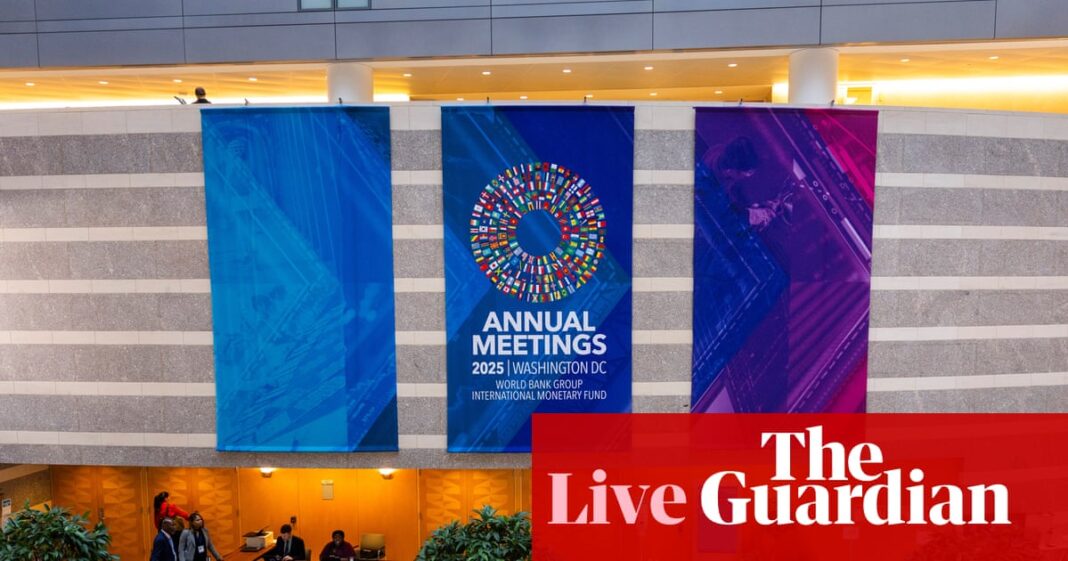
Introduction: Reeves to pitch UK as ‘beacon of stability and growth’ at IMF
Good morning, and welcome to our rolling coverage of business, the financial markets and the world economy.
Rachel Reeves is jetting across the Atlantic to pitch the UK as a “beacon of stability” in unstable times.
The UK chancellor is due to meet with senior figures from other G7 countries, and aim to solicit foreign investment from top global firms, as she attends the Annual Meetings of the International Monetary Fund and the World Bank in Washington DC. She’ll also attend a Ukraine roundtable.
Speaking before her arrival, Reeves says:
“Our Plan for Change is delivering national renewal built on the rock of economic stability – the foundation for more security, more respect and more opportunity for every part of the UK.
“In Washington I will showcase Britain’s commitment to fiscal responsibility – while creating the conditions to boost productivity, attract investment and secure our place as a strong and credible partner in a stable global economy.”
Reeves is expected to pitch her fiscal rules as “the bedrock for growth and investment”, and also point to the government’s plans for a National Wealth Fund, and capital spending plans for infrastructure, energy, digital transformation and research.
Yesterday, the IMF raised its forecast for global growth this year, concluding that tariff shocks and financial conditions have proven more benign than expected.
It also released new forecast showing that the UK is likely to suffer the highest inflation in the G7 group of leading economies this year and next, unpalatable news for Reeves and UK consumers alike.
The IMF modestly increased its forecast for economic growth in the UK for this year, from 1.2% to 1.3%, and slightly downgraded it for 2026, also to 1.3%, amid concerns over the labour market.
Bank of England governor Andrew Bailey smeared a little grease on the ‘beacon of stability’ last night, though. He’s also attending the Annual Meetings, and raised concerns about the UK economy running “under potential” and a softening jobs market.
Bailey told an event organised by the Institute of International Finance:
“We’re seeing some softening of the labor market,”
…adding that “that broadly is the story that I pick up” as he travels around the UK.
The agenda
-
10am BST: Bank of England to issue response to the banker bonus deferral consultation
-
1.45pm BST: IMF to release its Fiscal monitor
-
2:15pm Treasury Committee hearing on AI in financial services
Key events
Analysts at Goldman Sachs are expecting Rachel Reeves to announce around £30bn-worth of tax rises and spending cuts in the budget.
In a research note today, they say:
We now expect the government to deliver around £30bn (or 1% of GDP) of fiscal measures in the Budget (vs £20bn before). The adjustment is likely to come on the tax side, including an extension of threshold freezes, new gambling taxes, reduced tax avoidance measures, as well as changes in pensions and property taxation.
We expect these measures to exert an additional demand drag of 0.3% over the coming years and believe the government will avoid raising inflationary taxes.
Regulators: This will cut complexity and boost competitiveness….
The UK regulators insist that their bonus changes won’t encourage reckless behaviour among bankers.
Sam Woods, deputy governor of prudential regulation and CEO of the PRA, said:
“These new rules will cut red tape without encouraging the reckless pay structures that contributed to the 2008 financial crisis. These changes are the latest example of our commitment to boosting UK competitiveness.”
Sarah Pritchard, deputy CEO at the FCA, said:
“Streamlining our remuneration rules by 70% will cut unneeded complexity and make them simpler to follow.
And we’re working faster and smarter to support growth by letting firms apply the changes to this year’s pay cycle.
“The new rules also mean senior managers will continue to follow our high standards and remain on the hook where poor decisions affect consumers and markets”.
As well as speeding up bonus payouts, the UK’s financial regulators are watering down restrictions on how bonuses are deferred, and allowing bankers quicker access to the cash element of their bonuses.
They say their new changes to senior banker pay include:
-
Lifting restrictions on the proportion of bonuses that need to be deferred, going further than at consultation. Previously, 60% of the full amount of any bonuses above the £660,000 threshold needed to be deferred. Now only 60% of amounts above that threshold will need to be deferred.
-
New rules to give firms more flexibility to allow a greater share of the cash element of bonuses to be received up front. More of the component comprised of shares and other instruments can now be deferred, which helps promote responsible risk-taking. Previously, both the upfront and deferred components of bonuses had to be 50% cash and 50% instruments.
UK bankers to get bonuses faster under new plans
UK bankers will get their hands on their bonuses more quickly, under changes just announced by the Bank of England.
The BoE’s Prudential Regulation Authority, and City watchdog the Financial Conduct Authority have confirmed they will allow more “flexibility around senior banker pay”.
The changes mean that the amount of time that senior bankers must now wait before receiving their full amount of bonus will be cut from eight to four years.
Previously, they had suggested cutting bonus deferrals to five years for senior bankers, and four for less senior staff.
The regulators will also allow part-payment of bonuses for the most senior bankers from year one, rather than year three as it was previously.
The new rules will come into force tomorrow, in time for 2025 pay awards and any other awards made but not yet fully paid.
The PRA and FCA say these changes will create better links between bonus awards and responsible risk-taking, and follow the removal of the banker bonus cap in 2023 (which itself was brought in after the 2008 financial crisis, to deter dangerous risktaking…)
Saxo UK investor strategist Neil Wilson writes…
Rachel Reeves, the Chancellor, is pitching Britain as a paragon of stability and growth at the IMF today. Good luck with that. There is the small matter of one of the most consequential budgets in a generation to get through first. It would be interesting to hear what most business leaders felt about it. Shore Capital pull no punches: The Treasury does “not understand the damage they are causing to this country’s consumer economy.”
Reeves is also reportedly looking again at slashing the allowance for cash ISAs to boost investment in UK equities. It will take a lot more than tweaking around with allowances for retail investors to do this. And I’m not sure about the second order effects – do you move up the risk curve or just plump for less tax efficient cash rates? This has been discussed a lot already but suffice to say a stick is maybe not as good as a carrot.
UK bond yields fall after chancellor’s tax comments
UK government borrowing costs have dropped today, after chancellor Rachel Reeves indicated she could raise taxes in the budget.
The yield, or interest rate, on 10-year UK gilts has dropped by 4 basis points to 4.54%, down from 4.58% last night.
Longer-dated borrowing costs are also lower, with the yield on 30-year gilts dropping by 3 basis points to 5.35%.
Yields, which measure the rate of return on a bond, fall when bond prices rise in the markets.
Bond traders will have noted Reeves’s comments to Sky News that “Of course, we’re looking at tax and spending as well,” when explaining her approach to closing UK’s fiscal black hole in her November budget.
Those comments could reassure the City that the government really is committed to sticking to its fiscal rules, rather than allowing borrowing to rise even higher than planned…
Chip giant ASML warns of China slowdown
Semiconductor firm ASML is continuing to benefit from the AI boom, but also expects a significant fall in demand from China next year.
ASML, which makes machines which make chips, has reported a small slowdown in sales in the last quarter this morning. It posted total net sales of €7.5bn in the third quarter of this year, down from nearly €7.7bn in Q2.
ASML told shareholders:
“On the market side, we have seen continued positive momentum around investments in AI, and have also seen this extending to more customers, both in leading-edge Logic and advanced DRAM. On the other hand, we expect China customer demand, and therefore our China total net sales in 2026, to decline significantly compared to our very strong business there in 2024 and 2025.
Overall, ASML expects total sales in 2026 to at least match 2025.
Shares in European luxury goods makers are rallying this morning, after LVMH Moët Hennessy Louis Vuitton reported a rise in sales thanks to improved demand in China.
LVMH reported a 1% rise in sales in the third quarter of this year, “despite a disrupted geopolitical and economic environment”.
The French luxury house reported “solid local demand” in Europe and the US, a drop in sales in Japan, and a “noticeable improvement in trends” in the rest of Asia.
Kathleen Brooks, research director at XTB, says:
This suggests that the slump in the demand for luxury is starting to level off. There was also growth in sales to China, which had been hit by a slump in recent years. Analysts now expect the leather goods sector, especially Luis Vuitton and Christian Dior, could fuel growth for this sector into next year.
Sharesi in LVMH have jumped by 12% in early trading. In London, Burberry are up 6.8%.
Trump threatens China with cooking oil embargo over soybeans
Cooking oil has become the latest front in the US-China trade war.
Last night, President Donald Trump suggested his administration is considering terminating cooking oil purchases from China, in retaliation for Beijing refusing to buy U.S. soybeans.
Posting on his Truth Social site, Trump said:
I believe that China purposefully not buying our Soybeans, and causing difficulty for our Soybean Farmers, is an Economically Hostile Act. We are considering terminating business with China having to do with Cooking Oil, and other elements of Trade, as retribution. As an example, we can easily produce Cooking Oil ourselves, we don’t need to purchase it from China.
US soya bean farmers have warned that China – usually a major customer – has halted orders amid the trade war with Washington.
Another fine! Outsourcing giant Capita has been fined £14m by the Information Commissioner’s Office (ICO) for failing to protect personal data after hackers stole 6.6 million people’s information during a cyber attack in 2023.
The data watchdog said the breach in March 2023 saw the hackers access information including pension details and staff records, as well as details of customers of organisations Capita supports.
In some cases this included sensitive information such as details of criminal records, financial data or so-called special category data, which can include race, religion and sexual orientation.
The ICO fined Capita £8m and a further £6m for Capita Pension Solutions, which processes personal information on behalf of more than 600 groups providing pension schemes, with 325 of these organisations also impacted by the data breach.
John Edwards, UK information commissioner, said:
“Capita failed in its duty to protect the data entrusted to it by millions of people.
“The scale of this breach and its impact could have been prevented had sufficient security measures been in place.”
Update: Adolfo Hernandez, chief executive officer at Capita, has said the company has been taking steps to strengthen itself against cyber attacks (a rising threat for businesses):
“As an organisation delivering essential public services as well as key services for private sector clients, Capita was among the first in the recent wave of highly significant cyber-attacks on large UK companies.”
“When I joined as CEO the year after the attack I accelerated our cyber security transformation, with new digital and technology leadership and significant investment. As a result, we have hugely strengthened our cybersecurity posture, built in advanced protections and embedded a culture of continuous vigilance.”
“Following an extended period of dialogue with the ICO over the last two years, we are pleased to have concluded this matter and reach today’s settlement. The Capita team continues to focus tirelessly on our Group transformation journey for the benefit of our customers, our people and wider society.”
Royal Mail fined (again) for missing delivery targets
Royal Mail has been fined £21m for missing its delivery targets in the 2024/25 financial year.
The postal operator was penalised by regulator Ofcom for only delivering 77% of First Class mail and 92.5% of Second Class mail on time, well short of its 93% and 98.5% targets.
This is the third year running in which Royal Mail has been fined for delivery target failures – it was billed £5.6m in November 2023 and £10.5m in December 2024.
Announcing today’s fine, an exasperated-sounding Ofcom says Royal Mail must urgently publish – and deliver – a credible improvement plan, or fines are likely to continue.
Ian Strawhorne, director of enforcement at Ofcom, says:
“Millions of important letters are arriving late, and people aren’t getting what they pay for when they buy a stamp. These persistent failures are unacceptable, and customers expect and deserve better.
“Royal Mail must rebuild consumers’ confidence as a matter of urgency. And that means making actual significant improvements, not more empty promises. We’ve told the company to publicly set out how it’s going to deliver this change, and we expect to start seeing meaningful progress soon. If this doesn’t happen, fines are likely to continue.”
Vets could be made to publish prices after UK watchdog investigation

Julia Kollewe
Vets in the UK could be forced to publish their prices and whether they are part of a larger group after an investigation by the markets watchdog into claims chain-owned surgeries have left pet owners with dwindling choice and higher bills.
The Competition and Markets Authority (CMA) found pet owners pay 16.6% more on average at large vet groups than at independent vets and called for a market that is “not fit” for purpose to be modernised.
Publishing its findings on Wednesday of an investigation into how veterinary services operate in Britain, the regulator found that owners were often unaware of the prices of commonly used services and whether their local practices are part of large national chains.
FT: Rachel Reeves revives plans to overhaul cash Isas
The Financial Times are reporting that Reeves is considering reviving plans for a major overhaul of tax-free Isas.
Back in July, the chancellor shelved plans to cut the amount savers can put into tax-efficient cash Isas from £20,000 per year to £5,000, after lobbying from banks, building societies and consumer groups.
According to the FT, the Treasury is now considering halving the annual cash limit, to £10,000 per year, in an attempt to divert tens of billions of pounds of savings from cash into domestic stocks.
Sky: Chancellor admits tax rises and spending cuts considered for budget
Rachel Reeves has told Sky News she is looking at both tax rises and spending cuts in the budget.
When asked how she would deal with the country’s economic challenges in her 26 November statement, the chancellor replied:
“Of course, we’re looking at tax and spending as well.”
Spending cuts could be politically challenging for the government, though, following the revolt over welfare cuts last summer, which is why many economists expect tax rises in the budget.
With forecasts swirling of a black hole of perhaps £20bn in the budget calculations, Reeves also insisted she would stick to her fiscal rules, saying:
“The numbers will always add up with me as chancellor because we saw just three years ago what happens when a government, where the Conservatives, lost control of the public finances: inflation and interest rates went through the roof.”
And asked if she could promise she won’t allow the economy to get stuck in a doom loop cycle, Reeves replied: “Nobody wants that cycle to end more than I do.”
Chancellor Rachel Reeves exclusively tells @SamCoatesSky, ‘of course, we’re looking at tax and spending as well’.
The Chancellor said she is looking at both tax rises and spending cuts in the budget in her first interview since being briefed on the scale of the black hole. pic.twitter.com/CjxYpFqkfi
— Sky News (@SkyNews) October 15, 2025
Reeves pushed to show ‘credibility’ on fiscal consolidation

Heather Stewart
Rachel Reeves may also face pressure to show a credible tax and spending plan in November’s budget, and measures to improve productivity, during her visit to Washington.
Yesterday, at a press conference about the outlook for global financial stability, IMF expert Antansios Vamvakidis warned:
“clearly markets are concerned about the UK economy, and we have seen more volatility in the UK compared to other advanced economies.”
Pointing to above-target inflation and weak productivity, he said:
“the market is asking for more details on the fiscal plans in the UK: so yields, as a result, are higher in the UK compared to other advanced economies.”
With Rachel Reeves currently drawing up her budget for 26 November, Vamvakidis added that the IMF recommends the government show, “credibility on the fiscal consolidation plan, and reforms to increase productivity.”
Introduction: Reeves to pitch UK as ‘beacon of stability and growth’ at IMF
Good morning, and welcome to our rolling coverage of business, the financial markets and the world economy.
Rachel Reeves is jetting across the Atlantic to pitch the UK as a “beacon of stability” in unstable times.
The UK chancellor is due to meet with senior figures from other G7 countries, and aim to solicit foreign investment from top global firms, as she attends the Annual Meetings of the International Monetary Fund and the World Bank in Washington DC. She’ll also attend a Ukraine roundtable.
Speaking before her arrival, Reeves says:
“Our Plan for Change is delivering national renewal built on the rock of economic stability – the foundation for more security, more respect and more opportunity for every part of the UK.
“In Washington I will showcase Britain’s commitment to fiscal responsibility – while creating the conditions to boost productivity, attract investment and secure our place as a strong and credible partner in a stable global economy.”
Reeves is expected to pitch her fiscal rules as “the bedrock for growth and investment”, and also point to the government’s plans for a National Wealth Fund, and capital spending plans for infrastructure, energy, digital transformation and research.
Yesterday, the IMF raised its forecast for global growth this year, concluding that tariff shocks and financial conditions have proven more benign than expected.
It also released new forecast showing that the UK is likely to suffer the highest inflation in the G7 group of leading economies this year and next, unpalatable news for Reeves and UK consumers alike.
The IMF modestly increased its forecast for economic growth in the UK for this year, from 1.2% to 1.3%, and slightly downgraded it for 2026, also to 1.3%, amid concerns over the labour market.
Bank of England governor Andrew Bailey smeared a little grease on the ‘beacon of stability’ last night, though. He’s also attending the Annual Meetings, and raised concerns about the UK economy running “under potential” and a softening jobs market.
Bailey told an event organised by the Institute of International Finance:
“We’re seeing some softening of the labor market,”
…adding that “that broadly is the story that I pick up” as he travels around the UK.
The agenda
-
10am BST: Bank of England to issue response to the banker bonus deferral consultation
-
1.45pm BST: IMF to release its Fiscal monitor
-
2:15pm Treasury Committee hearing on AI in financial services