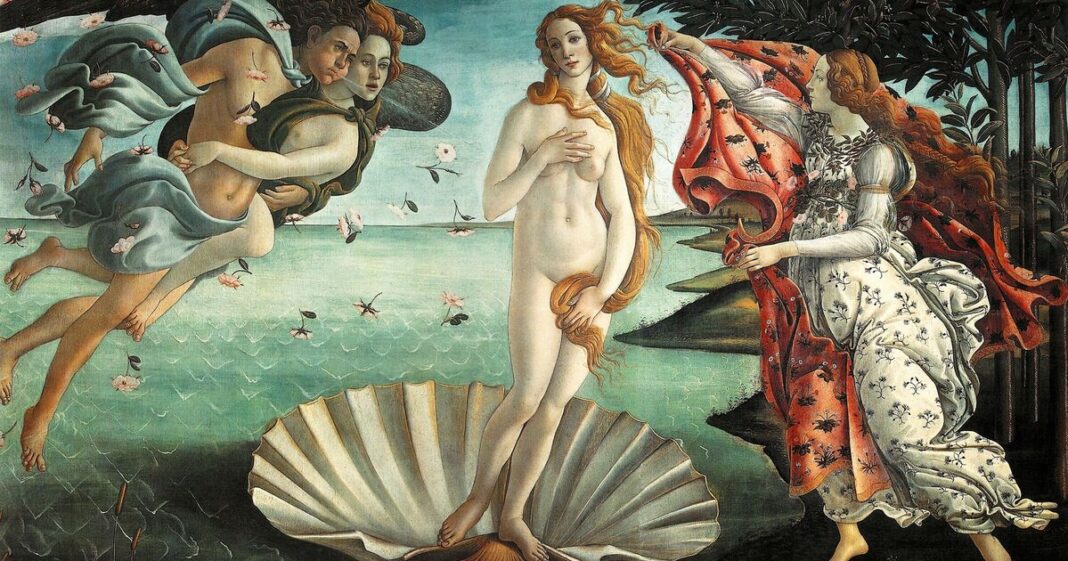
The Birth of Venus is one of the most famous paintings by the renowned artist Sandro Botticelli. Originally painted in the mid-1480s, it depicts the goddess arriving on an island.
In the painting Venus, with flowing blond hair, is standing on a shell. She is also surrounded by several figures including two to her right and another, more clothed, to her left.
Since it was first created, it is a painting that has triggered much debate among scholars and historians; including whether there are any hidden messages within it. However, now people believe there may be a sign on Venus’ face herself of a much sadder secret.
A new study has suggested that Botticelli may have painted in signs into the painting that gave clues of an illness affecting his muse. In fact, they believe that the muse suffered from a condition that would not be discovered by doctors for several hundred years.
The muse is believed to be Simonetta Vespucci of Florence, who was reportedly known throughout Renaissance Italy at the time, but who died prematurely at the age of just 23.
In the painting she has irregularly placed eyes. Researchers from Queen Mary University in London (QMUL) believe that this misalignment may have been caused by a brain tumour on the pituitary gland. Also known as a pituitary adenoma, this sort of tumour is usually benign.
The study by QMUL expands on a theory first put forward seven years ago in 2019, that this is what Simonetta may have suffered from. Their latest study looks at whether an expansion of the adenoma caused tumour apoplexy that led to her untimely death. Pituitary adenomas wouldn’t be discovered until the early 1930s, nearly 500 years after Simonetta’s death.
Speaking about the painting, senior author of the study, published in the Endocrinology, Diabetes & Metabolism journal, and Clinical Research Professor at QMUL, Paolo Pozzilli explained how there were a series of clues that could indicate the health of Simonetta at the time.
Professor Pozzilli said: “Botticelli’s allegorical portrait of a woman shows a woman – the model is Simonetta Vespucci – lactating, and yet we know she had no children. This is a surprising way to portray her and we believe that this – along with changes in facial traits – could show the real physical symptoms of a prolactin-growth hormone secreting adenoma.
“We’ve confirmed this possible diagnosis using a facial recognition algorithm based on a pre-trained deep learning model, on five portraits of Simonetta.
“It’s also possible that the irregular eye positioning in the Birth of Venus -the ‘strabismus’ or squint later considered a trait of piety and beauty – may be caused by the pituitary tumour.”
This theory put forward by QMUL is backed up by reports of Simonetta’s condition in her final days. First author Dr Domiziana Nardelli of the Universita Campus Bio-Medico di Roma added: “Letters between Piero Vespucci and Lorenzo de’Medici about Simonetta’s final days discuss how she collapsed during a ball and was then resting in a darkened room where she suffered from terrible headaches, hallucinations, vomiting and high fever. These are all symptoms of a rapidly expanding pituitary tumour.”