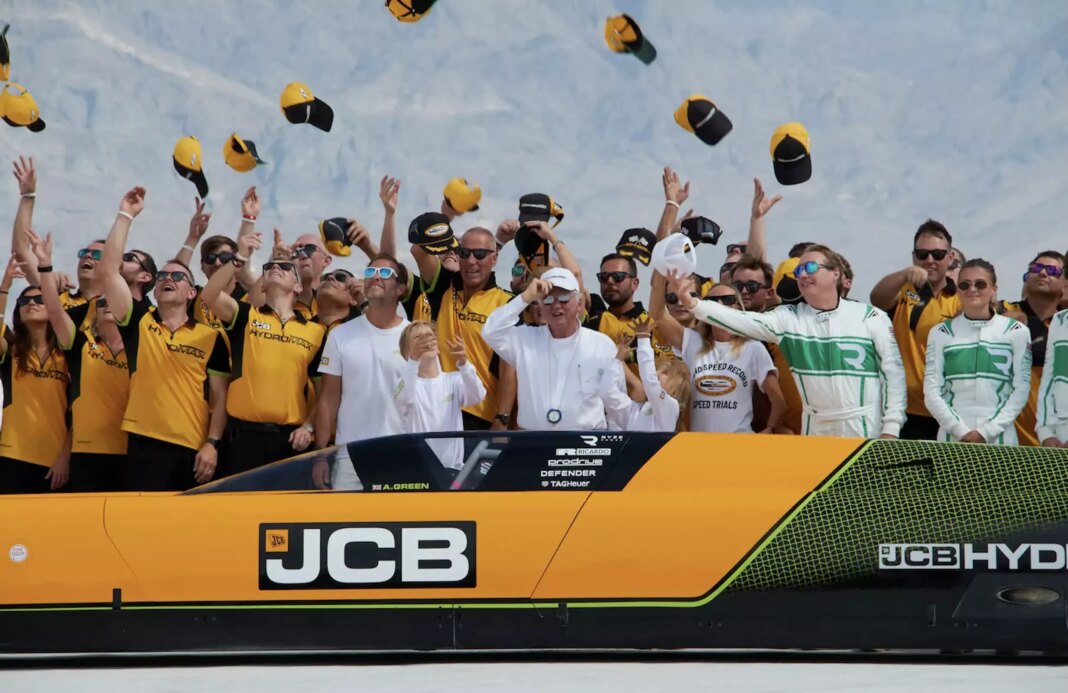
What just happened? JCB’s hydrogen-powered land-speed vehicle reached 406.320 mph at the Bonneville Salt Flats in Utah, setting a new speed record for a hydrogen-fueled internal-combustion vehicle. The Fédération Internationale de l’Automobile confirmed the record after driver Andy Green completed the run Tuesday. The 406.320 mph result surpassed the previous record of 185.5 mph, set by BMW’s H2R in 2004.
Green drove JCB’s Hydromax, a specially built vehicle designed to test hydrogen combustion at extreme speeds. The British equipment manufacturer is developing hydrogen engines for its construction and agricultural machinery, and the record run was intended to demonstrate what the technology can do under demanding conditions.
“The ground comes at you very, very quickly,” Green told The New York Times. “You’re driving five or six times as fast as on the interstate. Everything happens very quickly.”
The Hydromax does not use a hydrogen fuel cell or an electric drivetrain. Instead, it is powered by hydrogen-burning internal-combustion engines. JCB has called it “the fastest hydrogen-powered vehicle of any kind in history.”
The car faced many of the same challenges as other land-speed vehicles, including vibration, noise, heat, and limited visual reference points. Green said the course markers appeared to pass by faster as the vehicle accelerated across the white salt surface. The car took about 72 seconds to accelerate from 50 mph to 400 mph.
“You can physically see the curvature of the earth,” Green said. “This smooth surface is so long.”

The run took place on a 12-mile course at Bonneville, a roughly 30,000-acre salt flat in Utah’s Great Salt Lake Basin. The site has been used for land-speed competitions since 1912 because its hard, flat surface provides a long stretch for high-speed runs.
Green, 64, is well known in land-speed racing. In 1997, he became the first person to break the sound barrier on land when he drove ThrustSSC to an average speed of 763.035 mph in Nevada’s Black Rock Desert. The vehicle was powered by two Rolls-Royce engines originally designed for a Phantom fighter jet.
He said he believed he had retired from speed racing before JCB approached him about the Hydromax project.
The new record is nowhere near the overall land-speed record Green set nearly three decades ago. It wasn’t meant to be. The vehicle was built to establish a record for hydrogen combustion and support JCB’s work on engines that could run on hydrogen rather than diesel.
Hydrogen combustion is drawing attention as equipment makers look for ways to cut carbon emissions from machines that can be difficult to electrify. Heavy construction and agricultural equipment often require long operating hours, high power output and quick refueling, all of which can be more difficult to achieve with large battery packs.
Green said water was the only exhaust product from the Hydromax. “This is as zero carbon as it gets,” he said.
Mohammed Ben Sulayem, president of the FIA, called the result a “historic milestone” in a statement. The organization said the vehicle was not built to compete for the overall land-speed record, but that the run marked an important development for motorsports and hydrogen technology.
Image credit: The New York Times