Every now and then, a hiker, climber or biologist lays eyes on a mountain goat in the nooks and crannies of the mighty Teton Range.
A striking white alpine species, mountain goats are being targeted by gunners because they’re seen as a threat to native bighorn sheep. Mountain goats are more aggressive, overlap habitat and can also spread diseases that can be catastrophic.
“We have seen mountain goats — and we have removed those when we have found them,” Grand Teton National Park Superintendent Chip Jenkins told WyoFile in February. “We hire a private contractor who does the flying in terms of doing the survey, and we hire a private contractor who does the removal.”
Those contracted crews are “highly specialized” in dealing with wildlife, he said.
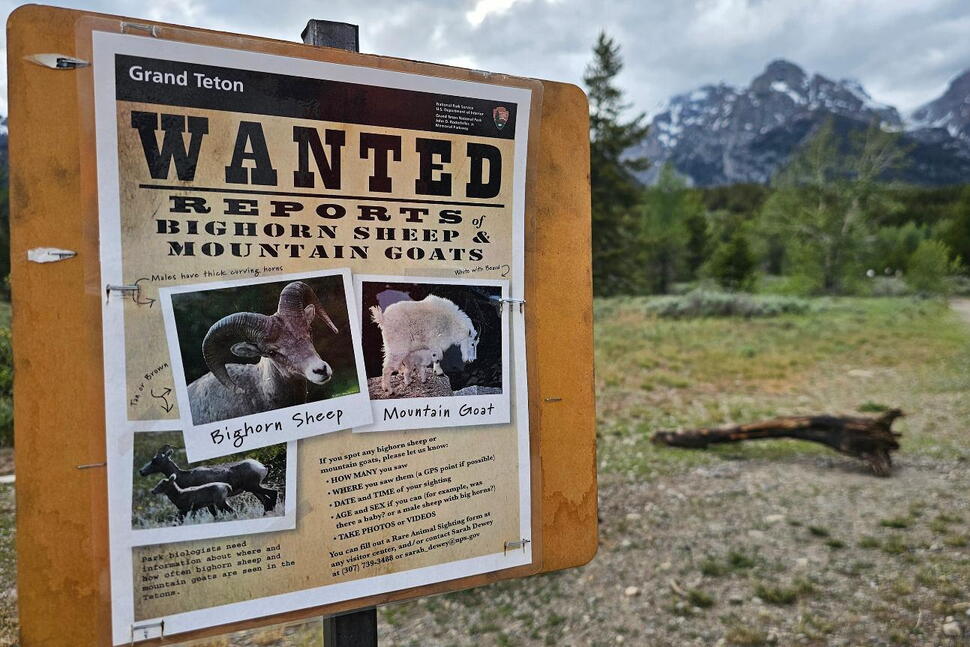
Park rangers have enlisted the public in their efforts to keep mountain goats out of the Tetons. Signs have been posted at places like the Taggart Lake trailhead, and the messaging asks recreators to report, photograph and even record GPS points of bighorn sheep and mountain goats.
Mountain goats are managed much differently. The Park Service is trying to remove the remainder to protect the bighorns.
“We’re in the perpetuity business,” Jenkins told WyoFile. “We’re working to be able to ensure that we’ve got bighorn sheep in the Tetons forevermore.”
Mountain goats reached the Tetons in the late 1970s from the Snake River Range population introduced by the Idaho Department of Fish and Game. By 2008, they were observed reproducing, and the National Park Service first proposed eliminating the population in 2013, when an estimated “10 to 15” animals inhabited the range. It took nearly seven years to push those plans through, though, and by the time aerial gunners took flight in early 2020, the population had ballooned to about 100 animals.
It’s been known for years that the hunters and aerial gunners missed some mountain goats, which dwell in treacherous, complex Teton Range terrain.
“It’s extremely difficult to get every last one,” Jenkins said. “There’s always been an expectation that some would remain.”
At that time, park wildlife biologist Sarah Dewey told the News&Guide that they weren’t actively killing remnant goats.
“We don’t have any specific actions planned at this time,” Dewey said in 2024, “but it’s very likely that we will need to take action at some point.”
By the time Jenkins briefed WyoFile on the issue in February, the lethal operations were underway.
“The big effort was five years ago, in terms of doing the removal,” the superintendent said. “Now, what we’re doing is maintenance.”
In November 2024, the Park Service’s contracted gunners killed 14 remnant mountain goats. There were 14 verified goat sightings in 2025, but no lethal operations occurred because there wasn’t the money to hire the aerial crews, said Yvette Converse, Teton Park’s division lead for science and resource management.
“We are potentially going to do it again this fall,” Converse said, “but we have to see if that makes sense at the time.”
So far, park rangers have not hiked into the Tetons to pursue mountain goats, but that option is on the table.
“It’s just risky and also difficult and costly to send people out on foot,” Converse said. “If we get to a point where we have very, very few sightings … then we could potentially do that.”
In 2027 and beyond, Grand Teton’s Mountain Goat Management Plan calls for population “maintenance” that’s focused on “preventing immigration and removing any new goats that enter the park, using ground-based, tactical methods.”
In the meantime, very few mountain goats likely remain in the Tetons.
“Based on a review of 2025 observations — considering location, group composition, and timing — we estimate 7–8 goats remain in the southern portion of the park, with others possibly in the northern trailless and more remote canyons,” Converse wrote in an email.
The Wyoming Game and Fish Department shares the park’s goal of protecting Teton Range bighorns and the state agency authorized an aggressive mountain goat hunt along the west slope of the range starting in 2019 with the intent of removing the population. A few years later, however, the hunt was halted.
“We were eventually selling a license where it was really difficult to find a mountain goat,” said Brad Hovinga, Game and Fish’s Jackson Region supervisor.
Wyoming wildlife managers don’t play any role in the goat-killing operations in Grand Teton National Park, Hovinga said. Outside the park, there hasn’t been a need to kill remnant goats, he said, because none have been documented for several years.
But if mountain goats are spotted outside the park along the west slope of the Tetons, Wyoming plans to follow suit.
“We do plan to remove (animals) if we do see mountain goats reappear,” Hovinga said.
This story was originally published by WyoFile and distributed through a partnership with The Associated Press.
Copyright 2026 The Associated Press. All rights reserved. This material may not be published, broadcast, rewritten or redistributed.
Photos You Should See – June 2026