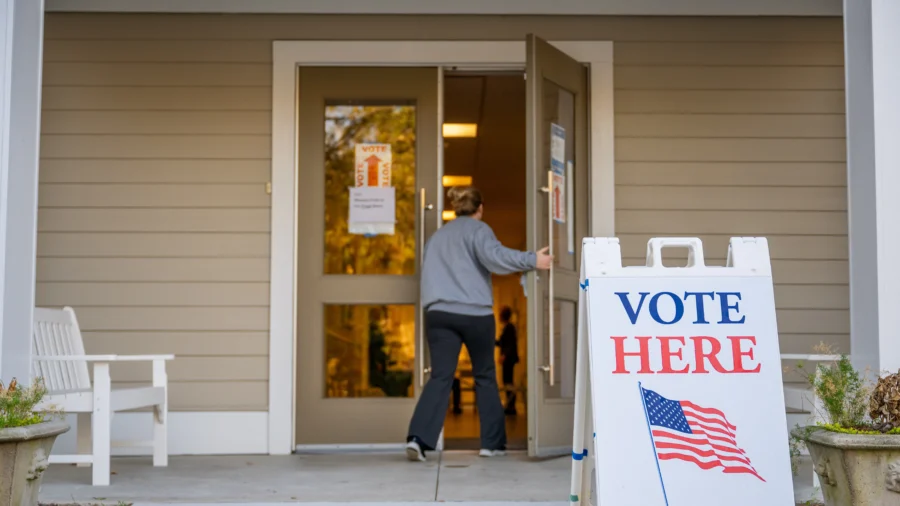
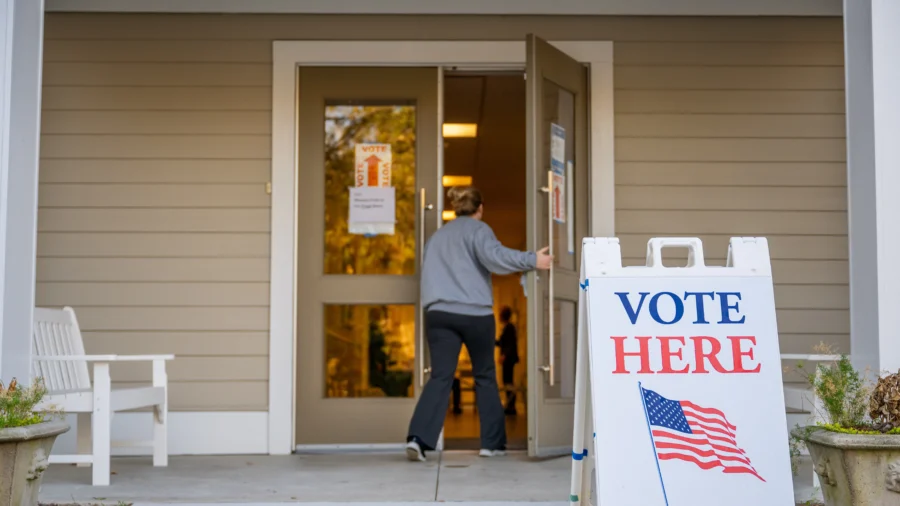
The Democratic National Committee (DNC) voted on Aug. 15 to approve the first six states for its 2028 presidential nominating calendar, with South Carolina set to be the party’s first primary contest.
The Democratic Party’s new primary schedule removes Iowa and New Hampshire from the traditional first caucus and primary contests, replacing them with the first primary in South Carolina on Jan. 22, 2028, and the second primary in Nevada on Feb. 1, 2028. The committee’s plan also includes primary contests in New Hampshire on Feb. 8, 2028, New Mexico on Feb. 15, 2028, Michigan on Feb. 22, 2028, and Virginia on Feb. 29, 2028.
“The DNC has delivered a 2028 nominating calendar that truly represents our party and our values, and will help us retake the White House in 2028,” DNC Chairman Ken Martin said in a statement following Saturday’s vote, which took place during the committee’s summer meeting in Austin, Texas.
Martin said that for candidates to win in the general election, “You have to be battle-tested in a way that you already have campaigned in front of and for the support of various communities throughout the country.”
Iowa’s Democratic caucuses had been featured first in the party’s presidential nominating calendar from 1972 to 2020. The Democratic Party started making changes to the nominating calendar after the reporting system for the 2020 Iowa caucuses led to results being delayed for days.
As the first-in-the-South primary, South Carolina was more decisive than Iowa and New Hampshire for nominees Barack Obama in 2008, Hillary Clinton in 2016, and Biden in 2020. All three dominated among South Carolina’s large black population, which can yield more than half the state’s Democratic primary electorate.
With Nevada and New Mexico following, that will require candidates to court more Latino voters early in the process.
The DNC said the 2028 calendar would ensure that the party’s presidential nominee was tested in key battleground states and with a diverse range of voters. It said the first six state primaries represented the “most diverse open field early window” in the party’s history.
The early window states include 4.6 million black voters; 4.2 million Latino voters; 1.4 million Asian American, Native Hawaiian, and Pacific Islander voters; and 370,000 Native American voters, according to the committee.
“It’s about more than a calendar. It’s a statement about the kind of Democratic Party we want to be — and the kind of country we believe America should be,” Martin said.
“Our party is at its strongest when it reflects the country we hope to lead. And our presidential nominees are at their strongest when they must earn support across the full breadth of America: every region, race, generation and economic circumstance.”
The committee also said the early nominating calendar window for 2028 would be affordable for presidential candidates, ensuring that the nominee was chosen by voters and not just by money. It noted that states such as South Carolina and Nevada had relatively inexpensive media markets, while both South Carolina and New Hampshire’s compact size made them affordable for candidates traveling for campaigns.
During the Aug. 15 meeting, Iowa Democratic Party Chair Rita Hart argued that the DNC needed a Midwest state among the first four primaries. “I’m deeply concerned that our party has not learned from past mistakes,” she said.
Following Saturday’s vote, New Hampshire Democratic Party Chair Ray Buckley said the change to the presidential primary process was disappointing.
“Time and again, New Hampshire has proven we are uniquely suited to battle-test candidates,” Buckley said. “Our small, purple state gives candidates a level playing field with the opportunity to meet voters face-to-face, answer tough questions, and earn support one conversation at a time.”
“We will continue making the case to ensure that Granite Staters have a meaningful voice in choosing the next Democratic nominee for president,” he said.
The Associated Press contributed to this report.