FAIRBANKS, Alaska (AP) — As Ted Schuur stepped along the edges of Smith Lake, a bubble surfaced from the muck underfoot. And then another.
They’re bubbles of methane, a potent heat-trapping gas made from decomposing plants and animals that had once been stuck in Alaska’s frigid permafrost. But that frozen ground is thawing because the Arctic is warming four times faster than the rest of the globe. For thousands of years that frozen ground stored dead plants and animals, but the accelerating thaw is allowing them to decay into methane and carbon dioxide.
“Once you start leaking this carbon out, there’s so much in the ground that it’s not going to shut off,” said Schuur, an ecologist at Northern Arizona University, calling it one of climate change’s scary tipping points. “Essentially every year is setting a permafrost record.”
There’s three times as much carbon still frozen in permafrost than what’s now in the air, but all over the Arctic those heat-trapping gases are escaping into the atmosphere. Their release adds to what’s already in the air from humanity’s burning coal, oil and natural gas, changing the delicate balance of how a warming world deals with the buildup of heat-trapping carbon, Schuur said.
Permafrost is ground that stays frozen — below 32 degrees Fahrenheit (zero degrees Celsius) — for at least two years and often for centuries and even millennia. That frozen ground — found in Alaska, Canada, Siberia, Antarctica and high mountain elevations elsewhere — has special advantages, trapping decaying matter, keeping it from turning into greenhouse gases and just being firm enough for communities and industries to build their lives upon.
But warming is undercutting that.
Two different studies project that by the end of this century, those previously trapped gases in permafrost will add nearly half a degree of warming (about a quarter degree Celsius) in addition to warming from the burning of fossil fuels. Over that time period, that’ll warm the Earth about as much as a major industrialized country like the United States or the whole of Europe, scientists said.
“The permafrost system is really like a sleeping giant,” said Gustaf Hugelius, a permafrost expert at Stockholm University.
For thousands of years, when the climate was somewhat stable, the Arctic helped Earth’s delicate carbon cycle by acting as a sink. That means plants in the cold areas used to pull some heat-trapping gas out of the air and capture it in the frozen ground, with the Arctic essentially withdrawing more carbon from the air than it added, benefiting the entire globe. A few years ago, warming caused that balance to shift so that once-frozen ground is venting more heat-trapping gases than it takes in. Instead of reducing climate change, the Arctic is now adding to the problem, said Columbia University ecologist Duncan Menge.
Permafrost thaw, along with other “warming-induced emissions” from fires and changes to wetlands and lakes, are likely to increase warming by 20% by the end of the century, according to a September study co-authored by Arctic ecologist Sue Natali of the Woodwell Climate Research Center.
It may be a small amount, not worthy of scenarios of doom, but it’s something “that we’re going to have to deal with” on top of everything else, said University of Victoria climate scientist Andrew Weaver, who first calculated the half-a-degree of expected permafrost warming in a 2012 study.
What’s troublesome is that when politicians and scientists talk about future warming, they’re usually not accounting for the extra greenhouse gases from permafrost thawing, said Natali and Hugelius. So while the U.N. says without policy changes the world will warm 2.6 degrees C (4.7 degrees F) above pre-industrial times by the end of the century, it leaves out a few tenths of a degree from thawing permafrost, they said.
Thawing permafrost is not just messing with the planet’s carbon balance, it’s destabilizing the very land underfoot, making once-rigid ground collapse and sink, Natali said.
Ground that’s solidly frozen holds up mountains and skyscrapers, but once the permafrost thaws, it’s no longer strong enough. That was likely one of several still-to-be-determined factors in the Nepal disaster, said George Washington University permafrost scientist Dmitry Streletskiy, lead author of an August study that found significant permafrost thawing in most of the Northern Hemisphere.
Permafrost in Alaska and other Arctic areas has long supported homes, roads and pipelines, but it’s no longer so reliable. For example, in Galbraith on Alaska’s North Slope, a recently formed 10-foot (3-meter) deep, craterlike hole was visible during a recent foray by scientists. These holes, known as slumps, occur when ice melts and the land collapses, releasing methane, Natali said. A Woodwell team has identified more than 40,000 of these slumps across the Arctic using satellites, according to scientist Kyle Arndt.
University of Alaska Fairbanks geophysicist Vladimir Romanovsky said when he first started studying permafrost in the 1970s, “everybody believed permafrost was very stable. People thought it was forever.”
“It took some thousands and tens of thousands of years to sequester this carbon into permafrost,” Romanovsky said. “You need a new ice age to put back this ice into the ground.”
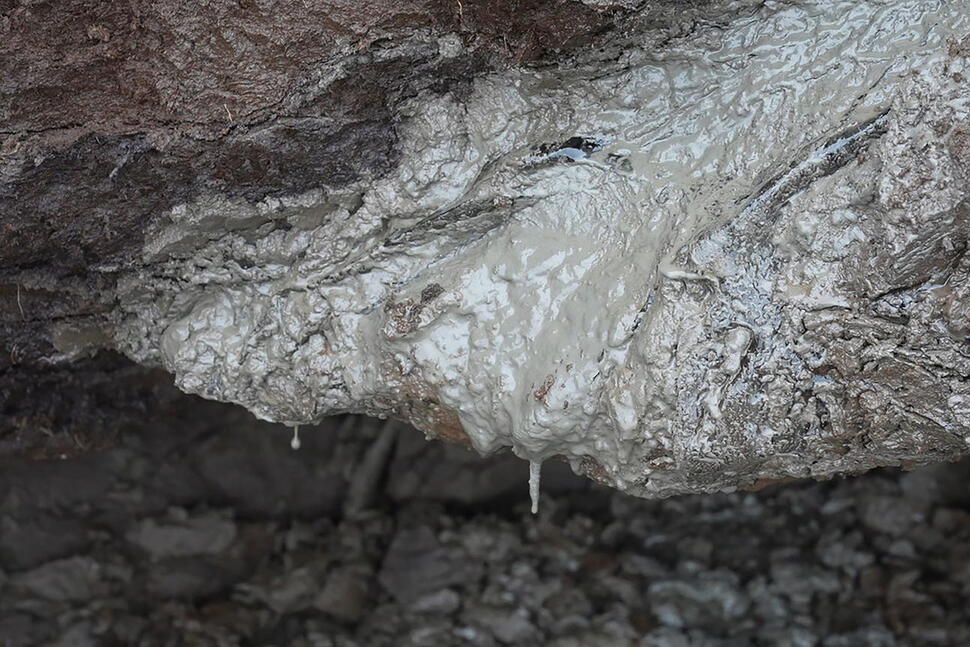
A time capsule to the last ice age is visible under a Fairbanks hill where the U.S. Army drilled a massive permafrost research tunnel. Artificially cooled and used for training, the tunnel’s icy walls are dotted with bones of bison and mammoths, producing a sewage-like odor that vividly illustrates where the Arctic methane comes from.
“Every time I go there, I’m reminded of the magnitude of the problem. You smell it. You see it. You feel it all around you,” Natali said. “You see how deep the ice is and just how the carbon is buried and then when you go on top and you see these large thaw features. … This isn’t a problem of 100 years from now. This is a problem of right now.”
The Associated Press’ climate and environmental coverage receives financial support from multiple private foundations. AP is solely responsible for all content. Find AP’s standards for working with philanthropies, a list of supporters and funded coverage areas at AP.org.
Copyright 2026 The Associated Press. All rights reserved. This material may not be published, broadcast, rewritten or redistributed.
The Month in Photos: Sept. 2026