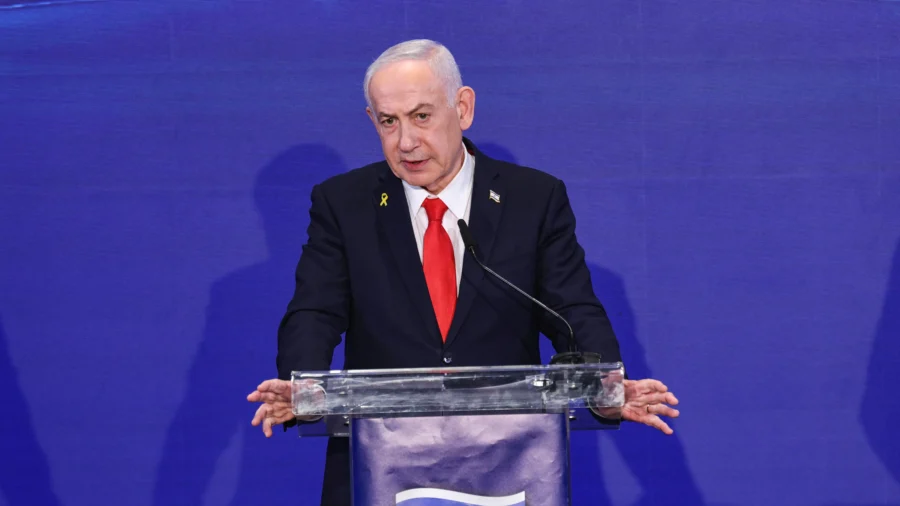
Israeli Prime Minister Benjamin Netanyahu’s office has responded to President Donald Trump’s recent announcement to end billions of dollars in aid to the country.
“U.S. military aid to Israel has always been a cross-the-aisle agreement,” Netanyahu’s office wrote in a post on X. “Israel has used it both to defend itself and to confront enemies who threaten America and the West. Today, Israel has a strong and stable economy.”
Framing Trump’s announcement as a collaborative transition from “aid to partnership,” the office wrote that the decision “shows the strength and sophistication of our relationship, and its ability to adapt and stand strong over time.”
Trump said on Election Day, Nov. 3, that the U.S. government would cease sending some $4 billion in annual military assistance to the country, telling Fox News’ “Fox & Friends” program that Israel no longer needs the funding and signaled it has become a contentious topic in the United States.
“They don’t need it. If they did need it, I would say keep it going. But Bibi Netanyahu, we reached an agreement on that. And can I be honest with you? He brought it up,” Trump told Fox, using another name for the Israeli leader.
In 2016, the United States set up a memorandum of understanding with the Israeli government that provided around $38 billion in security assistance to the country from fiscal years 2019 to 2028.
Earlier this year, Netanyahu signaled during an interview with CBS News’ “60 Minutes” that his office would attempt to move away from depending on U.S. aid.
“I want to draw down to zero the American financial support, the financial component of the military cooperation that we have. Because we receive … $3.8 billion a year,” he said, adding, “I think that it’s time that we weaned ourselves from the remaining military support.”
Americans have become increasingly unfavorable toward U.S.–Israeli ties since Netanyahu launched a major ground invasion of Gaza in response to the Oct. 7, 2023, terrorist attack led by Hamas, as well as Israel’s involvement in the war against Iran.
An Associated Press-NORC poll released in July shows that only 20 percent of U.S. adults have a favorable view of Netanyahu, while 38 percent have an unfavorable view. Some 41 percent said they don’t know enough to have an opinion.
Meanwhile, Netanyahu is still in power as a caretaker prime minister following an election in Israel during the past week that did not result in a government being formed. Netanyahu’s Likud Party won the most Knesset seats, but a possible coalition fell short of the 61 seats needed to form a government.
“The fact that the security establishment, along with Israeli citizens, is learning about a change in the strategic relationship framework through the media highlights just how much Benjamin Netanyahu’s conduct poses a genuine danger,” Eisenkot said on X.
In a lengthy post on Friday, Eisenkot also asserted that Israel is in a “true, tangible, and dangerous state of emergency” because Netanyahu’s government is still effectively in power and added that he would seek to “establish a national emergency government” in response.