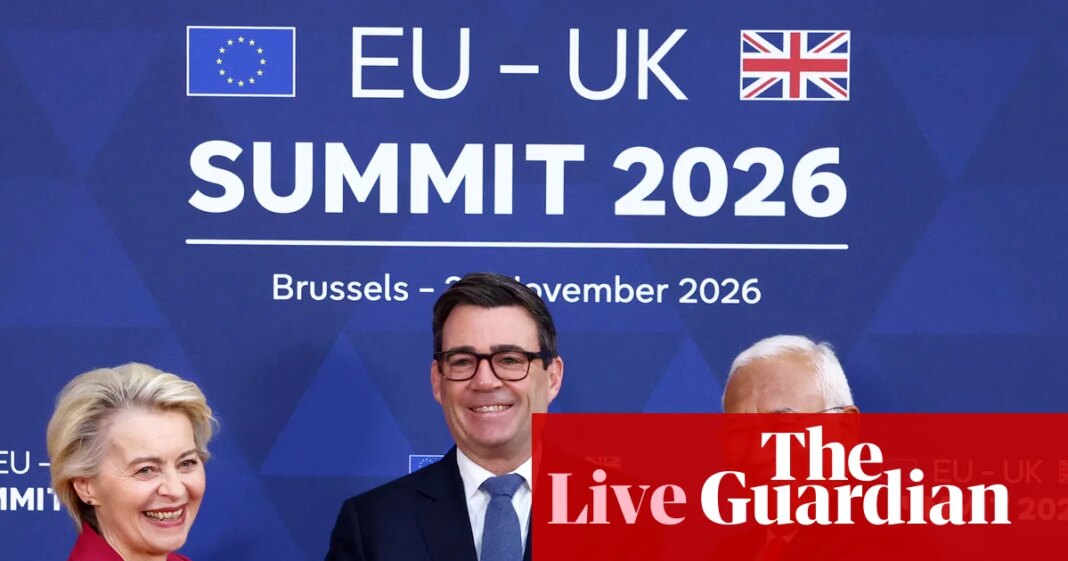
European council president says EU wants the ‘closest possible relationship’ with the UK
On the UK’s broader deliberations about its long-term relationship with the EU, Costa says diplomatically:
“We respected the sovereign decision taken by the British people in 2016, and I recall the words of the European Council after the referendum: we regret, but we respect. And we will equally respect whatever decision the United Kingdom takes about the future of its long term relationship with the European Union.”
He says the EU “remains open to have the closest possible relationship” with the UK.
But he also pointedly says, “you know our principles well,” including “the indivisibility of all of our four freedoms of the single markets.”
Key events
-
Burnham, EU leaders condemn ‘utterly unacceptable’ Russian incursion into Polish airspace
-
‘Britain of today and the EU of today is not the one of 2016,’ Burnham says
-
‘We draw a line on decade of drift and division by reconnecting with old friends,’ Burnham says
-
‘People can see the status quo is not working,’ Burnham says
-
European council president says EU wants the ‘closest possible relationship’ with the UK
-
Burnham, EU leaders speak on EU-UK reset – watch live
-
Burnham hails ‘landmark agreement,’ as EU talks of ‘turning point’ in post-Brexit relationship
-
UK officials push back against suggestions reset deals could be jeopardised by tuition fees disagreement
-
‘Deal is done,’ No10 spokesperson says, but talks ‘will continue in some areas’
-
EU-UK reset deal agreed, Downing Street says
-
Tuition fees hold up mostly political – snap analysis
-
‘Heavily choreographed’ welcome ceremony with several ministers in attendance
-
Three sectoral deals to be signed, but won’t enter into force until tuition fees issue resolved
-
EU-UK summit about to get under way in Brussels – watch live
-
Tuition fees deferral seeks to neutralise London’s leverage in talks – snap analysis
-
New EU-UK deals to provide 0.5% boost to UK’s GDP, Burnham says
-
Deals on food and drink, emissions trading, youth mobility agreed, but tricky question of tuition fees ‘kicked down the road’
-
‘It just makes sense to get closer,’ Burnham tells business leaders
-
PM Burnham leads business roundtable ahead of EU-UK summit in Brussels
-
UK and EU plan first talks on sending refused asylum seekers to third countries
-
Row over voting rights dispels myths that UK comes to negotiations from position of strength – snap analysis
-
Talks went down to the wire this morning
-
Morning opening: Second post-Brexit EU-UK summit gets under way in Brussels
And then we are back to questions on today’s deal and the tuition fees disagreement – and whether the two EU leaders agree with Burnham that today’s deal marks the high point of what can be done without a broader vision for the EU-UK relationship.
Costa smiles and says that the focus needs to be on building “the closest relationship possible” between the EU and the UK, but how close it can get needs to be defined by the British.
“In the meantime, we need to work very hard to try to solve problems to our companies, to our citizens, to improve the competitiveness of our economies,” he says.
But, somewhat echoing Burnham’s language earlier (14:37), he focuses on younger generations and says “these young people, a large part of them, was not here ten years ago, but they are here today.”
“And this is our duty to open to them new opportunities,” he says.
He says today’s deal on youth mobility for 100,000 people “is the best way to give future to our shared values, our mutual interest, our historic bond and cultural values that we share together.”
Von der Leyen says “we can always work on an incremental improvement to our relationship,” but she agrees that there is a much broader question on “the wider picture, the bigger picture” of how Europe should respond to “dramatic and big changes globally.”
Burnham, EU leaders condemn ‘utterly unacceptable’ Russian incursion into Polish airspace
The next question is on something very different – on continuing hybrid attacks about different European countries, asked in the context of airspace violations in Poland.
Two Russian cruise missiles and a jet-powered drone are reported to have crashed in Poland during Russian air attacks on Ukraine that took place amid major western military exercises by allied countries.
All three speakers condemn the incident.
EU’s Costa says “it shows that, unfortunately, Russia instead of showing willingness to engage in peace talks continue to spread the threats.”
“This is very dangerous and shows Russia is going in the wrong direction,” he says.
Von der Leyen strikes a similar line.
Burnham says the incursion into Polish airspace is “utterly unacceptable,” as he says he wants to send “a strong message of solidarity to prime minister Tusk and the Polish people who we will support, always, in any way that we can.”
He makes a broader point on the back of that, saying “Europe is becoming more coordinated in terms of defence and security,” and today’s agreement helps with that.
He pivots to Ukraine more broadly, saying “if European security is to come into that question, first we must have a ceasefire, and we must have the basis of a peace deal between Russia and Ukraine.”
“We will have to think this through carefully, together, to ensure that we are stronger in the next decade, than we were in the last.
I think some of what we’ve seen in Europe came at us without us being fully prepared. Not just the aggression, but also the disruption within our democracies and other factors that have sought to weaken Europe.
We will come back stronger in this decade, and we collaborate more deeply on security and defence.”
Asked about British people making up their minds, von der Leyen smiles that “I have many British friends and they are very good at making up their minds.”
“I know that by experience.”
On today’s deals, she backs Burnham’s line that today’s deal matters.
“We have three major agreements where many people thought we would never be able, to come to the finish line.”
Burnham strongly pushes back against some criticism or suggestions that today’s deal is not fully done, until there is an agreement on tuition fees.
He says “the deal is done; it’s there in black and white, in front of you, the bill is entering parliament next week.”
He repeats that today’s deal is “a good deal for Britain,” and repeats that “the British people will be the boss of what happens next.”
He says “we will not be running ahead of public opinion,” but adds that “public opinion … has been ahead of politicians on this question.”
von der Leyen diplomatically says:
“I think, of course, it’s ultimately … for the people of, the UK to decide where the journey goes, to which direction of travel the country is taking.
But I very much welcome, Andy, your willingness to have a broader debate about the future relationship. I can only say we are open for brainstorming, and we welcome this brainstorming, so count on us.”
‘Britain of today and the EU of today is not the one of 2016,’ Burnham says
Burnham accepts a suggestion from a reporter that “we do need to consider what is the right long-term relationship,” as “incremental steps only take us so far.”
“We are in the process of developing a ten year plan for Britain, which will be published next month. It will set out big ambitions about the industrialisation of Britain, getting growth going in all parts of Britain, making Britain a more balanced, more equal country across its regions and nations, and making sure that we do provide new opportunity for young people, new paths into those industries.
So all of those ambitions, in my view, are connected to our long term relationship with our nearest partner and what we will seek to do over the next year, before the next UK EU summit.”
But in a hint of what his future messaging is likely to be, he says:
“The important point is that Britain of today and the EU of today is not the one of 2016. Life has moved on in so many ways we couldn’t have imagined, actually; some of the things that have happened in the last decade, not least the issues we were all discussing in the coalition of the Willing in Berlin, yesterday.
So we need to draw a line, … look at the world as it is now, open up a discussion, see what those options are and then allow there to be a process of consideration, as we look towards the next parliament.”
He says “what we are announcing today is probably the limit of what we can achieve in this parliament given what needs to be done to implement it.”
‘We draw a line on decade of drift and division by reconnecting with old friends,’ Burnham says
Burnham then comes to the conclusion of this speech, echoing the tone of his domestic political messaging:
“Today, we do draw a line on a decade of drift and division by reconnecting with old friends by building a much more constructive relationship with our nearest neighbours and our largest market.
I think people across Britain can look forward now to a better, more hopeful decade ahead of us.”
Q&A next.
Burnham points to the importance of today’s deal for the UK agriculture sector, saying “we can do something to turn around” the loss of over 30% of exports to the EU in the last decade.
He also talks about migration, saying people’s concerns on this point are being addressed.
But his main message is directed, it seems, at young people as he says:
“So for young people out there who are wondering how this deal today affects them and their lives, I would say: this deal is for you. This deal really is about lifting your life chances.”
He says:
“I think we’re all conscious that the last decade has been hard for many people, but hardest most of all, for the young people of Britain and the young people of the EU.
Brexit did take away opportunity from our young people. It limited their horizons in their lives, but also it was followed by Covid and the impact then was greater as a result of that.”
He says the new deal will offer “a new freedom for anyone under 31” to travel with “much greater ease and ability to travel to any of the wonderful 27 member states to live, to work, to study.”
He says the UK will introduce a relevant bill into the British parliament to implement today’s deals as early as next week.
‘People can see the status quo is not working,’ Burnham says
Burnham declares that “this is a good day for Britain, and this is a good day for Europe.”
He says it is “a win-win” for both sides, and, somewhat defensively, stresses that “it is in tune with public opinion in the UK” as latest polling shows Brits favour closer ties with the EU.
“People can see the status quo isn’t working. It’s not good enough for Britain. … They want a better deal than the hard Brexit we ended up with.”
He heavily focuses on the cost of doing business, saying the solutions adopted today “will help take pressure off” and “will help relieved pressure” and “bring the cost of food down.”
He repeats his earlier comments that today’s deal are expected to add 0.5% to UK GDP, “a £17bn boost to the British economy; the single biggest growth measure that we could take in this parliament.”
von der Leyen then turns to SPS deal on foods, which she hails as “a two-way street for our businesses on both sides of the channel” to help with “easier trade, lower costs, and more choice and more affordable food” for consumers.
She also talks about negotiations on linking carbon markets, with further work continuing “towards the UK’s participation in our electricity market.”
She says the two sides also agreed to set up “a dialogue on economic security,” and to work on digital partnership to promote innovation in AI, quantum and secure connectivity in particular.
Like Costa earlier, she also makes a point on security, stressing the continuing support for Ukraine, and on defence and military mobility.
Von der Leyen also talks about joint fight against illegal migration through “a new structured dialogue on migration” to “prevent dangerous crossings and save lives.”
Burnham is next.
European Commission president Ursula von der Leyen is next.
She says “we know the world around us is changing fast, making a close and stronger partnership … the more important.”
She talks about the gradual process of bringing the UK closer again, starting with UK students rejoining Erasmus+ programme from 2027.
She confirms the new mobility scheme will allow “100,000 young people from each side to spend up to three years in each other’s countries to work, to study, to volunteer or simply travel.”
In a pretty sweet part of his speech, Costa says:
“We both have and respect our own specificities. We in the continent have not adopted the UK’s imperial measurement system – you measure distance in miles and this in kilometres – and we may drive on opposite sides of the road.
But the most important is that we are heading in the same direction, and that is what matters.”